

A K-torus is a higher-order limit cycle. For example, a two-torus can be visualized as the inner tube of a car tire, and motion on a two-torus as a trajectory that
runs periodically on its surface. A chaotic attractor reveals itself as a strange
attractor in the Poincaré map, consisting neither of a finite number of points, nor of
points on a smooth curve
3 . We further have:
Theorem 6.2 On the sum of Lyapunov exponents::
P n
j¼1
^ k j \0 for any dissipative system
This means that the total volume of the ellipsoid of states will always shrink,
even if the size of the ellipsoid may grow in certain directions. This is sometimes
referred to as the contracting nature of dissipative phase spaces. Finally we have:
Theorem 6.3 On the presence of a zero-valued Lyapunov exponent:
^ k j ¼ 0 for at least one j for any limit set that is not an equilibrium point.
This zero exponent, present for all attractors other than equilibrium points,
corresponds to the slowly changing magnitude of the principal axis that is tangential
to the trajectory.
Theorems 6.1–6.3 can be used to exclude the possibility of chaos for one- and
two-dimensional systems by the following arguments: Assume a chaotic attractor to
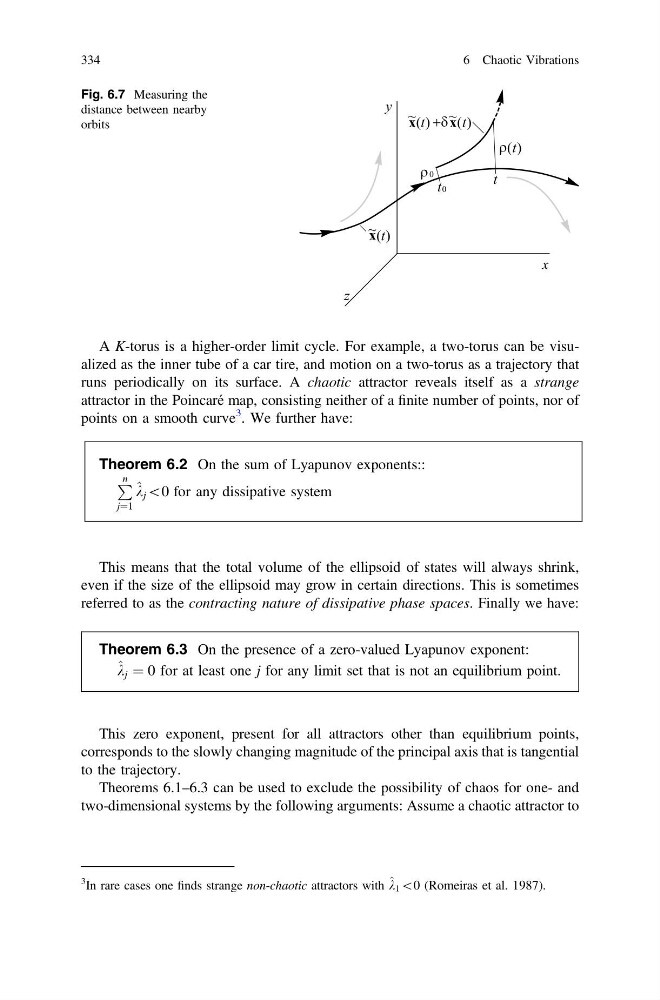
Fig. 6.7 Measuring the
distance between nearby
orbits
3
In rare cases one finds strange non-chaotic attractors with ^ k 1 \0 (Romeiras et al. 1987).
334
6 Chaotic Vibrations
runs periodically on its surface. A chaotic attractor reveals itself as a strange
attractor in the Poincaré map, consisting neither of a finite number of points, nor of
points on a smooth curve
3 . We further have:
Theorem 6.2 On the sum of Lyapunov exponents::
P n
j¼1
^ k j \0 for any dissipative system
This means that the total volume of the ellipsoid of states will always shrink,
even if the size of the ellipsoid may grow in certain directions. This is sometimes
referred to as the contracting nature of dissipative phase spaces. Finally we have:
Theorem 6.3 On the presence of a zero-valued Lyapunov exponent:
^ k j ¼ 0 for at least one j for any limit set that is not an equilibrium point.
This zero exponent, present for all attractors other than equilibrium points,
corresponds to the slowly changing magnitude of the principal axis that is tangential
to the trajectory.
Theorems 6.1–6.3 can be used to exclude the possibility of chaos for one- and
two-dimensional systems by the following arguments: Assume a chaotic attractor to
Fig. 6.7 Measuring the
distance between nearby
orbits
3
In rare cases one finds strange non-chaotic attractors with ^ k 1 \0 (Romeiras et al. 1987).
334
6 Chaotic Vibrations