

Changing the phase of the Poincaré map, e.g. by letting t 0 = u 0 /X with
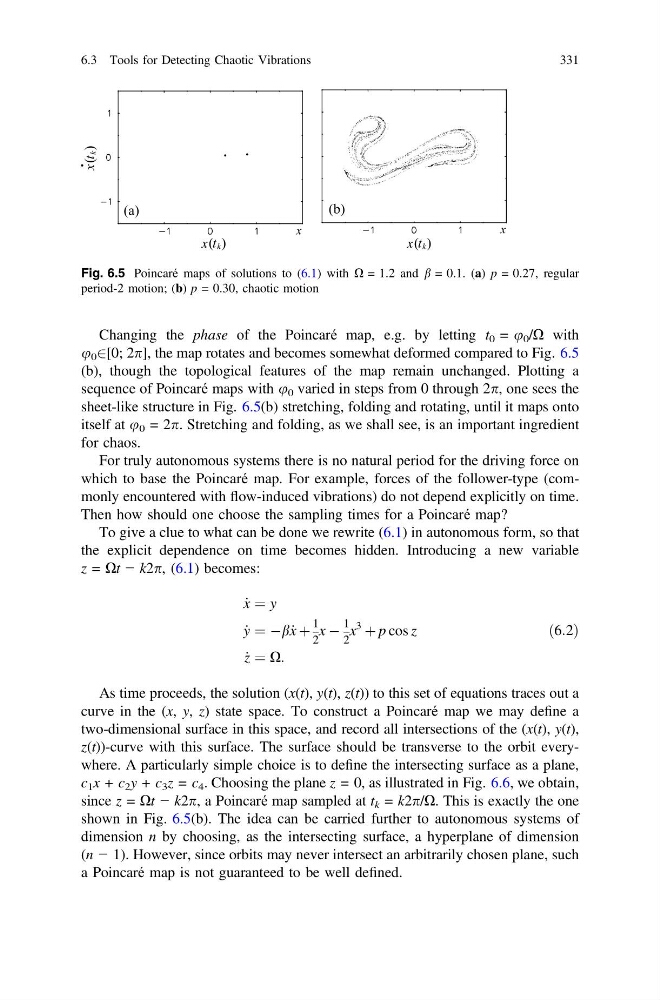
u 0 2[0; 2p], the map rotates and becomes somewhat deformed compared to Fig. 6.5
(b), though the topological features of the map remain unchanged. Plotting a
sequence of Poincaré maps with u 0 varied in steps from 0 through 2p, one sees the
sheet-like structure in Fig. 6.5(b) stretching, folding and rotating, until it maps onto
itself at u 0 = 2p. Stretching and folding, as we shall see, is an important ingredient
for chaos.
For truly autonomous systems there is no natural period for the driving force on
which to base the Poincaré map. For example, forces of the follower-type (commonly encountered with flow-induced vibrations) do not depend explicitly on time.
Then how should one choose the sampling times for a Poincaré map?
To give a clue to what can be done we rewrite (6.1) in autonomous form, so that
the explicit dependence on time becomes hidden. Introducing a new variable
z = Xt − k2p, (6.1) becomes:
_
x ¼ y
_
y ¼ Àb_ x þ
1
2
x À
1
2
x
3
þ p cos z
_
z ¼ X:
ð6:2Þ
As time proceeds, the solution (x(t), y(t), z(t)) to this set of equations traces out a
curve in the (x, y, z) state space. To construct a Poincaré map we may define a
two-dimensional surface in this space, and record all intersections of the (x(t), y(t),
z(t))-curve with this surface. The surface should be transverse to the orbit everywhere. A particularly simple choice is to define the intersecting surface as a plane,
c 1 x + c 2 y + c 3 z = c 4 . Choosing the plane z = 0, as illustrated in Fig. 6.6, we obtain,
since z = Xt − k2p, a Poincaré map sampled at t k = k2p/X. This is exactly the one
shown in Fig. 6.5(b). The idea can be carried further to autonomous systems of
dimension n by choosing, as the intersecting surface, a hyperplane of dimension
(n − 1). However, since orbits may never intersect an arbitrarily chosen plane, such
a Poincaré map is not guaranteed to be well defined.
Fig. 6.5 Poincaré maps of solutions to (6.1) with X = 1.2 and b = 0.1. (a) p = 0.27, regular
period-2 motion; (b) p = 0.30, chaotic motion
6.3 Tools for Detecting Chaotic Vibrations
331
u 0 2[0; 2p], the map rotates and becomes somewhat deformed compared to Fig. 6.5
(b), though the topological features of the map remain unchanged. Plotting a
sequence of Poincaré maps with u 0 varied in steps from 0 through 2p, one sees the
sheet-like structure in Fig. 6.5(b) stretching, folding and rotating, until it maps onto
itself at u 0 = 2p. Stretching and folding, as we shall see, is an important ingredient
for chaos.
For truly autonomous systems there is no natural period for the driving force on
which to base the Poincaré map. For example, forces of the follower-type (commonly encountered with flow-induced vibrations) do not depend explicitly on time.
Then how should one choose the sampling times for a Poincaré map?
To give a clue to what can be done we rewrite (6.1) in autonomous form, so that
the explicit dependence on time becomes hidden. Introducing a new variable
z = Xt − k2p, (6.1) becomes:
_
x ¼ y
_
y ¼ Àb_ x þ
1
2
x À
1
2
x
3
þ p cos z
_
z ¼ X:
ð6:2Þ
As time proceeds, the solution (x(t), y(t), z(t)) to this set of equations traces out a
curve in the (x, y, z) state space. To construct a Poincaré map we may define a
two-dimensional surface in this space, and record all intersections of the (x(t), y(t),
z(t))-curve with this surface. The surface should be transverse to the orbit everywhere. A particularly simple choice is to define the intersecting surface as a plane,
c 1 x + c 2 y + c 3 z = c 4 . Choosing the plane z = 0, as illustrated in Fig. 6.6, we obtain,
since z = Xt − k2p, a Poincaré map sampled at t k = k2p/X. This is exactly the one
shown in Fig. 6.5(b). The idea can be carried further to autonomous systems of
dimension n by choosing, as the intersecting surface, a hyperplane of dimension
(n − 1). However, since orbits may never intersect an arbitrarily chosen plane, such
a Poincaré map is not guaranteed to be well defined.
Fig. 6.5 Poincaré maps of solutions to (6.1) with X = 1.2 and b = 0.1. (a) p = 0.27, regular
period-2 motion; (b) p = 0.30, chaotic motion
6.3 Tools for Detecting Chaotic Vibrations
331