

6.3 Tools for Detecting Chaotic Vibrations
Here we present a number of tools for detecting the presence of chaotic vibrations.
Each tool is applied to the system (6.1) for two sets of system parameters corresponding to, respectively, regular and chaotic motion. Moon (1987) and Parker and
Chua (1989) may be consulted for further information on each tool.
6.3.1 Phase Planes
Drawing phase plane orbits provides a simple method for distinguishing periodic
from non-periodic and quasiperiodic motion. Chaotic motion looks complicated in
the phase plane. However, so do certain other types of motion.
Rewriting the equations of motion as a number of autonomous first-order
equations, an equal number of state variables span the phase space. The phase plane
is a two-dimensional projection of the phase space, spanning two arbitrary state
variables (usually a position and a velocity variable). Whereas the time variable
runs on forever, it is usually possible to choose the variables of a phase plane so that
motion in this plane becomes bounded.
The Duffing equation (6.1) can be rewritten as three first-order equations in the
three state variables (x, y, z), where y ¼ _
x; and z = Xt. Hence, the (x; _
x)-plane is a
phase plane. Sample phase plane orbits for (6.1) are shown in Fig. 6.3. The initial
part of the solution was cut off, so the figures show only stationary, post-transient
motion.
In Fig. 6.3(a) the solution traces out a closed orbit. This is a sign (but not a
proof
2 ) of regular periodic motion. A closed orbit crossing itself, as the double loop
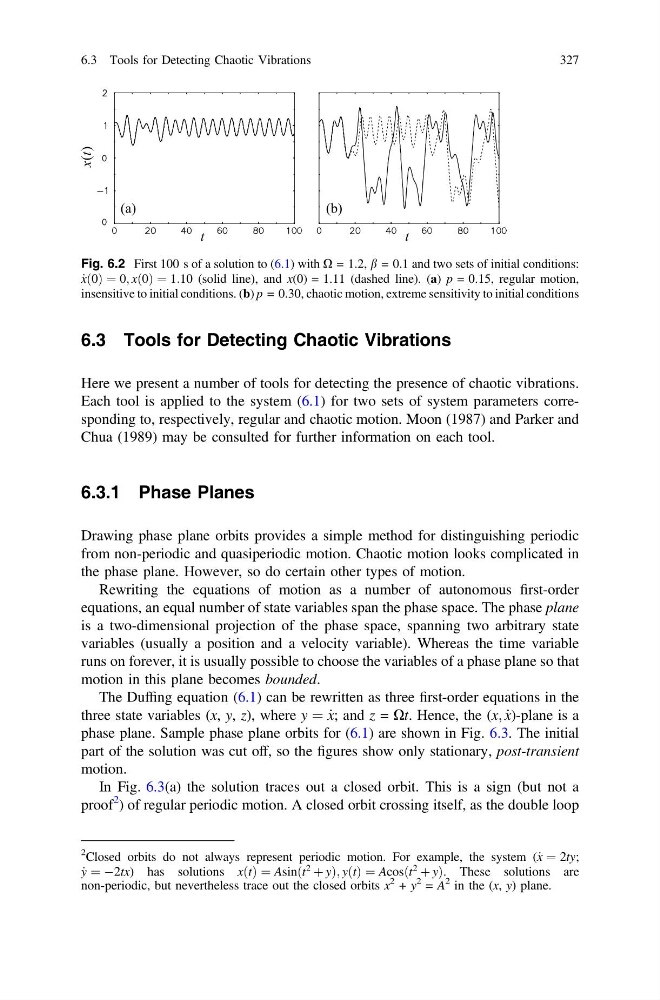
Fig. 6.2 First 100 s of a solution to (6.1) with X = 1.2, b = 0.1 and two sets of initial conditions:
_
xð0Þ ¼ 0; xð0Þ ¼ 1:10 (solid line), and x(0) = 1.11 (dashed line). (a) p = 0.15, regular motion,
insensitive to initial conditions. (b) p = 0.30, chaotic motion, extreme sensitivity to initial conditions
2
Closed orbits do not always represent periodic motion. For example, the system (_ x ¼ 2ty;
_
y ¼ À2tx) has solutions x t
ð Þ ¼ Asinðt
2
þ yÞ; y t
ð Þ ¼ Acosðt
2
þ yÞ. These solutions are
non-periodic, but nevertheless trace out the closed orbits x
2 + y
2 = A
2 in the (x, y) plane.
6.3 Tools for Detecting Chaotic Vibrations
327
Here we present a number of tools for detecting the presence of chaotic vibrations.
Each tool is applied to the system (6.1) for two sets of system parameters corresponding to, respectively, regular and chaotic motion. Moon (1987) and Parker and
Chua (1989) may be consulted for further information on each tool.
6.3.1 Phase Planes
Drawing phase plane orbits provides a simple method for distinguishing periodic
from non-periodic and quasiperiodic motion. Chaotic motion looks complicated in
the phase plane. However, so do certain other types of motion.
Rewriting the equations of motion as a number of autonomous first-order
equations, an equal number of state variables span the phase space. The phase plane
is a two-dimensional projection of the phase space, spanning two arbitrary state
variables (usually a position and a velocity variable). Whereas the time variable
runs on forever, it is usually possible to choose the variables of a phase plane so that
motion in this plane becomes bounded.
The Duffing equation (6.1) can be rewritten as three first-order equations in the
three state variables (x, y, z), where y ¼ _
x; and z = Xt. Hence, the (x; _
x)-plane is a
phase plane. Sample phase plane orbits for (6.1) are shown in Fig. 6.3. The initial
part of the solution was cut off, so the figures show only stationary, post-transient
motion.
In Fig. 6.3(a) the solution traces out a closed orbit. This is a sign (but not a
proof
2 ) of regular periodic motion. A closed orbit crossing itself, as the double loop
Fig. 6.2 First 100 s of a solution to (6.1) with X = 1.2, b = 0.1 and two sets of initial conditions:
_
xð0Þ ¼ 0; xð0Þ ¼ 1:10 (solid line), and x(0) = 1.11 (dashed line). (a) p = 0.15, regular motion,
insensitive to initial conditions. (b) p = 0.30, chaotic motion, extreme sensitivity to initial conditions
2
Closed orbits do not always represent periodic motion. For example, the system (_ x ¼ 2ty;
_
y ¼ À2tx) has solutions x t
ð Þ ¼ Asinðt
2
þ yÞ; y t
ð Þ ¼ Acosðt
2
þ yÞ. These solutions are
non-periodic, but nevertheless trace out the closed orbits x
2 + y
2 = A
2 in the (x, y) plane.
6.3 Tools for Detecting Chaotic Vibrations
327