

1.4.4 Normal Coordinates
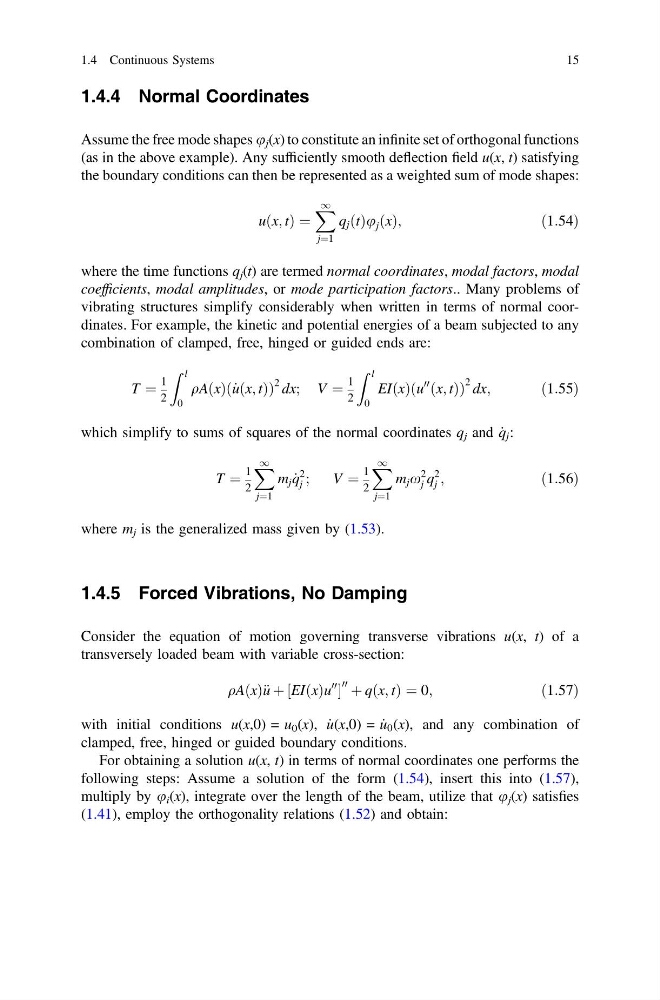
Assume the free mode shapes u j (x) to constitute an infinite set of orthogonal functions
(as in the above example). Any sufficiently smooth deflection field u(x, t) satisfying
the boundary conditions can then be represented as a weighted sum of mode shapes:
uðx; tÞ ¼
X 1
j¼1
q j ðtÞu j ðxÞ;
ð1:54Þ
where the time functions q j (t) are termed normal coordinates, modal factors, modal
coefficients, modal amplitudes, or mode participation factors.. Many problems of
vibrating structures simplify considerably when written in terms of normal coordinates. For example, the kinetic and potential energies of a beam subjected to any
combination of clamped, free, hinged or guided ends are:
T ¼
1
2
Z l
0
qAðxÞ _
uðx; tÞ
ð
Þ
2 dx; V ¼
1
2
Z l
0
EIðxÞ u
00
ðx; tÞ
ð
Þ
2 dx;
ð1:55Þ
which simplify to sums of squares of the normal coordinates q j and _
q j :
T ¼
1
2
X 1
j¼1
m j _
q
2
j ;
V ¼
1
2
X 1
j¼1
m j x
2
j q
2
j ;
ð1:56Þ
where m j is the generalized mass given by (1.53).
1.4.5 Forced Vibrations, No Damping
Consider the equation of motion governing transverse vibrations u(x, t) of a
transversely loaded beam with variable cross-section:
qAðxÞ€ u þ EIðxÞu
00
½
00 þ qðx; tÞ ¼ 0;
ð1:57Þ
with initial conditions u(x,0) = u 0 (x), _
u(x,0) = _
u 0 (x), and any combination of
clamped, free, hinged or guided boundary conditions.
For obtaining a solution u(x, t) in terms of normal coordinates one performs the
following steps: Assume a solution of the form (1.54), insert this into (1.57),
multiply by u i (x), integrate over the length of the beam, utilize that u j (x) satisfies
(1.41), employ the orthogonality relations (1.52) and obtain:
1.4 Continuous Systems
15
Assume the free mode shapes u j (x) to constitute an infinite set of orthogonal functions
(as in the above example). Any sufficiently smooth deflection field u(x, t) satisfying
the boundary conditions can then be represented as a weighted sum of mode shapes:
uðx; tÞ ¼
X 1
j¼1
q j ðtÞu j ðxÞ;
ð1:54Þ
where the time functions q j (t) are termed normal coordinates, modal factors, modal
coefficients, modal amplitudes, or mode participation factors.. Many problems of
vibrating structures simplify considerably when written in terms of normal coordinates. For example, the kinetic and potential energies of a beam subjected to any
combination of clamped, free, hinged or guided ends are:
T ¼
1
2
Z l
0
qAðxÞ _
uðx; tÞ
ð
Þ
2 dx; V ¼
1
2
Z l
0
EIðxÞ u
00
ðx; tÞ
ð
Þ
2 dx;
ð1:55Þ
which simplify to sums of squares of the normal coordinates q j and _
q j :
T ¼
1
2
X 1
j¼1
m j _
q
2
j ;
V ¼
1
2
X 1
j¼1
m j x
2
j q
2
j ;
ð1:56Þ
where m j is the generalized mass given by (1.53).
1.4.5 Forced Vibrations, No Damping
Consider the equation of motion governing transverse vibrations u(x, t) of a
transversely loaded beam with variable cross-section:
qAðxÞ€ u þ EIðxÞu
00
½
00 þ qðx; tÞ ¼ 0;
ð1:57Þ
with initial conditions u(x,0) = u 0 (x), _
u(x,0) = _
u 0 (x), and any combination of
clamped, free, hinged or guided boundary conditions.
For obtaining a solution u(x, t) in terms of normal coordinates one performs the
following steps: Assume a solution of the form (1.54), insert this into (1.57),
multiply by u i (x), integrate over the length of the beam, utilize that u j (x) satisfies
(1.41), employ the orthogonality relations (1.52) and obtain:
1.4 Continuous Systems
15