

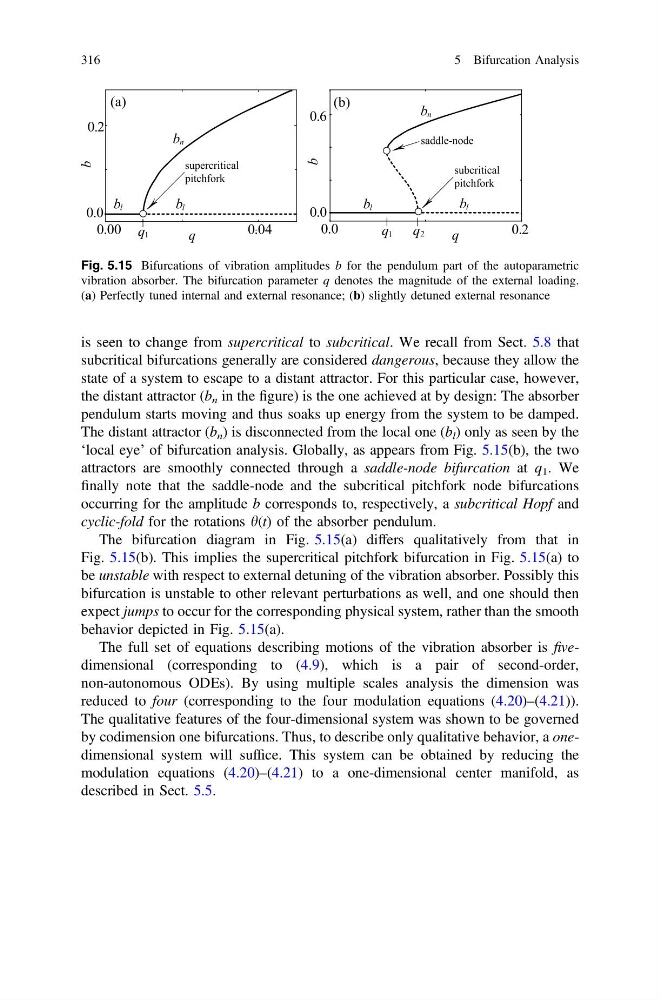
is seen to change from supercritical to subcritical. We recall from Sect. 5.8 that
subcritical bifurcations generally are considered dangerous, because they allow the
state of a system to escape to a distant attractor. For this particular case, however,
the distant attractor (b n in the figure) is the one achieved at by design: The absorber
pendulum starts moving and thus soaks up energy from the system to be damped.
The distant attractor (b n ) is disconnected from the local one (b l ) only as seen by the
‘local eye’ of bifurcation analysis. Globally, as appears from Fig. 5.15(b), the two
attractors are smoothly connected through a saddle-node bifurcation at q 1 . We
finally note that the saddle-node and the subcritical pitchfork node bifurcations
occurring for the amplitude b corresponds to, respectively, a subcritical Hopf and
cyclic-fold for the rotations h(t) of the absorber pendulum.
The bifurcation diagram in Fig. 5.15(a) differs qualitatively from that in
Fig. 5.15(b). This implies the supercritical pitchfork bifurcation in Fig. 5.15(a) to
be unstable with respect to external detuning of the vibration absorber. Possibly this
bifurcation is unstable to other relevant perturbations as well, and one should then
expect jumps to occur for the corresponding physical system, rather than the smooth
behavior depicted in Fig. 5.15(a).
The full set of equations describing motions of the vibration absorber is fivedimensional (corresponding to (4.9), which is a pair of second-order,
non-autonomous ODEs). By using multiple scales analysis the dimension was
reduced to four (corresponding to the four modulation equations (4.20)–(4.21)).
The qualitative features of the four-dimensional system was shown to be governed
by codimension one bifurcations. Thus, to describe only qualitative behavior, a onedimensional system will suffice. This system can be obtained by reducing the
modulation equations (4.20)–(4.21) to a one-dimensional center manifold, as
described in Sect. 5.5.
Fig. 5.15 Bifurcations of vibration amplitudes b for the pendulum part of the autoparametric
vibration absorber. The bifurcation parameter q denotes the magnitude of the external loading.
(a) Perfectly tuned internal and external resonance; (b) slightly detuned external resonance
316
5 Bifurcation Analysis
subcritical bifurcations generally are considered dangerous, because they allow the
state of a system to escape to a distant attractor. For this particular case, however,
the distant attractor (b n in the figure) is the one achieved at by design: The absorber
pendulum starts moving and thus soaks up energy from the system to be damped.
The distant attractor (b n ) is disconnected from the local one (b l ) only as seen by the
‘local eye’ of bifurcation analysis. Globally, as appears from Fig. 5.15(b), the two
attractors are smoothly connected through a saddle-node bifurcation at q 1 . We
finally note that the saddle-node and the subcritical pitchfork node bifurcations
occurring for the amplitude b corresponds to, respectively, a subcritical Hopf and
cyclic-fold for the rotations h(t) of the absorber pendulum.
The bifurcation diagram in Fig. 5.15(a) differs qualitatively from that in
Fig. 5.15(b). This implies the supercritical pitchfork bifurcation in Fig. 5.15(a) to
be unstable with respect to external detuning of the vibration absorber. Possibly this
bifurcation is unstable to other relevant perturbations as well, and one should then
expect jumps to occur for the corresponding physical system, rather than the smooth
behavior depicted in Fig. 5.15(a).
The full set of equations describing motions of the vibration absorber is fivedimensional (corresponding to (4.9), which is a pair of second-order,
non-autonomous ODEs). By using multiple scales analysis the dimension was
reduced to four (corresponding to the four modulation equations (4.20)–(4.21)).
The qualitative features of the four-dimensional system was shown to be governed
by codimension one bifurcations. Thus, to describe only qualitative behavior, a onedimensional system will suffice. This system can be obtained by reducing the
modulation equations (4.20)–(4.21) to a one-dimensional center manifold, as
described in Sect. 5.5.
Fig. 5.15 Bifurcations of vibration amplitudes b for the pendulum part of the autoparametric
vibration absorber. The bifurcation parameter q denotes the magnitude of the external loading.
(a) Perfectly tuned internal and external resonance; (b) slightly detuned external resonance
316
5 Bifurcation Analysis