

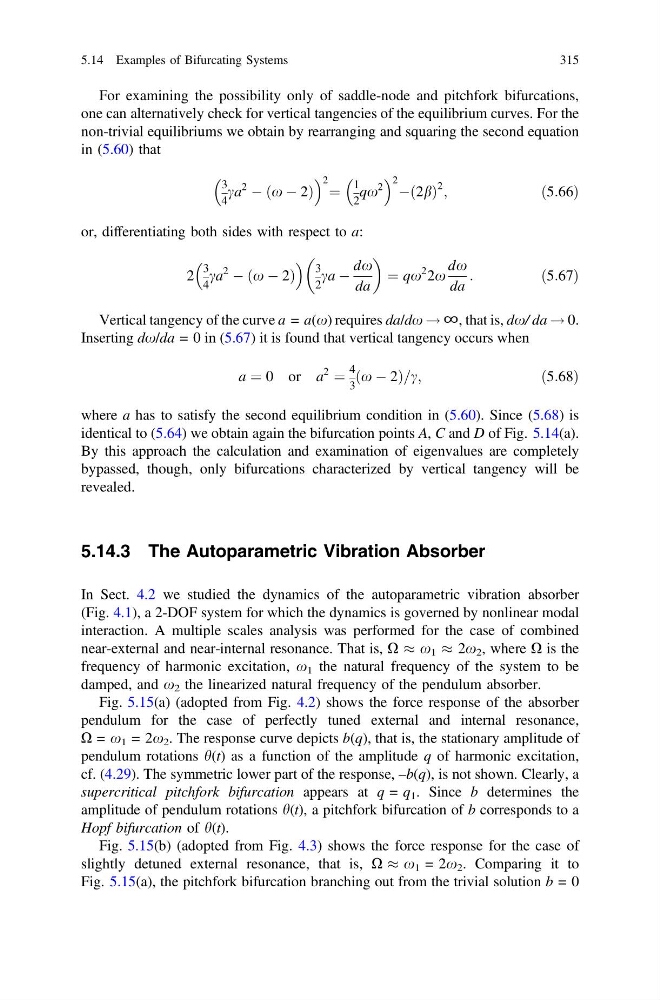
For examining the possibility only of saddle-node and pitchfork bifurcations,
one can alternatively check for vertical tangencies of the equilibrium curves. For the
non-trivial equilibriums we obtain by rearranging and squaring the second equation
in (5.60) that
3
4
ca
2
À ðx À 2Þ
2 ¼
1
2
qx
2
2 À 2b
ð Þ
2 ;
ð5:66Þ
or, differentiating both sides with respect to a:
2
3
4
ca
2
À ðx À 2Þ
3
2
ca À
dx
da
¼ qx
2 2x
dx
da
:
ð5:67Þ
Vertical tangency of the curve a = a(x) requires da/dx ! ∞, that is, dx/ da ! 0.
Inserting dx/da = 0 in (5.67) it is found that vertical tangency occurs when
a ¼ 0 or a
2
¼
4
3
ðx À 2Þ=c;
ð5:68Þ
where a has to satisfy the second equilibrium condition in (5.60). Since (5.68) is
identical to (5.64) we obtain again the bifurcation points A, C and D of Fig. 5.14(a).
By this approach the calculation and examination of eigenvalues are completely
bypassed, though, only bifurcations characterized by vertical tangency will be
revealed.
5.14.3 The Autoparametric Vibration Absorber
In Sect. 4.2 we studied the dynamics of the autoparametric vibration absorber
(Fig. 4.1), a 2-DOF system for which the dynamics is governed by nonlinear modal
interaction. A multiple scales analysis was performed for the case of combined
near-external and near-internal resonance. That is, X % x 1 % 2x 2 , where X is the
frequency of harmonic excitation, x 1 the natural frequency of the system to be
damped, and x 2 the linearized natural frequency of the pendulum absorber.
Fig. 5.15(a) (adopted from Fig. 4.2) shows the force response of the absorber
pendulum for the case of perfectly tuned external and internal resonance,
X = x 1 = 2x 2 . The response curve depicts b(q), that is, the stationary amplitude of
pendulum rotations h(t) as a function of the amplitude q of harmonic excitation,
cf. (4.29). The symmetric lower part of the response, –b(q), is not shown. Clearly, a
supercritical pitchfork bifurcation appears at q = q 1 . Since b determines the
amplitude of pendulum rotations h(t), a pitchfork bifurcation of b corresponds to a
Hopf bifurcation of h(t).
Fig. 5.15(b) (adopted from Fig. 4.3) shows the force response for the case of
slightly detuned external resonance, that is, X % x 1 = 2x 2 . Comparing it to
Fig. 5.15(a), the pitchfork bifurcation branching out from the trivial solution b = 0
5.14 Examples of Bifurcating Systems
315
one can alternatively check for vertical tangencies of the equilibrium curves. For the
non-trivial equilibriums we obtain by rearranging and squaring the second equation
in (5.60) that
3
4
ca
2
À ðx À 2Þ
2 ¼
1
2
qx
2
2 À 2b
ð Þ
2 ;
ð5:66Þ
or, differentiating both sides with respect to a:
2
3
4
ca
2
À ðx À 2Þ
3
2
ca À
dx
da
¼ qx
2 2x
dx
da
:
ð5:67Þ
Vertical tangency of the curve a = a(x) requires da/dx ! ∞, that is, dx/ da ! 0.
Inserting dx/da = 0 in (5.67) it is found that vertical tangency occurs when
a ¼ 0 or a
2
¼
4
3
ðx À 2Þ=c;
ð5:68Þ
where a has to satisfy the second equilibrium condition in (5.60). Since (5.68) is
identical to (5.64) we obtain again the bifurcation points A, C and D of Fig. 5.14(a).
By this approach the calculation and examination of eigenvalues are completely
bypassed, though, only bifurcations characterized by vertical tangency will be
revealed.
5.14.3 The Autoparametric Vibration Absorber
In Sect. 4.2 we studied the dynamics of the autoparametric vibration absorber
(Fig. 4.1), a 2-DOF system for which the dynamics is governed by nonlinear modal
interaction. A multiple scales analysis was performed for the case of combined
near-external and near-internal resonance. That is, X % x 1 % 2x 2 , where X is the
frequency of harmonic excitation, x 1 the natural frequency of the system to be
damped, and x 2 the linearized natural frequency of the pendulum absorber.
Fig. 5.15(a) (adopted from Fig. 4.2) shows the force response of the absorber
pendulum for the case of perfectly tuned external and internal resonance,
X = x 1 = 2x 2 . The response curve depicts b(q), that is, the stationary amplitude of
pendulum rotations h(t) as a function of the amplitude q of harmonic excitation,
cf. (4.29). The symmetric lower part of the response, –b(q), is not shown. Clearly, a
supercritical pitchfork bifurcation appears at q = q 1 . Since b determines the
amplitude of pendulum rotations h(t), a pitchfork bifurcation of b corresponds to a
Hopf bifurcation of h(t).
Fig. 5.15(b) (adopted from Fig. 4.3) shows the force response for the case of
slightly detuned external resonance, that is, X % x 1 = 2x 2 . Comparing it to
Fig. 5.15(a), the pitchfork bifurcation branching out from the trivial solution b = 0
5.14 Examples of Bifurcating Systems
315