

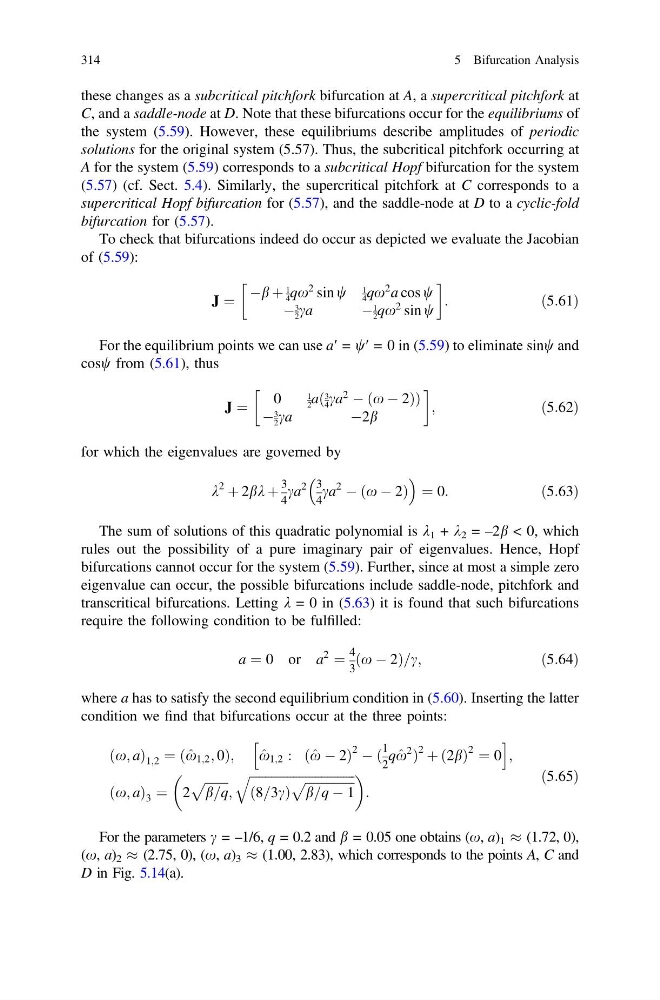
these changes as a subcritical pitchfork bifurcation at A, a supercritical pitchfork at
C, and a saddle-node at D. Note that these bifurcations occur for the equilibriums of
the system (5.59). However, these equilibriums describe amplitudes of periodic
solutions for the original system (5.57). Thus, the subcritical pitchfork occurring at
A for the system (5.59) corresponds to a subcritical Hopf bifurcation for the system
(5.57) (cf. Sect. 5.4). Similarly, the supercritical pitchfork at C corresponds to a
supercritical Hopf bifurcation for (5.57), and the saddle-node at D to a cyclic-fold
bifurcation for (5.57).
To check that bifurcations indeed do occur as depicted we evaluate the Jacobian
of (5.59):
J ¼
Àb þ
1
4 qx
2 sin w
1
4 qx
2 a cos w
À
3
2 ca
À
1
2 qx
2 sin w
!
:
ð5:61Þ
For the equilibrium points we can use a′ = w′ = 0 in (5.59) to eliminate sinw and
cosw from (5.61), thus
J ¼
0
1
2 a
3
4 ca
2
À ðx À 2Þ
ð
Þ
À
3
2 ca
À2b
!
;
ð5:62Þ
for which the eigenvalues are governed by
k
2
þ 2bk þ
3
4
ca
2 3
4
ca
2
À ðx À 2Þ
¼ 0:
ð5:63Þ
The sum of solutions of this quadratic polynomial is k 1 + k 2 = –2b < 0, which
rules out the possibility of a pure imaginary pair of eigenvalues. Hence, Hopf
bifurcations cannot occur for the system (5.59). Further, since at most a simple zero
eigenvalue can occur, the possible bifurcations include saddle-node, pitchfork and
transcritical bifurcations. Letting k = 0 in (5.63) it is found that such bifurcations
require the following condition to be fulfilled:
a ¼ 0 or a
2
¼
4
3
ðx À 2Þ=c;
ð5:64Þ
where a has to satisfy the second equilibrium condition in (5.60). Inserting the latter
condition we find that bifurcations occur at the three points:
ðx; aÞ 1;2 ¼ ð^ x 1;2 ; 0Þ;
^
x 1;2 : ð ^
x À 2Þ
2 À ð
1
2
q ^
x
2
Þ
2 þ ð2bÞ
2 ¼ 0
h
i
;
ðx; aÞ 3 ¼ 2
ffiffiffiffiffiffiffi ffi
b=q
p
;
ffiffiffiffiffiffiffiffiffiffiffiffiffiffiffiffiffiffiffiffiffiffiffiffiffiffiffiffiffiffiffiffiffiffi
8=3c
ð
Þ
ffiffiffiffiffiffiffiffiffiffiffiffiffiffiffiffi
b=q À 1
p
q
:
ð5:65Þ
For the parameters c = –1/6, q = 0.2 and b = 0.05 one obtains (x, a) 1 % (1.72, 0),
(x, a) 2 % (2.75, 0), (x, a) 3 % (1.00, 2.83), which corresponds to the points A, C and
D in Fig. 5.14(a).
314
5 Bifurcation Analysis
C, and a saddle-node at D. Note that these bifurcations occur for the equilibriums of
the system (5.59). However, these equilibriums describe amplitudes of periodic
solutions for the original system (5.57). Thus, the subcritical pitchfork occurring at
A for the system (5.59) corresponds to a subcritical Hopf bifurcation for the system
(5.57) (cf. Sect. 5.4). Similarly, the supercritical pitchfork at C corresponds to a
supercritical Hopf bifurcation for (5.57), and the saddle-node at D to a cyclic-fold
bifurcation for (5.57).
To check that bifurcations indeed do occur as depicted we evaluate the Jacobian
of (5.59):
J ¼
Àb þ
1
4 qx
2 sin w
1
4 qx
2 a cos w
À
3
2 ca
À
1
2 qx
2 sin w
!
:
ð5:61Þ
For the equilibrium points we can use a′ = w′ = 0 in (5.59) to eliminate sinw and
cosw from (5.61), thus
J ¼
0
1
2 a
3
4 ca
2
À ðx À 2Þ
ð
Þ
À
3
2 ca
À2b
!
;
ð5:62Þ
for which the eigenvalues are governed by
k
2
þ 2bk þ
3
4
ca
2 3
4
ca
2
À ðx À 2Þ
¼ 0:
ð5:63Þ
The sum of solutions of this quadratic polynomial is k 1 + k 2 = –2b < 0, which
rules out the possibility of a pure imaginary pair of eigenvalues. Hence, Hopf
bifurcations cannot occur for the system (5.59). Further, since at most a simple zero
eigenvalue can occur, the possible bifurcations include saddle-node, pitchfork and
transcritical bifurcations. Letting k = 0 in (5.63) it is found that such bifurcations
require the following condition to be fulfilled:
a ¼ 0 or a
2
¼
4
3
ðx À 2Þ=c;
ð5:64Þ
where a has to satisfy the second equilibrium condition in (5.60). Inserting the latter
condition we find that bifurcations occur at the three points:
ðx; aÞ 1;2 ¼ ð^ x 1;2 ; 0Þ;
^
x 1;2 : ð ^
x À 2Þ
2 À ð
1
2
q ^
x
2
Þ
2 þ ð2bÞ
2 ¼ 0
h
i
;
ðx; aÞ 3 ¼ 2
ffiffiffiffiffiffiffi ffi
b=q
p
;
ffiffiffiffiffiffiffiffiffiffiffiffiffiffiffiffiffiffiffiffiffiffiffiffiffiffiffiffiffiffiffiffiffiffi
8=3c
ð
Þ
ffiffiffiffiffiffiffiffiffiffiffiffiffiffiffiffi
b=q À 1
p
q
:
ð5:65Þ
For the parameters c = –1/6, q = 0.2 and b = 0.05 one obtains (x, a) 1 % (1.72, 0),
(x, a) 2 % (2.75, 0), (x, a) 3 % (1.00, 2.83), which corresponds to the points A, C and
D in Fig. 5.14(a).
314
5 Bifurcation Analysis