

5.14.2 Pendulum with a Moving Support
(Parametric Excitation)
In Sect. 3.6 we considered a pendulum with a harmonically oscillating support
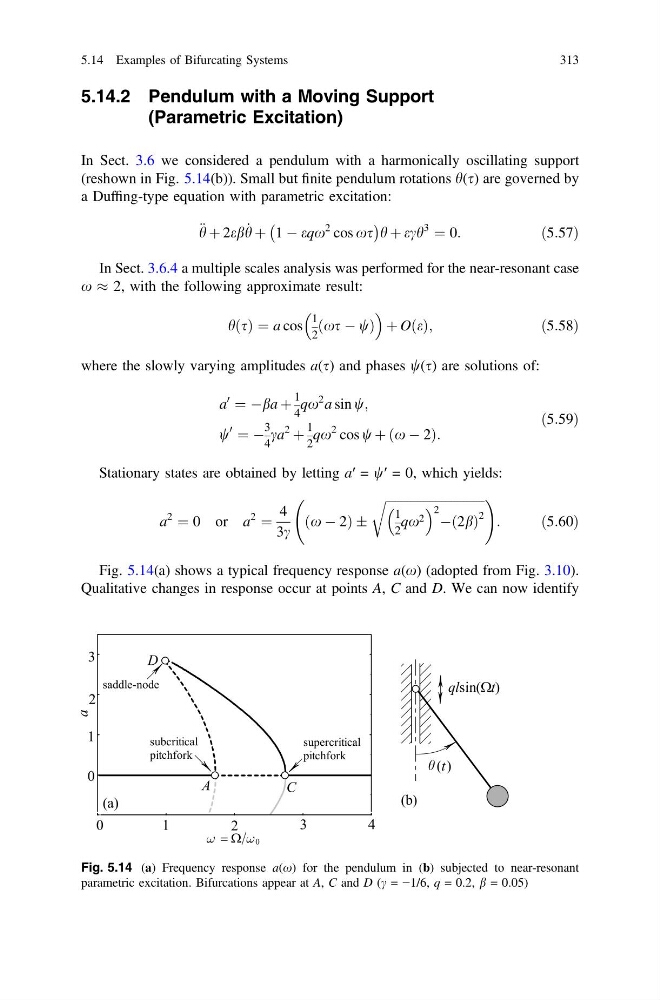
(reshown in Fig. 5.14(b)). Small but finite pendulum rotations h(s) are governed by
a Duffing-type equation with parametric excitation:
€ h þ 2eb _
h þ 1 À eqx
2 cos xs
À
Á
h þ ech
3
¼ 0:
ð5:57Þ
In Sect. 3.6.4 a multiple scales analysis was performed for the near-resonant case
x % 2, with the following approximate result:
hðsÞ ¼ a cos
1
2
ðxs À wÞ
þ OðeÞ;
ð5:58Þ
where the slowly varying amplitudes a(s) and phases w(s) are solutions of:
a
0
¼ Àba þ
1
4
qx
2 a sin w;
w
0
¼ À
3
4
ca
2
þ
1
2
qx
2 cos w þ ðx À 2Þ:
ð5:59Þ
Stationary states are obtained by letting a′ = w′ = 0, which yields:
a
2
¼ 0 or a
2
¼
4
3c
ðx À 2Þ Æ
ffiffiffiffiffiffiffiffiffiffiffiffiffiffiffiffiffiffiffiffiffiffiffiffiffiffiffiffiffiffiffiffi
1
2
qx 2
2 À 2b
ð Þ
2
r
!
:
ð5:60Þ
Fig. 5.14(a) shows a typical frequency response a(x) (adopted from Fig. 3.10).
Qualitative changes in response occur at points A, C and D. We can now identify
Fig. 5.14 (a) Frequency response a(x) for the pendulum in (b) subjected to near-resonant
parametric excitation. Bifurcations appear at A, C and D (c = −1/6, q = 0.2, b = 0.05)
5.14 Examples of Bifurcating Systems
313
(Parametric Excitation)
In Sect. 3.6 we considered a pendulum with a harmonically oscillating support
(reshown in Fig. 5.14(b)). Small but finite pendulum rotations h(s) are governed by
a Duffing-type equation with parametric excitation:
€ h þ 2eb _
h þ 1 À eqx
2 cos xs
À
Á
h þ ech
3
¼ 0:
ð5:57Þ
In Sect. 3.6.4 a multiple scales analysis was performed for the near-resonant case
x % 2, with the following approximate result:
hðsÞ ¼ a cos
1
2
ðxs À wÞ
þ OðeÞ;
ð5:58Þ
where the slowly varying amplitudes a(s) and phases w(s) are solutions of:
a
0
¼ Àba þ
1
4
qx
2 a sin w;
w
0
¼ À
3
4
ca
2
þ
1
2
qx
2 cos w þ ðx À 2Þ:
ð5:59Þ
Stationary states are obtained by letting a′ = w′ = 0, which yields:
a
2
¼ 0 or a
2
¼
4
3c
ðx À 2Þ Æ
ffiffiffiffiffiffiffiffiffiffiffiffiffiffiffiffiffiffiffiffiffiffiffiffiffiffiffiffiffiffiffiffi
1
2
qx 2
2 À 2b
ð Þ
2
r
!
:
ð5:60Þ
Fig. 5.14(a) shows a typical frequency response a(x) (adopted from Fig. 3.10).
Qualitative changes in response occur at points A, C and D. We can now identify
Fig. 5.14 (a) Frequency response a(x) for the pendulum in (b) subjected to near-resonant
parametric excitation. Bifurcations appear at A, C and D (c = −1/6, q = 0.2, b = 0.05)
5.14 Examples of Bifurcating Systems
313