

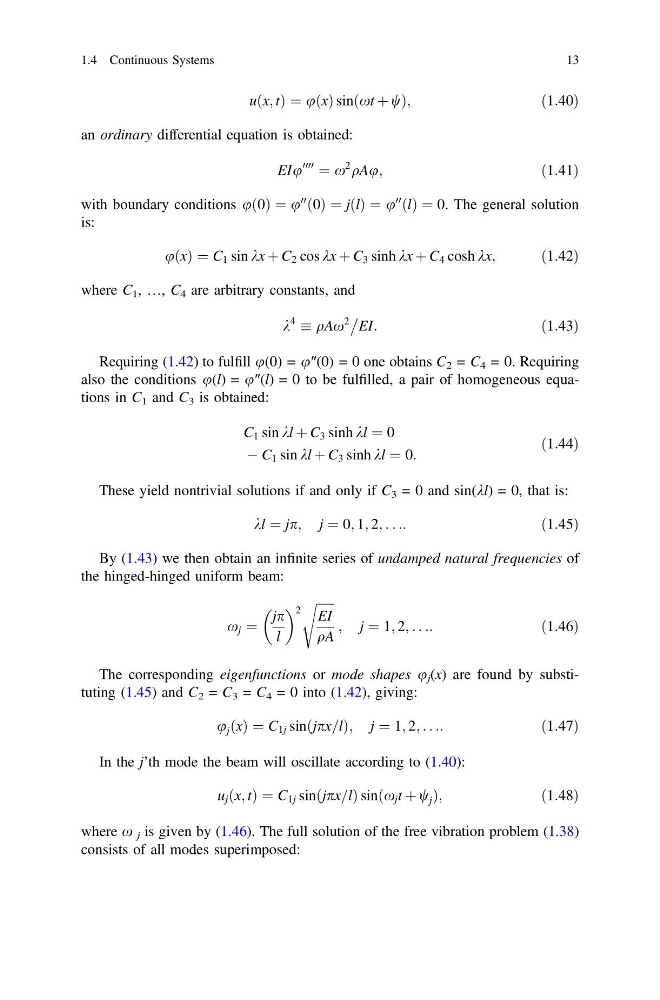
uðx; tÞ ¼ uðxÞ sinðxt þ wÞ;
ð1:40Þ
an ordinary differential equation is obtained:
EIu
0000
¼ x
2 qAu;
ð1:41Þ
with boundary conditions u 0
ð Þ ¼ u
00 0
ð Þ ¼ j l
ð Þ ¼ u
00 l
ð Þ ¼ 0. The general solution
is:
uðxÞ ¼ C 1 sin kx þ C 2 cos kx þ C 3 sinh kx þ C 4 cosh kx;
ð1:42Þ
where C 1 , …, C 4 are arbitrary constants, and
k
4
qAx
2
EI:
ð1:43Þ
Requiring (1.42) to fulfill u(0) = u″(0) = 0 one obtains C 2 = C 4 = 0. Requiring
also the conditions u(l) = u″(l) = 0 to be fulfilled, a pair of homogeneous equations in C 1 and C 3 is obtained:
C 1 sin kl þ C 3 sinh kl ¼ 0
À C 1 sin kl þ C 3 sinh kl ¼ 0:
ð1:44Þ
These yield nontrivial solutions if and only if C 3 = 0 and sin(kl) = 0, that is:
kl ¼ jp; j ¼ 0; 1; 2; . . .:
ð1:45Þ
By (1.43) we then obtain an infinite series of undamped natural frequencies of
the hinged-hinged uniform beam:
x j ¼
jp
l
2
ffiffiffiffiffiffi
EI
qA
s
; j ¼ 1; 2; . . .:
ð1:46Þ
The corresponding eigenfunctions or mode shapes u j (x) are found by substituting (1.45) and C 2 = C 3 = C 4 = 0 into (1.42), giving:
u j ðxÞ ¼ C 1j sinðjpx=lÞ; j ¼ 1; 2; . . .:
ð1:47Þ
In the j’th mode the beam will oscillate according to (1.40):
u j ðx; tÞ ¼ C 1j sinðjpx=lÞ sinðx j t þ w j Þ;
ð1:48Þ
where x j is given by (1.46). The full solution of the free vibration problem (1.38)
consists of all modes superimposed:
1.4 Continuous Systems
13
ð1:40Þ
an ordinary differential equation is obtained:
EIu
0000
¼ x
2 qAu;
ð1:41Þ
with boundary conditions u 0
ð Þ ¼ u
00 0
ð Þ ¼ j l
ð Þ ¼ u
00 l
ð Þ ¼ 0. The general solution
is:
uðxÞ ¼ C 1 sin kx þ C 2 cos kx þ C 3 sinh kx þ C 4 cosh kx;
ð1:42Þ
where C 1 , …, C 4 are arbitrary constants, and
k
4
qAx
2
EI:
ð1:43Þ
Requiring (1.42) to fulfill u(0) = u″(0) = 0 one obtains C 2 = C 4 = 0. Requiring
also the conditions u(l) = u″(l) = 0 to be fulfilled, a pair of homogeneous equations in C 1 and C 3 is obtained:
C 1 sin kl þ C 3 sinh kl ¼ 0
À C 1 sin kl þ C 3 sinh kl ¼ 0:
ð1:44Þ
These yield nontrivial solutions if and only if C 3 = 0 and sin(kl) = 0, that is:
kl ¼ jp; j ¼ 0; 1; 2; . . .:
ð1:45Þ
By (1.43) we then obtain an infinite series of undamped natural frequencies of
the hinged-hinged uniform beam:
x j ¼
jp
l
2
ffiffiffiffiffiffi
EI
qA
s
; j ¼ 1; 2; . . .:
ð1:46Þ
The corresponding eigenfunctions or mode shapes u j (x) are found by substituting (1.45) and C 2 = C 3 = C 4 = 0 into (1.42), giving:
u j ðxÞ ¼ C 1j sinðjpx=lÞ; j ¼ 1; 2; . . .:
ð1:47Þ
In the j’th mode the beam will oscillate according to (1.40):
u j ðx; tÞ ¼ C 1j sinðjpx=lÞ sinðx j t þ w j Þ;
ð1:48Þ
where x j is given by (1.46). The full solution of the free vibration problem (1.38)
consists of all modes superimposed:
1.4 Continuous Systems
13