

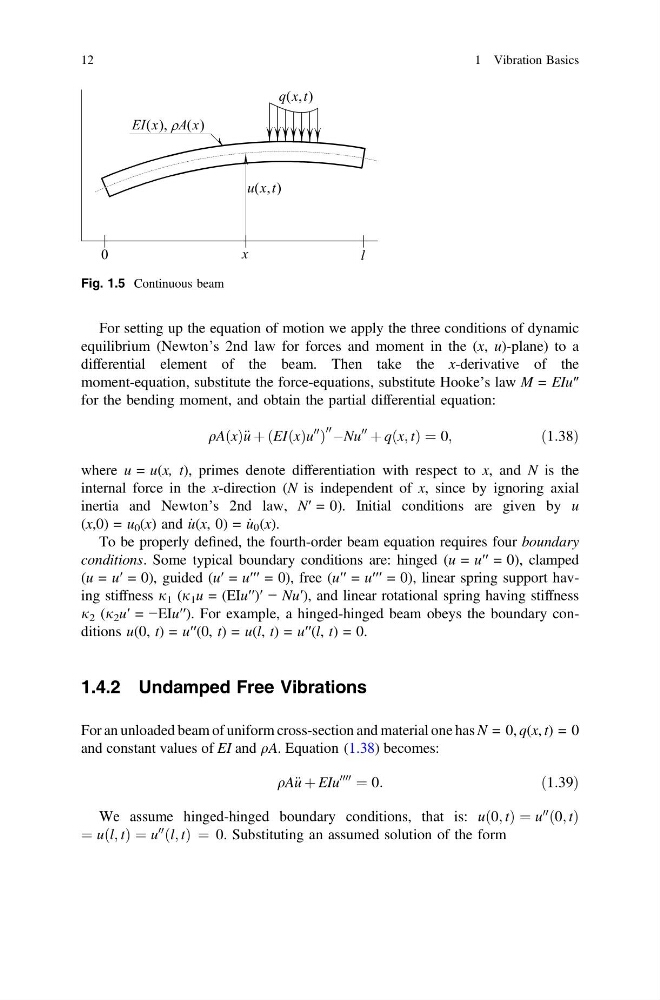
For setting up the equation of motion we apply the three conditions of dynamic
equilibrium (Newton’s 2nd law for forces and moment in the (x, u)-plane) to a
differential element of the beam. Then take the x-derivative of the
moment-equation, substitute the force-equations, substitute Hooke’s law M = EIu″
for the bending moment, and obtain the partial differential equation:
qAðxÞ€ u þ EIðxÞu
00
ð
Þ
00 ÀNu
00
þ qðx; tÞ ¼ 0;
ð1:38Þ
where u = u(x, t), primes denote differentiation with respect to x, and N is the
internal force in the x-direction (N is independent of x, since by ignoring axial
inertia and Newton’s 2nd law, N′ = 0). Initial conditions are given by u
(x,0) = u 0 (x) and _
u(x, 0) = _
u 0 (x).
To be properly defined, the fourth-order beam equation requires four boundary
conditions. Some typical boundary conditions are: hinged (u = u′′ = 0), clamped
(u = u′ = 0), guided (u′ = u′′′ = 0), free (u′′ = u′′′ = 0), linear spring support having stiffness j 1 (j 1 u = (EIu′′)′ − Nu′), and linear rotational spring having stiffness
j 2 (j 2 u′ = −EIu′′). For example, a hinged-hinged beam obeys the boundary conditions u(0, t) = u′′(0, t) = u(l, t) = u′′(l, t) = 0.
1.4.2 Undamped Free Vibrations
For an unloaded beam of uniform cross-section and material one has N = 0, q(x, t) = 0
and constant values of EI and qA. Equation (1.38) becomes:
qA€ u þ EIu
0000
¼ 0:
ð1:39Þ
We assume hinged-hinged boundary conditions, that is: u 0; t
ð Þ ¼ u
00 0; t
ð Þ
¼ u l; t
ð Þ ¼ u
00 l; t
ð Þ ¼ 0. Substituting an assumed solution of the form
Fig. 1.5 Continuous beam
12
1 Vibration Basics
equilibrium (Newton’s 2nd law for forces and moment in the (x, u)-plane) to a
differential element of the beam. Then take the x-derivative of the
moment-equation, substitute the force-equations, substitute Hooke’s law M = EIu″
for the bending moment, and obtain the partial differential equation:
qAðxÞ€ u þ EIðxÞu
00
ð
Þ
00 ÀNu
00
þ qðx; tÞ ¼ 0;
ð1:38Þ
where u = u(x, t), primes denote differentiation with respect to x, and N is the
internal force in the x-direction (N is independent of x, since by ignoring axial
inertia and Newton’s 2nd law, N′ = 0). Initial conditions are given by u
(x,0) = u 0 (x) and _
u(x, 0) = _
u 0 (x).
To be properly defined, the fourth-order beam equation requires four boundary
conditions. Some typical boundary conditions are: hinged (u = u′′ = 0), clamped
(u = u′ = 0), guided (u′ = u′′′ = 0), free (u′′ = u′′′ = 0), linear spring support having stiffness j 1 (j 1 u = (EIu′′)′ − Nu′), and linear rotational spring having stiffness
j 2 (j 2 u′ = −EIu′′). For example, a hinged-hinged beam obeys the boundary conditions u(0, t) = u′′(0, t) = u(l, t) = u′′(l, t) = 0.
1.4.2 Undamped Free Vibrations
For an unloaded beam of uniform cross-section and material one has N = 0, q(x, t) = 0
and constant values of EI and qA. Equation (1.38) becomes:
qA€ u þ EIu
0000
¼ 0:
ð1:39Þ
We assume hinged-hinged boundary conditions, that is: u 0; t
ð Þ ¼ u
00 0; t
ð Þ
¼ u l; t
ð Þ ¼ u
00 l; t
ð Þ ¼ 0. Substituting an assumed solution of the form
Fig. 1.5 Continuous beam
12
1 Vibration Basics