

Using the principle of superposition (valid for linear systems) we may compute
the response to a sum of excitations as a sum of responses to single excitation terms.
That is, one computes the response to each Fourier-term in (1.35) (using results
from Sect. 1.3.6), and add up all individual responses to obtain the full solution. For
many applications the infinite Fourier series is truncated at some finite value of k,
typically quite low.
1.3.8 Arbitrary Forcing, Transients
For the system (1.14) with general excitation f(t) we may still decouple the equations in terms of the undamped mode shapes, at least if proportional damping as in
(1.30) is assumed. Assuming again a solution of the form (1.31) one obtains,
instead of (1.32):
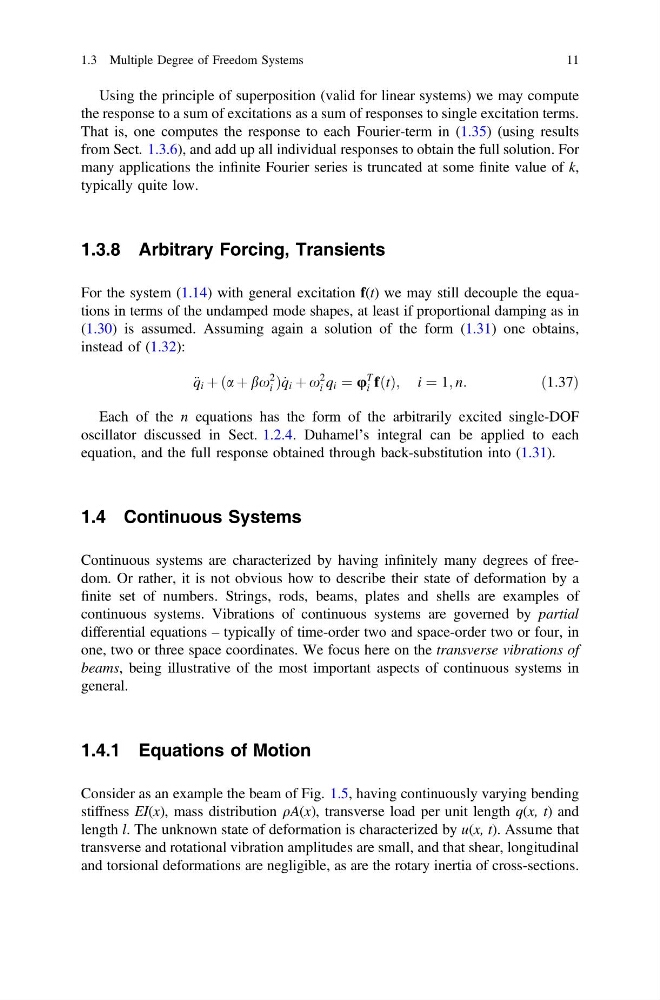
€ q i þ ða þ bx
2
i Þ _
q i þ x
2
i q i ¼ u
T
i fðtÞ; i ¼ 1; n:
ð1:37Þ
Each of the n equations has the form of the arbitrarily excited single-DOF
oscillator discussed in Sect. 1.2.4. Duhamel’s integral can be applied to each
equation, and the full response obtained through back-substitution into (1.31).
1.4 Continuous Systems
Continuous systems are characterized by having infinitely many degrees of freedom. Or rather, it is not obvious how to describe their state of deformation by a
finite set of numbers. Strings, rods, beams, plates and shells are examples of
continuous systems. Vibrations of continuous systems are governed by partial
differential equations – typically of time-order two and space-order two or four, in
one, two or three space coordinates. We focus here on the transverse vibrations of
beams, being illustrative of the most important aspects of continuous systems in
general.
1.4.1 Equations of Motion
Consider as an example the beam of Fig. 1.5, having continuously varying bending
stiffness EI(x), mass distribution qA(x), transverse load per unit length q(x, t) and
length l. The unknown state of deformation is characterized by u(x, t). Assume that
transverse and rotational vibration amplitudes are small, and that shear, longitudinal
and torsional deformations are negligible, as are the rotary inertia of cross-sections.
1.3 Multiple Degree of Freedom Systems
11
the response to a sum of excitations as a sum of responses to single excitation terms.
That is, one computes the response to each Fourier-term in (1.35) (using results
from Sect. 1.3.6), and add up all individual responses to obtain the full solution. For
many applications the infinite Fourier series is truncated at some finite value of k,
typically quite low.
1.3.8 Arbitrary Forcing, Transients
For the system (1.14) with general excitation f(t) we may still decouple the equations in terms of the undamped mode shapes, at least if proportional damping as in
(1.30) is assumed. Assuming again a solution of the form (1.31) one obtains,
instead of (1.32):
€ q i þ ða þ bx
2
i Þ _
q i þ x
2
i q i ¼ u
T
i fðtÞ; i ¼ 1; n:
ð1:37Þ
Each of the n equations has the form of the arbitrarily excited single-DOF
oscillator discussed in Sect. 1.2.4. Duhamel’s integral can be applied to each
equation, and the full response obtained through back-substitution into (1.31).
1.4 Continuous Systems
Continuous systems are characterized by having infinitely many degrees of freedom. Or rather, it is not obvious how to describe their state of deformation by a
finite set of numbers. Strings, rods, beams, plates and shells are examples of
continuous systems. Vibrations of continuous systems are governed by partial
differential equations – typically of time-order two and space-order two or four, in
one, two or three space coordinates. We focus here on the transverse vibrations of
beams, being illustrative of the most important aspects of continuous systems in
general.
1.4.1 Equations of Motion
Consider as an example the beam of Fig. 1.5, having continuously varying bending
stiffness EI(x), mass distribution qA(x), transverse load per unit length q(x, t) and
length l. The unknown state of deformation is characterized by u(x, t). Assume that
transverse and rotational vibration amplitudes are small, and that shear, longitudinal
and torsional deformations are negligible, as are the rotary inertia of cross-sections.
1.3 Multiple Degree of Freedom Systems
11