

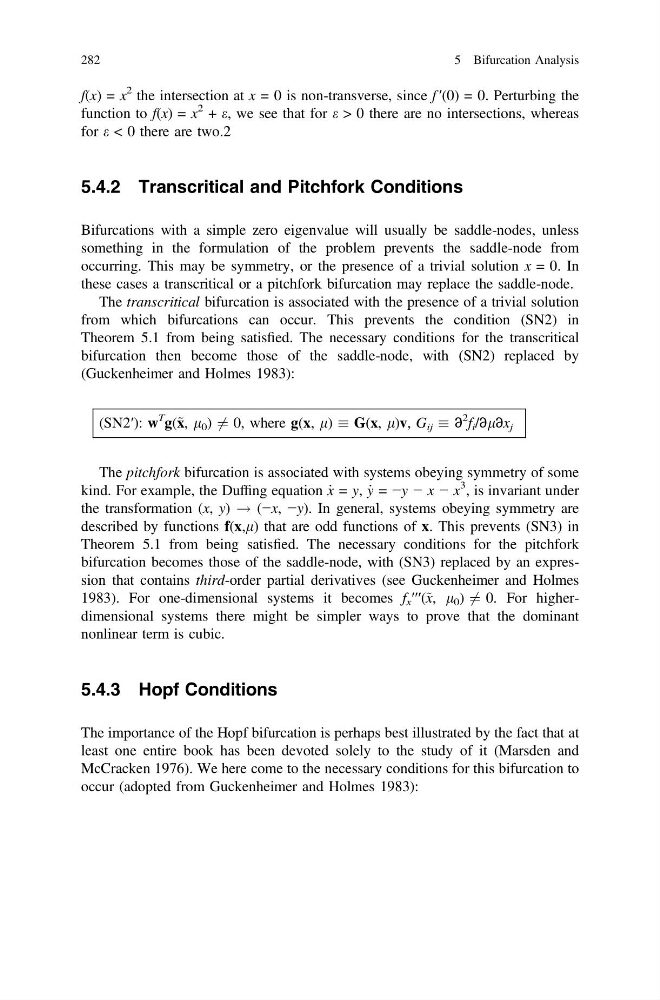
f(x) = x
2 the intersection at x = 0 is non-transverse, since f ′(0) = 0. Perturbing the
function to f(x) = x
2 + e, we see that for e > 0 there are no intersections, whereas
for e < 0 there are two.2
5.4.2 Transcritical and Pitchfork Conditions
Bifurcations with a simple zero eigenvalue will usually be saddle-nodes, unless
something in the formulation of the problem prevents the saddle-node from
occurring. This may be symmetry, or the presence of a trivial solution x = 0. In
these cases a transcritical or a pitchfork bifurcation may replace the saddle-node.
The transcritical bifurcation is associated with the presence of a trivial solution
from which bifurcations can occur. This prevents the condition (SN2) in
Theorem 5.1 from being satisfied. The necessary conditions for the transcritical
bifurcation then become those of the saddle-node, with (SN2) replaced by
(Guckenheimer and Holmes 1983):
(SN2′): w
T
g(~ x, l 0 ) 6 ¼ 0, where g(x, l) G(x, l)v, G ij ∂
2 f i /∂l∂x j
The pitchfork bifurcation is associated with systems obeying symmetry of some
kind. For example, the Duffing equation _
x = y, _
y = −y − x − x
3 , is invariant under
the transformation (x, y) ! (−x, −y). In general, systems obeying symmetry are
described by functions f(x,l) that are odd functions of x. This prevents (SN3) in
Theorem 5.1 from being satisfied. The necessary conditions for the pitchfork
bifurcation becomes those of the saddle-node, with (SN3) replaced by an expression that contains third-order partial derivatives (see Guckenheimer and Holmes
1983). For one-dimensional systems it becomes f x ′′′(~ x, l 0 ) 6 ¼ 0. For higherdimensional systems there might be simpler ways to prove that the dominant
nonlinear term is cubic.
5.4.3 Hopf Conditions
The importance of the Hopf bifurcation is perhaps best illustrated by the fact that at
least one entire book has been devoted solely to the study of it (Marsden and
McCracken 1976). We here come to the necessary conditions for this bifurcation to
occur (adopted from Guckenheimer and Holmes 1983):
282
5 Bifurcation Analysis
2 the intersection at x = 0 is non-transverse, since f ′(0) = 0. Perturbing the
function to f(x) = x
2 + e, we see that for e > 0 there are no intersections, whereas
for e < 0 there are two.2
5.4.2 Transcritical and Pitchfork Conditions
Bifurcations with a simple zero eigenvalue will usually be saddle-nodes, unless
something in the formulation of the problem prevents the saddle-node from
occurring. This may be symmetry, or the presence of a trivial solution x = 0. In
these cases a transcritical or a pitchfork bifurcation may replace the saddle-node.
The transcritical bifurcation is associated with the presence of a trivial solution
from which bifurcations can occur. This prevents the condition (SN2) in
Theorem 5.1 from being satisfied. The necessary conditions for the transcritical
bifurcation then become those of the saddle-node, with (SN2) replaced by
(Guckenheimer and Holmes 1983):
(SN2′): w
T
g(~ x, l 0 ) 6 ¼ 0, where g(x, l) G(x, l)v, G ij ∂
2 f i /∂l∂x j
The pitchfork bifurcation is associated with systems obeying symmetry of some
kind. For example, the Duffing equation _
x = y, _
y = −y − x − x
3 , is invariant under
the transformation (x, y) ! (−x, −y). In general, systems obeying symmetry are
described by functions f(x,l) that are odd functions of x. This prevents (SN3) in
Theorem 5.1 from being satisfied. The necessary conditions for the pitchfork
bifurcation becomes those of the saddle-node, with (SN3) replaced by an expression that contains third-order partial derivatives (see Guckenheimer and Holmes
1983). For one-dimensional systems it becomes f x ′′′(~ x, l 0 ) 6 ¼ 0. For higherdimensional systems there might be simpler ways to prove that the dominant
nonlinear term is cubic.
5.4.3 Hopf Conditions
The importance of the Hopf bifurcation is perhaps best illustrated by the fact that at
least one entire book has been devoted solely to the study of it (Marsden and
McCracken 1976). We here come to the necessary conditions for this bifurcation to
occur (adopted from Guckenheimer and Holmes 1983):
282
5 Bifurcation Analysis