

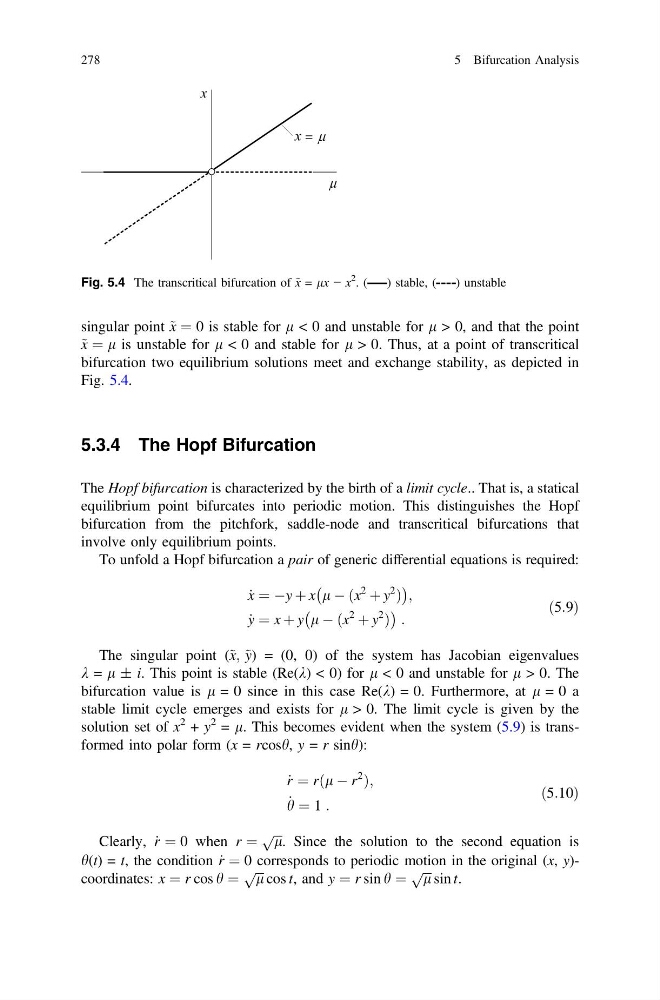
singular point ~ x ¼ 0 is stable for l < 0 and unstable for l > 0, and that the point
~ x ¼ l is unstable for l < 0 and stable for l > 0. Thus, at a point of transcritical
bifurcation two equilibrium solutions meet and exchange stability, as depicted in
Fig. 5.4.
5.3.4 The Hopf Bifurcation
The Hopf bifurcation is characterized by the birth of a limit cycle.. That is, a statical
equilibrium point bifurcates into periodic motion. This distinguishes the Hopf
bifurcation from the pitchfork, saddle-node and transcritical bifurcations that
involve only equilibrium points.
To unfold a Hopf bifurcation a pair of generic differential equations is required:
_
x ¼ Ày þ x l À ðx
2
þ y
2
Þ
À
Á ;
_
y ¼ x þ y l À ðx
2
þ y
2
Þ
À
Á :
ð5:9Þ
The singular point (~ x; ~ y) = (0, 0) of the system has Jacobian eigenvalues
k = l ± i. This point is stable (Re(k) < 0) for l < 0 and unstable for l > 0. The
bifurcation value is l = 0 since in this case Re(k) = 0. Furthermore, at l = 0 a
stable limit cycle emerges and exists for l > 0. The limit cycle is given by the
solution set of x
2 + y
2 = l. This becomes evident when the system (5.9) is transformed into polar form (x = rcosh, y = r sinh):
_
r ¼ rðl À r
2
Þ;
_
h ¼ 1 :
ð5:10Þ
Clearly, _
r ¼ 0 when r ¼
ffiffiffi
l
p . Since the solution to the second equation is
h(t) = t, the condition _
r ¼ 0 corresponds to periodic motion in the original (x, y)coordinates: x ¼ r cos h ¼
ffiffiffi
l
p cos t, and y ¼ r sin h ¼
ffiffiffi
l
p sin t.
Fig. 5.4 The transcritical bifurcation of ~ x = lx − x
2
. (
) stable, (
) unstable
278
5 Bifurcation Analysis
~ x ¼ l is unstable for l < 0 and stable for l > 0. Thus, at a point of transcritical
bifurcation two equilibrium solutions meet and exchange stability, as depicted in
Fig. 5.4.
5.3.4 The Hopf Bifurcation
The Hopf bifurcation is characterized by the birth of a limit cycle.. That is, a statical
equilibrium point bifurcates into periodic motion. This distinguishes the Hopf
bifurcation from the pitchfork, saddle-node and transcritical bifurcations that
involve only equilibrium points.
To unfold a Hopf bifurcation a pair of generic differential equations is required:
_
x ¼ Ày þ x l À ðx
2
þ y
2
Þ
À
Á ;
_
y ¼ x þ y l À ðx
2
þ y
2
Þ
À
Á :
ð5:9Þ
The singular point (~ x; ~ y) = (0, 0) of the system has Jacobian eigenvalues
k = l ± i. This point is stable (Re(k) < 0) for l < 0 and unstable for l > 0. The
bifurcation value is l = 0 since in this case Re(k) = 0. Furthermore, at l = 0 a
stable limit cycle emerges and exists for l > 0. The limit cycle is given by the
solution set of x
2 + y
2 = l. This becomes evident when the system (5.9) is transformed into polar form (x = rcosh, y = r sinh):
_
r ¼ rðl À r
2
Þ;
_
h ¼ 1 :
ð5:10Þ
Clearly, _
r ¼ 0 when r ¼
ffiffiffi
l
p . Since the solution to the second equation is
h(t) = t, the condition _
r ¼ 0 corresponds to periodic motion in the original (x, y)coordinates: x ¼ r cos h ¼
ffiffiffi
l
p cos t, and y ¼ r sin h ¼
ffiffiffi
l
p sin t.
Fig. 5.4 The transcritical bifurcation of ~ x = lx − x
2
. (
) stable, (
) unstable
278
5 Bifurcation Analysis