

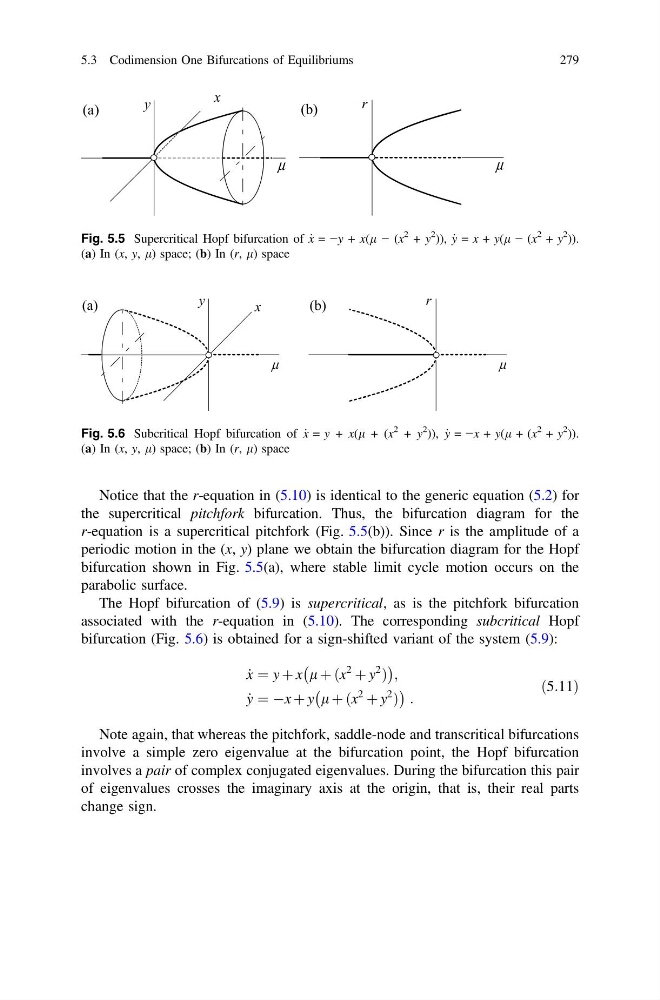
Notice that the r-equation in (5.10) is identical to the generic equation (5.2) for
the supercritical pitchfork bifurcation. Thus, the bifurcation diagram for the
r-equation is a supercritical pitchfork (Fig. 5.5(b)). Since r is the amplitude of a
periodic motion in the (x, y) plane we obtain the bifurcation diagram for the Hopf
bifurcation shown in Fig. 5.5(a), where stable limit cycle motion occurs on the
parabolic surface.
The Hopf bifurcation of (5.9) is supercritical, as is the pitchfork bifurcation
associated with the r-equation in (5.10). The corresponding subcritical Hopf
bifurcation (Fig. 5.6) is obtained for a sign-shifted variant of the system (5.9):
_
x ¼ y þ x l þ ðx
2
þ y
2
Þ
À
Á ;
_
y ¼ Àx þ y l þ ðx
2
þ y
2
Þ
À
Á :
ð5:11Þ
Note again, that whereas the pitchfork, saddle-node and transcritical bifurcations
involve a simple zero eigenvalue at the bifurcation point, the Hopf bifurcation
involves a pair of complex conjugated eigenvalues. During the bifurcation this pair
of eigenvalues crosses the imaginary axis at the origin, that is, their real parts
change sign.
y
x
µ
(a)
µ
(b)
r
Fig. 5.5 Supercritical Hopf bifurcation of _
x = −y + x(l − (x
2 + y
2
)), _
y = x + y(l − (x
2 + y
2
)).
(a) In (x, y, l) space; (b) In (r, l) space
Fig. 5.6 Subcritical Hopf bifurcation of _
x = y + x(l + (x
2 + y
2
)), _
y = −x + y(l + (x
2 + y
2
)).
(a) In (x, y, l) space; (b) In (r, l) space
5.3 Codimension One Bifurcations of Equilibriums
279
the supercritical pitchfork bifurcation. Thus, the bifurcation diagram for the
r-equation is a supercritical pitchfork (Fig. 5.5(b)). Since r is the amplitude of a
periodic motion in the (x, y) plane we obtain the bifurcation diagram for the Hopf
bifurcation shown in Fig. 5.5(a), where stable limit cycle motion occurs on the
parabolic surface.
The Hopf bifurcation of (5.9) is supercritical, as is the pitchfork bifurcation
associated with the r-equation in (5.10). The corresponding subcritical Hopf
bifurcation (Fig. 5.6) is obtained for a sign-shifted variant of the system (5.9):
_
x ¼ y þ x l þ ðx
2
þ y
2
Þ
À
Á ;
_
y ¼ Àx þ y l þ ðx
2
þ y
2
Þ
À
Á :
ð5:11Þ
Note again, that whereas the pitchfork, saddle-node and transcritical bifurcations
involve a simple zero eigenvalue at the bifurcation point, the Hopf bifurcation
involves a pair of complex conjugated eigenvalues. During the bifurcation this pair
of eigenvalues crosses the imaginary axis at the origin, that is, their real parts
change sign.
y
x
µ
(a)
µ
(b)
r
Fig. 5.5 Supercritical Hopf bifurcation of _
x = −y + x(l − (x
2 + y
2
)), _
y = x + y(l − (x
2 + y
2
)).
(a) In (x, y, l) space; (b) In (r, l) space
Fig. 5.6 Subcritical Hopf bifurcation of _
x = y + x(l + (x
2 + y
2
)), _
y = −x + y(l + (x
2 + y
2
)).
(a) In (x, y, l) space; (b) In (r, l) space
5.3 Codimension One Bifurcations of Equilibriums
279