

Problem 4.10 Consider small vibrations u = u(x, t) of the in-plane loaded thin
plate in airflow shown in Fig. P4.10, governed by the linearized equation of motion:
qh€ u þ b _
u þ Du
0000
þ qu
00
þ pu
0
¼ 0
ð4:128Þ
where D is the bending stiffness, q the in-plane load, p the loading from the
airflow, qh mass per unit area, b the damping coefficient, all parameters are positive
unless otherwise stated, u
0
¼ @u=@x; and _
u ¼ @u=@t. The plate is simply supported
along x = 0 and x = l, and is considered infinitely long in the y-direction.
a) Perform a formal mode shape expansion (i.e. without specific choice of mode
shapes) of the partial differential equation of motion.
b) Classify the forces and the system (cf. Sect. 1.9) when, respectively, p = 0 and
p > 0… (see overleaf)
c) For a particular discretization, using expansion functions u 1 = sin(px/l) and
u 2 = sin(2px/l), calculate the characteristic polynomial whose roots determines
the stability of the equilibrium u = 0.
d) For p = 0, determine the critical value q
* of the in-plane load, so that the
equilibrium u = 0 is stable if and only if q < q
* .
e) Now assume that p > 0, and that q = ηq
* , where the parameter η 2 [0; 1[
describes how near the in-plane load is to the critical value q
* at zero airflow.
Calculate the critical value p
* = p
* (η) of the airflow, so that the equilibrium
u = 0 is stable if and only if p < p
* .
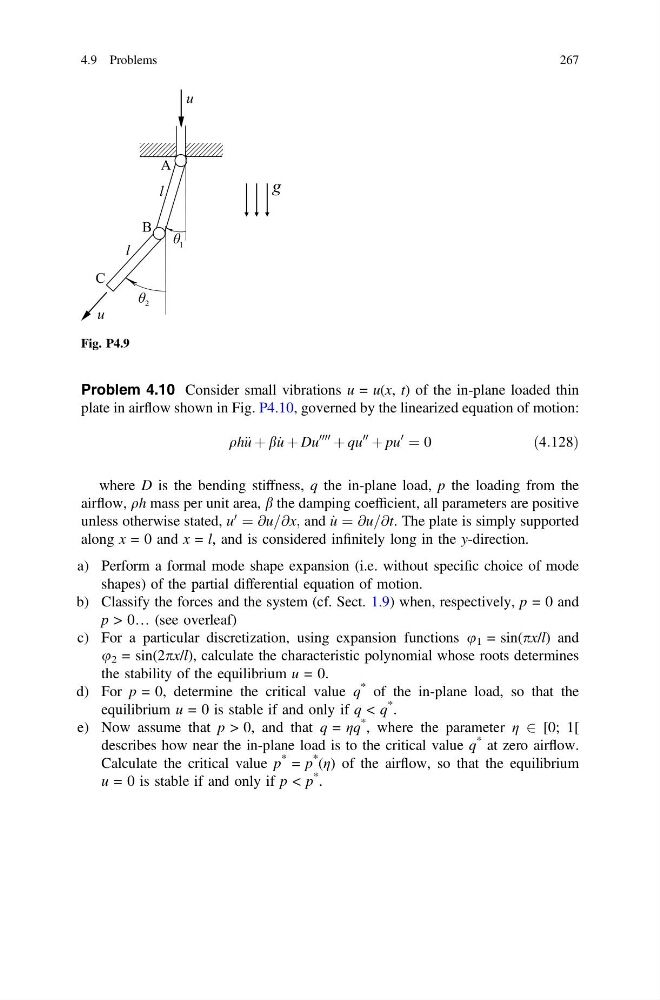
Fig. P4.9
4.9 Problems
267
plate in airflow shown in Fig. P4.10, governed by the linearized equation of motion:
qh€ u þ b _
u þ Du
0000
þ qu
00
þ pu
0
¼ 0
ð4:128Þ
where D is the bending stiffness, q the in-plane load, p the loading from the
airflow, qh mass per unit area, b the damping coefficient, all parameters are positive
unless otherwise stated, u
0
¼ @u=@x; and _
u ¼ @u=@t. The plate is simply supported
along x = 0 and x = l, and is considered infinitely long in the y-direction.
a) Perform a formal mode shape expansion (i.e. without specific choice of mode
shapes) of the partial differential equation of motion.
b) Classify the forces and the system (cf. Sect. 1.9) when, respectively, p = 0 and
p > 0… (see overleaf)
c) For a particular discretization, using expansion functions u 1 = sin(px/l) and
u 2 = sin(2px/l), calculate the characteristic polynomial whose roots determines
the stability of the equilibrium u = 0.
d) For p = 0, determine the critical value q
* of the in-plane load, so that the
equilibrium u = 0 is stable if and only if q < q
* .
e) Now assume that p > 0, and that q = ηq
* , where the parameter η 2 [0; 1[
describes how near the in-plane load is to the critical value q
* at zero airflow.
Calculate the critical value p
* = p
* (η) of the airflow, so that the equilibrium
u = 0 is stable if and only if p < p
* .
Fig. P4.9
4.9 Problems
267