

1 þ a
ð
Þ€ u þ c _
u þ ju
0000
þ a V
2 u
00
þ 2V _
u
0
À
Á ¼ 0;
uð0; tÞ ¼ u
00
ð0; tÞ ¼ uðl; tÞ ¼ u
00
ðl; tÞ ¼ 0;
ð4:126Þ
where u
0
¼ @u=@x; _
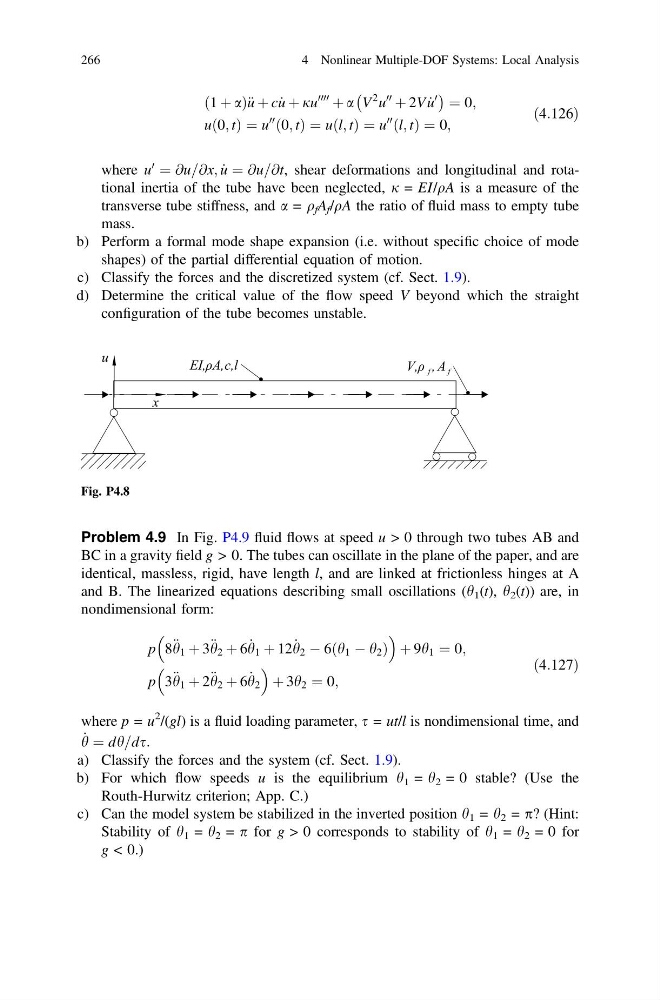
u ¼ @u=@t, shear deformations and longitudinal and rotational inertia of the tube have been neglected, j = EI/qA is a measure of the
transverse tube stiffness, and a = q f A f /qA the ratio of fluid mass to empty tube
mass.
b) Perform a formal mode shape expansion (i.e. without specific choice of mode
shapes) of the partial differential equation of motion.
c) Classify the forces and the discretized system (cf. Sect. 1.9).
d) Determine the critical value of the flow speed V beyond which the straight
configuration of the tube becomes unstable.
Problem 4.9 In Fig. P4.9 fluid flows at speed u > 0 through two tubes AB and
BC in a gravity field g > 0. The tubes can oscillate in the plane of the paper, and are
identical, massless, rigid, have length l, and are linked at frictionless hinges at A
and B. The linearized equations describing small oscillations (h 1 (t), h 2 (t)) are, in
nondimensional form:
p 8 € h 1 þ 3 € h 2 þ 6 _
h 1 þ 12 _
h 2 À 6 h 1 À h 2
ð
Þ
þ 9h 1 ¼ 0;
p 3 € h 1 þ 2 € h 2 þ 6 _
h 2
þ 3h 2 ¼ 0;
ð4:127Þ
where p = u
2 /(gl) is a fluid loading parameter, s = ut/l is nondimensional time, and
_
h ¼ dh=ds:
a) Classify the forces and the system (cf. Sect. 1.9).
b) For which flow speeds u is the equilibrium h 1 = h 2 = 0 stable? (Use the
Routh-Hurwitz criterion; App. C.)
c) Can the model system be stabilized in the inverted position h 1 = h 2 = p? (Hint:
Stability of h 1 = h 2 = p for g > 0 corresponds to stability of h 1 = h 2 = 0 for
g < 0.)
Fig. P4.8
266
4 Nonlinear Multiple-DOF Systems: Local Analysis
ð
Þ€ u þ c _
u þ ju
0000
þ a V
2 u
00
þ 2V _
u
0
À
Á ¼ 0;
uð0; tÞ ¼ u
00
ð0; tÞ ¼ uðl; tÞ ¼ u
00
ðl; tÞ ¼ 0;
ð4:126Þ
where u
0
¼ @u=@x; _
u ¼ @u=@t, shear deformations and longitudinal and rotational inertia of the tube have been neglected, j = EI/qA is a measure of the
transverse tube stiffness, and a = q f A f /qA the ratio of fluid mass to empty tube
mass.
b) Perform a formal mode shape expansion (i.e. without specific choice of mode
shapes) of the partial differential equation of motion.
c) Classify the forces and the discretized system (cf. Sect. 1.9).
d) Determine the critical value of the flow speed V beyond which the straight
configuration of the tube becomes unstable.
Problem 4.9 In Fig. P4.9 fluid flows at speed u > 0 through two tubes AB and
BC in a gravity field g > 0. The tubes can oscillate in the plane of the paper, and are
identical, massless, rigid, have length l, and are linked at frictionless hinges at A
and B. The linearized equations describing small oscillations (h 1 (t), h 2 (t)) are, in
nondimensional form:
p 8 € h 1 þ 3 € h 2 þ 6 _
h 1 þ 12 _
h 2 À 6 h 1 À h 2
ð
Þ
þ 9h 1 ¼ 0;
p 3 € h 1 þ 2 € h 2 þ 6 _
h 2
þ 3h 2 ¼ 0;
ð4:127Þ
where p = u
2 /(gl) is a fluid loading parameter, s = ut/l is nondimensional time, and
_
h ¼ dh=ds:
a) Classify the forces and the system (cf. Sect. 1.9).
b) For which flow speeds u is the equilibrium h 1 = h 2 = 0 stable? (Use the
Routh-Hurwitz criterion; App. C.)
c) Can the model system be stabilized in the inverted position h 1 = h 2 = p? (Hint:
Stability of h 1 = h 2 = p for g > 0 corresponds to stability of h 1 = h 2 = 0 for
g < 0.)
Fig. P4.8
266
4 Nonlinear Multiple-DOF Systems: Local Analysis