

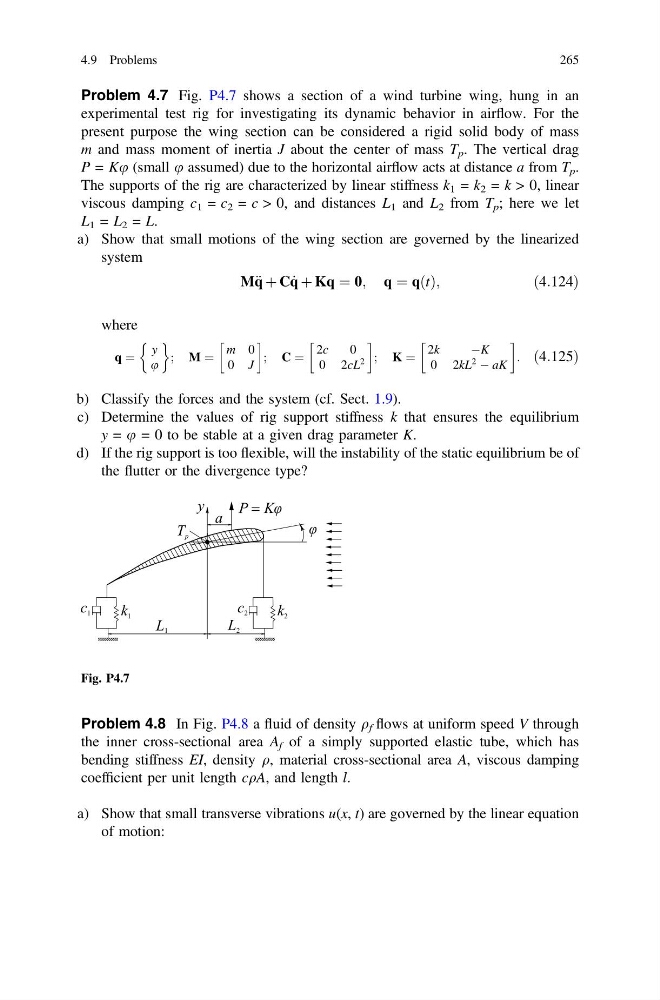
Problem 4.7 Fig. P4.7 shows a section of a wind turbine wing, hung in an
experimental test rig for investigating its dynamic behavior in airflow. For the
present purpose the wing section can be considered a rigid solid body of mass
m and mass moment of inertia J about the center of mass T p . The vertical drag
P = Ku (small u assumed) due to the horizontal airflow acts at distance a from T p .
The supports of the rig are characterized by linear stiffness k 1 = k 2 = k > 0, linear
viscous damping c 1 = c 2 = c > 0, and distances L 1 and L 2 from T p ; here we let
L 1 = L 2 = L.
a) Show that small motions of the wing section are governed by the linearized
system
M€ q þ C _
q þ Kq ¼ 0; q ¼ qðtÞ;
ð4:124Þ
where
q ¼
y
u
& '
; M ¼
m 0
0 J
!
; C ¼
2c
0
0 2cL
2
!
; K ¼
2k
ÀK
0 2kL
2 À aK
!
: ð4:125Þ
b) Classify the forces and the system (cf. Sect. 1.9).
c) Determine the values of rig support stiffness k that ensures the equilibrium
y = u = 0 to be stable at a given drag parameter K.
d) If the rig support is too flexible, will the instability of the static equilibrium be of
the flutter or the divergence type?
Problem 4.8 In Fig. P4.8 a fluid of density q f flows at uniform speed V through
the inner cross-sectional area A f of a simply supported elastic tube, which has
bending stiffness EI, density q, material cross-sectional area A, viscous damping
coefficient per unit length cqA, and length l.
a) Show that small transverse vibrations u(x, t) are governed by the linear equation
of motion:
Fig. P4.7
4.9 Problems
265
experimental test rig for investigating its dynamic behavior in airflow. For the
present purpose the wing section can be considered a rigid solid body of mass
m and mass moment of inertia J about the center of mass T p . The vertical drag
P = Ku (small u assumed) due to the horizontal airflow acts at distance a from T p .
The supports of the rig are characterized by linear stiffness k 1 = k 2 = k > 0, linear
viscous damping c 1 = c 2 = c > 0, and distances L 1 and L 2 from T p ; here we let
L 1 = L 2 = L.
a) Show that small motions of the wing section are governed by the linearized
system
M€ q þ C _
q þ Kq ¼ 0; q ¼ qðtÞ;
ð4:124Þ
where
q ¼
y
u
& '
; M ¼
m 0
0 J
!
; C ¼
2c
0
0 2cL
2
!
; K ¼
2k
ÀK
0 2kL
2 À aK
!
: ð4:125Þ
b) Classify the forces and the system (cf. Sect. 1.9).
c) Determine the values of rig support stiffness k that ensures the equilibrium
y = u = 0 to be stable at a given drag parameter K.
d) If the rig support is too flexible, will the instability of the static equilibrium be of
the flutter or the divergence type?
Problem 4.8 In Fig. P4.8 a fluid of density q f flows at uniform speed V through
the inner cross-sectional area A f of a simply supported elastic tube, which has
bending stiffness EI, density q, material cross-sectional area A, viscous damping
coefficient per unit length cqA, and length l.
a) Show that small transverse vibrations u(x, t) are governed by the linear equation
of motion:
Fig. P4.7
4.9 Problems
265