

€ h þ h ¼ e À2b 1
_
h þ uh À 2 _
u _
h
þ Oðe
2
Þ;
€ u þ x
2 u ¼ e À2b 2 _
u À
1
2
h
2
þ _
h
2
þ qX
2 cosðXsÞ
þ Oðe
2
Þ:
ð4:123Þ
d) Using the method of multiple scales, assume a two-term expansion for h(s) and
u(s) and identify all possible internal and external resonances.
e) Calculate the approximate responses h = h 0 + eh 1 and u = u 0 + eu 1 for the case
of primary external near-resonance, when there is no internal resonance.
f) Calculate the approximate response for the case of combined internal and
external near-resonance.
g) Calculate the stationary amplitudes of the system for the case of combined
external and internal resonance. Sketch typical force and frequency response
curves. (For assessing stability of response branches use the results of a relevant
example.)
h) Conclude your findings in brief form, using plain words. This part should be like
the ‘Summary and Conclusion’ section of a journal paper, that is: Describe as
clearly as possible the system you have considered, the (main) problem(s) you
have solved, the most important results (in physical terms), the validity of results
(assumptions and approximations), and a few suggestions for future work.
Problem 4.6 For the pendulum with a sliding disk shown in Fig. 4.14 (p. 192):
a) Set up the equations of motion for the case where horizontal oscillations of the
support of the form Z h ðtÞ ¼ Q h sinð e
Xt þ gÞ appear in addition to the vertical
oscillations Z v ðtÞ ¼ Q v sinð e
XtÞ; where η is a constant phase (so that the support
describes an elliptical trajectory).
b) Consider for this system the existence and stability of the following configuration: The rod performs small amplitude vibrations near h = 0, and the disk
performs small-amplitude vibrations near a fixed value of U 2 ]0; l[. (Use any
method or combination of methods find solutions, including numerical integration of the equations of motion.)
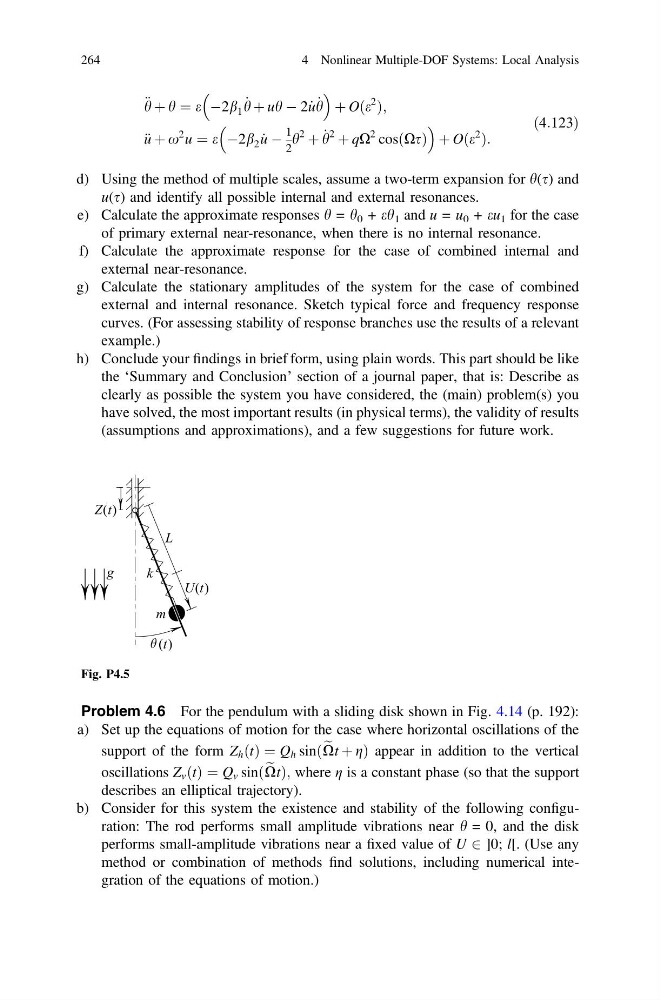
Fig. P4.5
264
4 Nonlinear Multiple-DOF Systems: Local Analysis
_
h þ uh À 2 _
u _
h
þ Oðe
2
Þ;
€ u þ x
2 u ¼ e À2b 2 _
u À
1
2
h
2
þ _
h
2
þ qX
2 cosðXsÞ
þ Oðe
2
Þ:
ð4:123Þ
d) Using the method of multiple scales, assume a two-term expansion for h(s) and
u(s) and identify all possible internal and external resonances.
e) Calculate the approximate responses h = h 0 + eh 1 and u = u 0 + eu 1 for the case
of primary external near-resonance, when there is no internal resonance.
f) Calculate the approximate response for the case of combined internal and
external near-resonance.
g) Calculate the stationary amplitudes of the system for the case of combined
external and internal resonance. Sketch typical force and frequency response
curves. (For assessing stability of response branches use the results of a relevant
example.)
h) Conclude your findings in brief form, using plain words. This part should be like
the ‘Summary and Conclusion’ section of a journal paper, that is: Describe as
clearly as possible the system you have considered, the (main) problem(s) you
have solved, the most important results (in physical terms), the validity of results
(assumptions and approximations), and a few suggestions for future work.
Problem 4.6 For the pendulum with a sliding disk shown in Fig. 4.14 (p. 192):
a) Set up the equations of motion for the case where horizontal oscillations of the
support of the form Z h ðtÞ ¼ Q h sinð e
Xt þ gÞ appear in addition to the vertical
oscillations Z v ðtÞ ¼ Q v sinð e
XtÞ; where η is a constant phase (so that the support
describes an elliptical trajectory).
b) Consider for this system the existence and stability of the following configuration: The rod performs small amplitude vibrations near h = 0, and the disk
performs small-amplitude vibrations near a fixed value of U 2 ]0; l[. (Use any
method or combination of methods find solutions, including numerical integration of the equations of motion.)
Fig. P4.5
264
4 Nonlinear Multiple-DOF Systems: Local Analysis