

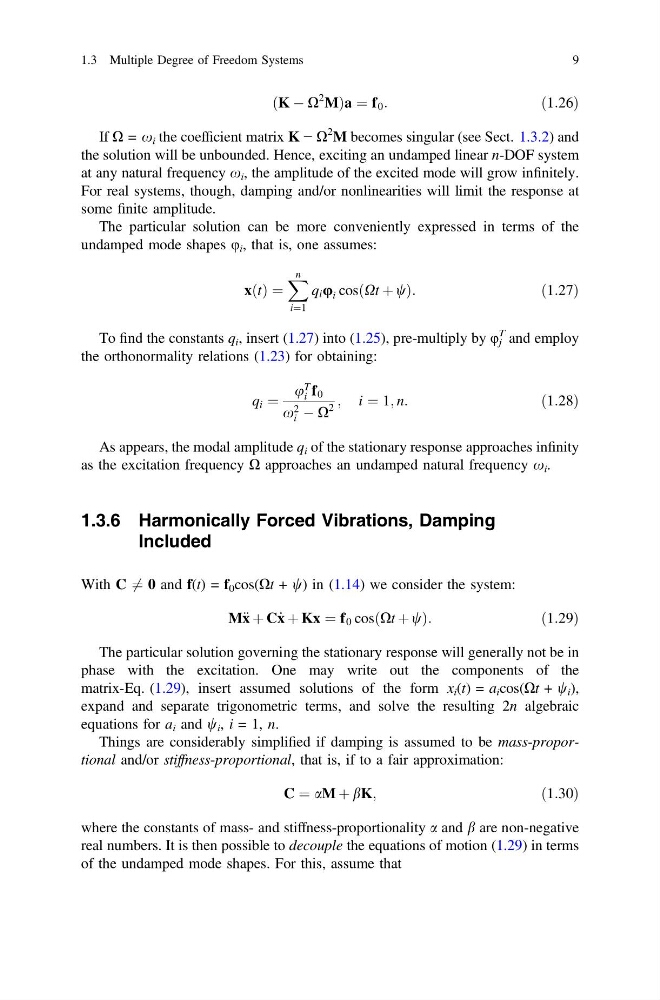
ðK À X
2
MÞa ¼ f 0 :
ð1:26Þ
If X = x i the coefficient matrix K − X
2
M becomes singular (see Sect. 1.3.2) and
the solution will be unbounded. Hence, exciting an undamped linear n-DOF system
at any natural frequency x i , the amplitude of the excited mode will grow infinitely.
For real systems, though, damping and/or nonlinearities will limit the response at
some finite amplitude.
The particular solution can be more conveniently expressed in terms of the
undamped mode shapes φ i , that is, one assumes:
xðtÞ ¼
X n
i¼1
q i u i cosðXt þ wÞ:
ð1:27Þ
To find the constants q i , insert (1.27) into (1.25), pre-multiply by φ j
T and employ
the orthonormality relations (1.23) for obtaining:
q i ¼
u
T
i f 0
x 2
i À X
2
; i ¼ 1; n:
ð1:28Þ
As appears, the modal amplitude q i of the stationary response approaches infinity
as the excitation frequency X approaches an undamped natural frequency x i .
1.3.6 Harmonically Forced Vibrations, Damping
Included
With C 6 ¼ 0 and f(t) = f 0 cos(Xt + w) in (1.14) we consider the system:
M€ x þ C _
x þ Kx ¼ f 0 cosðXt þ wÞ:
ð1:29Þ
The particular solution governing the stationary response will generally not be in
phase with the excitation. One may write out the components of the
matrix-Eq. (1.29), insert assumed solutions of the form x i (t) = a i cos(Xt + w i ),
expand and separate trigonometric terms, and solve the resulting 2n algebraic
equations for a i and w i , i = 1, n.
Things are considerably simplified if damping is assumed to be mass-proportional and/or stiffness-proportional, that is, if to a fair approximation:
C ¼ aM þ bK;
ð1:30Þ
where the constants of mass- and stiffness-proportionality a and b are non-negative
real numbers. It is then possible to decouple the equations of motion (1.29) in terms
of the undamped mode shapes. For this, assume that
1.3 Multiple Degree of Freedom Systems
9
2
MÞa ¼ f 0 :
ð1:26Þ
If X = x i the coefficient matrix K − X
2
M becomes singular (see Sect. 1.3.2) and
the solution will be unbounded. Hence, exciting an undamped linear n-DOF system
at any natural frequency x i , the amplitude of the excited mode will grow infinitely.
For real systems, though, damping and/or nonlinearities will limit the response at
some finite amplitude.
The particular solution can be more conveniently expressed in terms of the
undamped mode shapes φ i , that is, one assumes:
xðtÞ ¼
X n
i¼1
q i u i cosðXt þ wÞ:
ð1:27Þ
To find the constants q i , insert (1.27) into (1.25), pre-multiply by φ j
T and employ
the orthonormality relations (1.23) for obtaining:
q i ¼
u
T
i f 0
x 2
i À X
2
; i ¼ 1; n:
ð1:28Þ
As appears, the modal amplitude q i of the stationary response approaches infinity
as the excitation frequency X approaches an undamped natural frequency x i .
1.3.6 Harmonically Forced Vibrations, Damping
Included
With C 6 ¼ 0 and f(t) = f 0 cos(Xt + w) in (1.14) we consider the system:
M€ x þ C _
x þ Kx ¼ f 0 cosðXt þ wÞ:
ð1:29Þ
The particular solution governing the stationary response will generally not be in
phase with the excitation. One may write out the components of the
matrix-Eq. (1.29), insert assumed solutions of the form x i (t) = a i cos(Xt + w i ),
expand and separate trigonometric terms, and solve the resulting 2n algebraic
equations for a i and w i , i = 1, n.
Things are considerably simplified if damping is assumed to be mass-proportional and/or stiffness-proportional, that is, if to a fair approximation:
C ¼ aM þ bK;
ð1:30Þ
where the constants of mass- and stiffness-proportionality a and b are non-negative
real numbers. It is then possible to decouple the equations of motion (1.29) in terms
of the undamped mode shapes. For this, assume that
1.3 Multiple Degree of Freedom Systems
9