

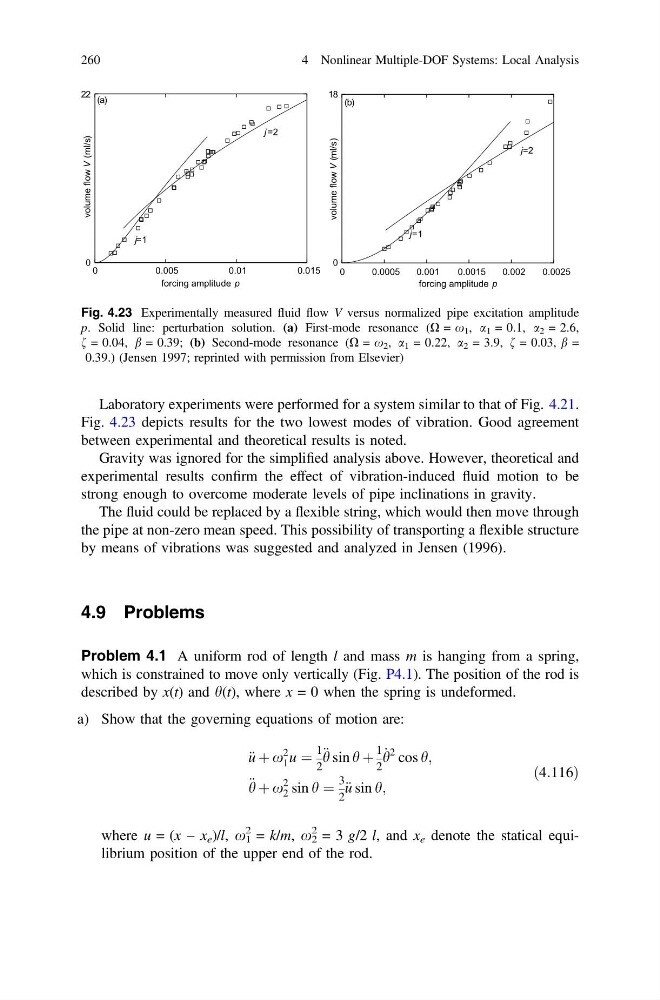
Laboratory experiments were performed for a system similar to that of Fig. 4.21.
Fig. 4.23 depicts results for the two lowest modes of vibration. Good agreement
between experimental and theoretical results is noted.
Gravity was ignored for the simplified analysis above. However, theoretical and
experimental results confirm the effect of vibration-induced fluid motion to be
strong enough to overcome moderate levels of pipe inclinations in gravity.
The fluid could be replaced by a flexible string, which would then move through
the pipe at non-zero mean speed. This possibility of transporting a flexible structure
by means of vibrations was suggested and analyzed in Jensen (1996).
4.9 Problems
Problem 4.1 A uniform rod of length l and mass m is hanging from a spring,
which is constrained to move only vertically (Fig. P4.1). The position of the rod is
described by x(t) and h(t), where x = 0 when the spring is undeformed.
a) Show that the governing equations of motion are:
€ u þ x
2
1 u ¼
1
2
€ h sin h þ
1
2
_
h
2 cos h;
€ h þ x
2
2 sin h ¼
3
2
€ u sin h;
ð4:116Þ
where u = (x – x e )/l, x 1
2 = k/m, x 2
2 = 3 g/2 l, and x e denote the statical equilibrium position of the upper end of the rod.
0
22
0
0.005
0.01
0.015
volume flow
ml/s
V (
)
forcing amplitude p
j =2
j=1
(a)
0
18
0
0.0005
0.001
0.0015
0.002
0.0025
j=1
j=2
(b)
volume flow ml/s
V (
)
forcing amplitude p
Fig. 4.23 Experimentally measured fluid flow V versus normalized pipe excitation amplitude
p. Solid line: perturbation solution. (a) First-mode resonance (X = x 1 , a 1 = 0.1, a 2 = 2.6,
f = 0.04, b = 0.39; (b) Second-mode resonance (X = x 2 , a 1 = 0.22, a 2 = 3.9, f = 0.03, b =
0.39.) (Jensen 1997; reprinted with permission from Elsevier)
260
4 Nonlinear Multiple-DOF Systems: Local Analysis
Fig. 4.23 depicts results for the two lowest modes of vibration. Good agreement
between experimental and theoretical results is noted.
Gravity was ignored for the simplified analysis above. However, theoretical and
experimental results confirm the effect of vibration-induced fluid motion to be
strong enough to overcome moderate levels of pipe inclinations in gravity.
The fluid could be replaced by a flexible string, which would then move through
the pipe at non-zero mean speed. This possibility of transporting a flexible structure
by means of vibrations was suggested and analyzed in Jensen (1996).
4.9 Problems
Problem 4.1 A uniform rod of length l and mass m is hanging from a spring,
which is constrained to move only vertically (Fig. P4.1). The position of the rod is
described by x(t) and h(t), where x = 0 when the spring is undeformed.
a) Show that the governing equations of motion are:
€ u þ x
2
1 u ¼
1
2
€ h sin h þ
1
2
_
h
2 cos h;
€ h þ x
2
2 sin h ¼
3
2
€ u sin h;
ð4:116Þ
where u = (x – x e )/l, x 1
2 = k/m, x 2
2 = 3 g/2 l, and x e denote the statical equilibrium position of the upper end of the rod.
0
22
0
0.005
0.01
0.015
volume flow
ml/s
V (
)
forcing amplitude p
j =2
j=1
(a)
0
18
0
0.0005
0.001
0.0015
0.002
0.0025
j=1
j=2
(b)
volume flow ml/s
V (
)
forcing amplitude p
Fig. 4.23 Experimentally measured fluid flow V versus normalized pipe excitation amplitude
p. Solid line: perturbation solution. (a) First-mode resonance (X = x 1 , a 1 = 0.1, a 2 = 2.6,
f = 0.04, b = 0.39; (b) Second-mode resonance (X = x 2 , a 1 = 0.22, a 2 = 3.9, f = 0.03, b =
0.39.) (Jensen 1997; reprinted with permission from Elsevier)
260
4 Nonlinear Multiple-DOF Systems: Local Analysis