

b) For the case of internal resonance x 1 % 2x 2 , determine a zero order multiple
scales expansion that is valid for small but finite amplitudes.
c) Can there be coupling between the x and the h motions in the linear case? In the
nonlinear?
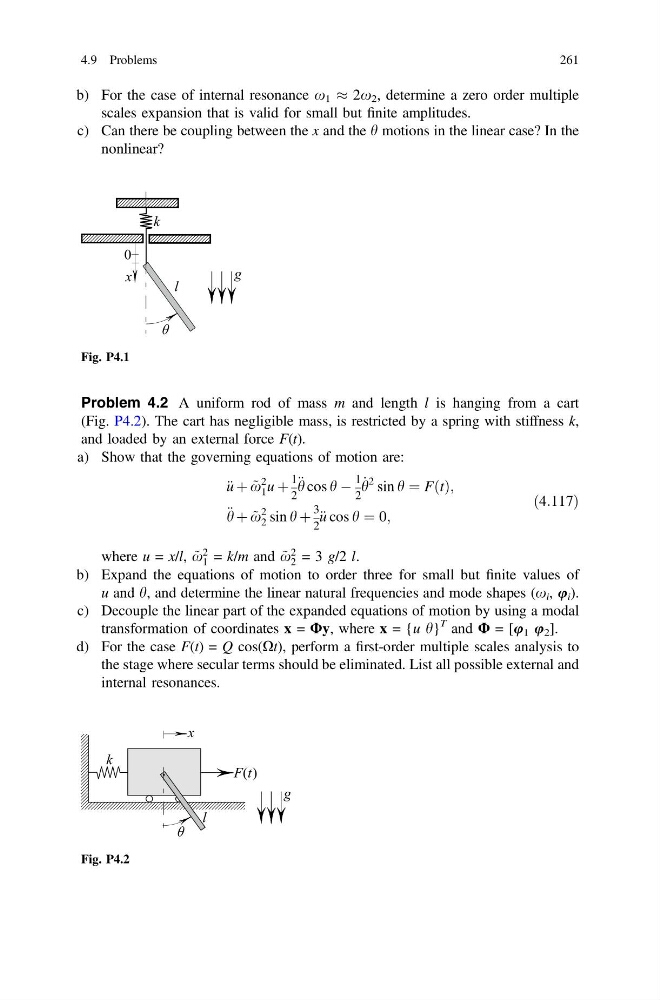
Problem 4.2 A uniform rod of mass m and length l is hanging from a cart
(Fig. P4.2). The cart has negligible mass, is restricted by a spring with stiffness k,
and loaded by an external force F(t).
a) Show that the governing equations of motion are:
€ u þ ~
x
2
1 u þ
1
2
€ h cos h À
1
2
_
h
2 sin h ¼ FðtÞ;
€ h þ ~
x
2
2 sin h þ
3
2
€ u cos h ¼ 0;
ð4:117Þ
where u = x/l, ~
x
2
1 = k/m and ~
x
2
2 = 3 g/2 l.
b) Expand the equations of motion to order three for small but finite values of
u and h, and determine the linear natural frequencies and mode shapes (x i , u i ).
c) Decouple the linear part of the expanded equations of motion by using a modal
transformation of coordinates x = Uy, where x = {u h}
T and U = [u 1 u 2 ].
d) For the case F(t) = Q cos(Xt), perform a first-order multiple scales analysis to
the stage where secular terms should be eliminated. List all possible external and
internal resonances.
Fig. P4.1
Fig. P4.2
4.9 Problems
261
scales expansion that is valid for small but finite amplitudes.
c) Can there be coupling between the x and the h motions in the linear case? In the
nonlinear?
Problem 4.2 A uniform rod of mass m and length l is hanging from a cart
(Fig. P4.2). The cart has negligible mass, is restricted by a spring with stiffness k,
and loaded by an external force F(t).
a) Show that the governing equations of motion are:
€ u þ ~
x
2
1 u þ
1
2
€ h cos h À
1
2
_
h
2 sin h ¼ FðtÞ;
€ h þ ~
x
2
2 sin h þ
3
2
€ u cos h ¼ 0;
ð4:117Þ
where u = x/l, ~
x
2
1 = k/m and ~
x
2
2 = 3 g/2 l.
b) Expand the equations of motion to order three for small but finite values of
u and h, and determine the linear natural frequencies and mode shapes (x i , u i ).
c) Decouple the linear part of the expanded equations of motion by using a modal
transformation of coordinates x = Uy, where x = {u h}
T and U = [u 1 u 2 ].
d) For the case F(t) = Q cos(Xt), perform a first-order multiple scales analysis to
the stage where secular terms should be eliminated. List all possible external and
internal resonances.
Fig. P4.1
Fig. P4.2
4.9 Problems
261