

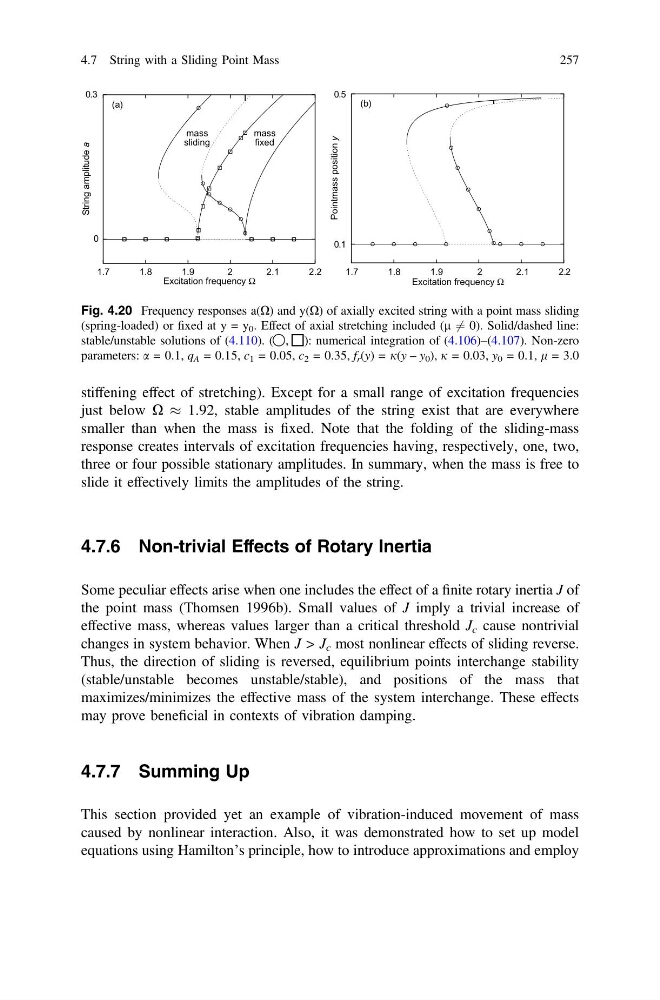
stiffening effect of stretching). Except for a small range of excitation frequencies
just below X % 1.92, stable amplitudes of the string exist that are everywhere
smaller than when the mass is fixed. Note that the folding of the sliding-mass
response creates intervals of excitation frequencies having, respectively, one, two,
three or four possible stationary amplitudes. In summary, when the mass is free to
slide it effectively limits the amplitudes of the string.
4.7.6 Non-trivial Effects of Rotary Inertia
Some peculiar effects arise when one includes the effect of a finite rotary inertia J of
the point mass (Thomsen 1996b). Small values of J imply a trivial increase of
effective mass, whereas values larger than a critical threshold J c cause nontrivial
changes in system behavior. When J > J c most nonlinear effects of sliding reverse.
Thus, the direction of sliding is reversed, equilibrium points interchange stability
(stable/unstable becomes unstable/stable), and positions of the mass that
maximizes/minimizes the effective mass of the system interchange. These effects
may prove beneficial in contexts of vibration damping.
4.7.7 Summing Up
This section provided yet an example of vibration-induced movement of mass
caused by nonlinear interaction. Also, it was demonstrated how to set up model
equations using Hamilton’s principle, how to introduce approximations and employ
0.1
0.5
1.7
1.8
1.9
2
2.1
2.2
Pointmass position
y
Excitation frequency Ω
(b)
0
0.3
1.7
1.8
1.9
2
2.1
2.2
String amplitude
a
Excitation frequency Ω
(a)
mass
sliding
mass
fixed
Fig. 4.20 Frequency responses a(X) and y(X) of axially excited string with a point mass sliding
(spring-loaded) or fixed at y = y 0 . Effect of axial stretching included (l 6 ¼ 0). Solid/dashed line:
stable/unstable solutions of (4.110). ( ⃝, ⃞): numerical integration of (4.106)–(4.107). Non-zero
parameters: a = 0.1, q A = 0.15, c 1 = 0.05, c 2 = 0.35, f r (y) = j(y – y 0 ), j = 0.03, y 0 = 0.1, l = 3.0
4.7 String with a Sliding Point Mass
257
just below X % 1.92, stable amplitudes of the string exist that are everywhere
smaller than when the mass is fixed. Note that the folding of the sliding-mass
response creates intervals of excitation frequencies having, respectively, one, two,
three or four possible stationary amplitudes. In summary, when the mass is free to
slide it effectively limits the amplitudes of the string.
4.7.6 Non-trivial Effects of Rotary Inertia
Some peculiar effects arise when one includes the effect of a finite rotary inertia J of
the point mass (Thomsen 1996b). Small values of J imply a trivial increase of
effective mass, whereas values larger than a critical threshold J c cause nontrivial
changes in system behavior. When J > J c most nonlinear effects of sliding reverse.
Thus, the direction of sliding is reversed, equilibrium points interchange stability
(stable/unstable becomes unstable/stable), and positions of the mass that
maximizes/minimizes the effective mass of the system interchange. These effects
may prove beneficial in contexts of vibration damping.
4.7.7 Summing Up
This section provided yet an example of vibration-induced movement of mass
caused by nonlinear interaction. Also, it was demonstrated how to set up model
equations using Hamilton’s principle, how to introduce approximations and employ
0.1
0.5
1.7
1.8
1.9
2
2.1
2.2
Pointmass position
y
Excitation frequency Ω
(b)
0
0.3
1.7
1.8
1.9
2
2.1
2.2
String amplitude
a
Excitation frequency Ω
(a)
mass
sliding
mass
fixed
Fig. 4.20 Frequency responses a(X) and y(X) of axially excited string with a point mass sliding
(spring-loaded) or fixed at y = y 0 . Effect of axial stretching included (l 6 ¼ 0). Solid/dashed line:
stable/unstable solutions of (4.110). ( ⃝, ⃞): numerical integration of (4.106)–(4.107). Non-zero
parameters: a = 0.1, q A = 0.15, c 1 = 0.05, c 2 = 0.35, f r (y) = j(y – y 0 ), j = 0.03, y 0 = 0.1, l = 3.0
4.7 String with a Sliding Point Mass
257