

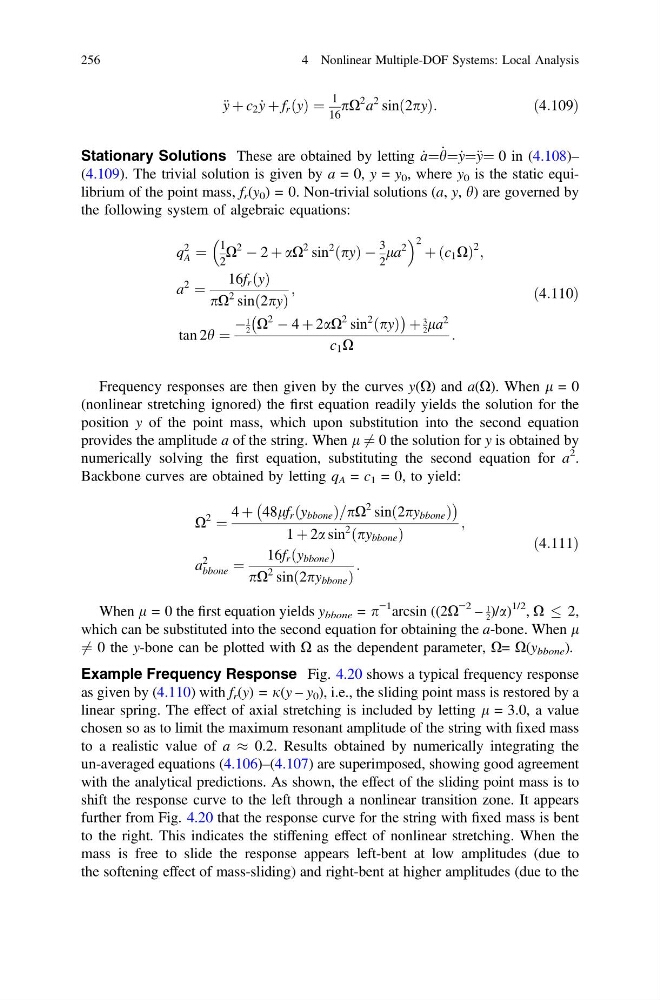
€ y þ c 2 _
y þ f r ðyÞ ¼
1
16
pX
2 a
2 sinð2pyÞ:
ð4:109Þ
Stationary Solutions These are obtained by letting _
a¼ _
h¼_ y¼€ y¼ 0 in (4.108)–
(4.109). The trivial solution is given by a = 0, y = y 0 , where y 0 is the static equilibrium of the point mass, f r (y 0 ) = 0. Non-trivial solutions (a, y, h) are governed by
the following system of algebraic equations:
q
2
A ¼
1
2
X
2
À 2 þ aX
2 sin
2
ðpyÞ À
3
2
la
2
2 þ ðc 1 XÞ
2 ;
a
2
¼
16f r ðyÞ
pX
2 sinð2pyÞ
;
tan 2h ¼
À
1
2 X
2
À 4 þ 2aX
2 sin
2
ðpyÞ
À
Á þ
3
2 la
2
c 1 X
:
ð4:110Þ
Frequency responses are then given by the curves y(X) and a(X). When l = 0
(nonlinear stretching ignored) the first equation readily yields the solution for the
position y of the point mass, which upon substitution into the second equation
provides the amplitude a of the string. When l 6 ¼ 0 the solution for y is obtained by
numerically solving the first equation, substituting the second equation for a
2 .
Backbone curves are obtained by letting q A = c 1 = 0, to yield:
X
2
¼
4 þ 48lf r ðy bbone Þ=pX
2 sinð2py bbone Þ
À
Á
1 þ 2a sin
2
ðpy bbone Þ
;
a
2
bbone ¼
16f r ðy bbone Þ
pX
2 sinð2py bbone Þ
:
ð4:111Þ
When l = 0 the first equation yields y bbone = p
−1 arcsin ((2X
−2
–
1
2 )/a)
1/2 , X
2,
which can be substituted into the second equation for obtaining the a-bone. When l
6 ¼ 0 the y-bone can be plotted with X as the dependent parameter, X= X(y bbone ).
Example Frequency Response Fig. 4.20 shows a typical frequency response
as given by (4.110) with f r (y) = j(y – y 0 ), i.e., the sliding point mass is restored by a
linear spring. The effect of axial stretching is included by letting l = 3.0, a value
chosen so as to limit the maximum resonant amplitude of the string with fixed mass
to a realistic value of a % 0.2. Results obtained by numerically integrating the
un-averaged equations (4.106)–(4.107) are superimposed, showing good agreement
with the analytical predictions. As shown, the effect of the sliding point mass is to
shift the response curve to the left through a nonlinear transition zone. It appears
further from Fig. 4.20 that the response curve for the string with fixed mass is bent
to the right. This indicates the stiffening effect of nonlinear stretching. When the
mass is free to slide the response appears left-bent at low amplitudes (due to
the softening effect of mass-sliding) and right-bent at higher amplitudes (due to the
256
4 Nonlinear Multiple-DOF Systems: Local Analysis
y þ f r ðyÞ ¼
1
16
pX
2 a
2 sinð2pyÞ:
ð4:109Þ
Stationary Solutions These are obtained by letting _
a¼ _
h¼_ y¼€ y¼ 0 in (4.108)–
(4.109). The trivial solution is given by a = 0, y = y 0 , where y 0 is the static equilibrium of the point mass, f r (y 0 ) = 0. Non-trivial solutions (a, y, h) are governed by
the following system of algebraic equations:
q
2
A ¼
1
2
X
2
À 2 þ aX
2 sin
2
ðpyÞ À
3
2
la
2
2 þ ðc 1 XÞ
2 ;
a
2
¼
16f r ðyÞ
pX
2 sinð2pyÞ
;
tan 2h ¼
À
1
2 X
2
À 4 þ 2aX
2 sin
2
ðpyÞ
À
Á þ
3
2 la
2
c 1 X
:
ð4:110Þ
Frequency responses are then given by the curves y(X) and a(X). When l = 0
(nonlinear stretching ignored) the first equation readily yields the solution for the
position y of the point mass, which upon substitution into the second equation
provides the amplitude a of the string. When l 6 ¼ 0 the solution for y is obtained by
numerically solving the first equation, substituting the second equation for a
2 .
Backbone curves are obtained by letting q A = c 1 = 0, to yield:
X
2
¼
4 þ 48lf r ðy bbone Þ=pX
2 sinð2py bbone Þ
À
Á
1 þ 2a sin
2
ðpy bbone Þ
;
a
2
bbone ¼
16f r ðy bbone Þ
pX
2 sinð2py bbone Þ
:
ð4:111Þ
When l = 0 the first equation yields y bbone = p
−1 arcsin ((2X
−2
–
1
2 )/a)
1/2 , X
2,
which can be substituted into the second equation for obtaining the a-bone. When l
6 ¼ 0 the y-bone can be plotted with X as the dependent parameter, X= X(y bbone ).
Example Frequency Response Fig. 4.20 shows a typical frequency response
as given by (4.110) with f r (y) = j(y – y 0 ), i.e., the sliding point mass is restored by a
linear spring. The effect of axial stretching is included by letting l = 3.0, a value
chosen so as to limit the maximum resonant amplitude of the string with fixed mass
to a realistic value of a % 0.2. Results obtained by numerically integrating the
un-averaged equations (4.106)–(4.107) are superimposed, showing good agreement
with the analytical predictions. As shown, the effect of the sliding point mass is to
shift the response curve to the left through a nonlinear transition zone. It appears
further from Fig. 4.20 that the response curve for the string with fixed mass is bent
to the right. This indicates the stiffening effect of nonlinear stretching. When the
mass is free to slide the response appears left-bent at low amplitudes (due to
the softening effect of mass-sliding) and right-bent at higher amplitudes (due to the
256
4 Nonlinear Multiple-DOF Systems: Local Analysis