

the second and third equation to yield the string amplitude a and corresponding
phase h. Frequency-responses are given by the curves y(X) and a(X) so obtained.
The stability of solutions is determined by evaluating eigenvalues of the Jacobian of
the system (4.99)–(4.100), written as a system of four first-order equations.
A solution of (4.102) having one or more Jacobian eigenvalues with positive real
part is unstable.
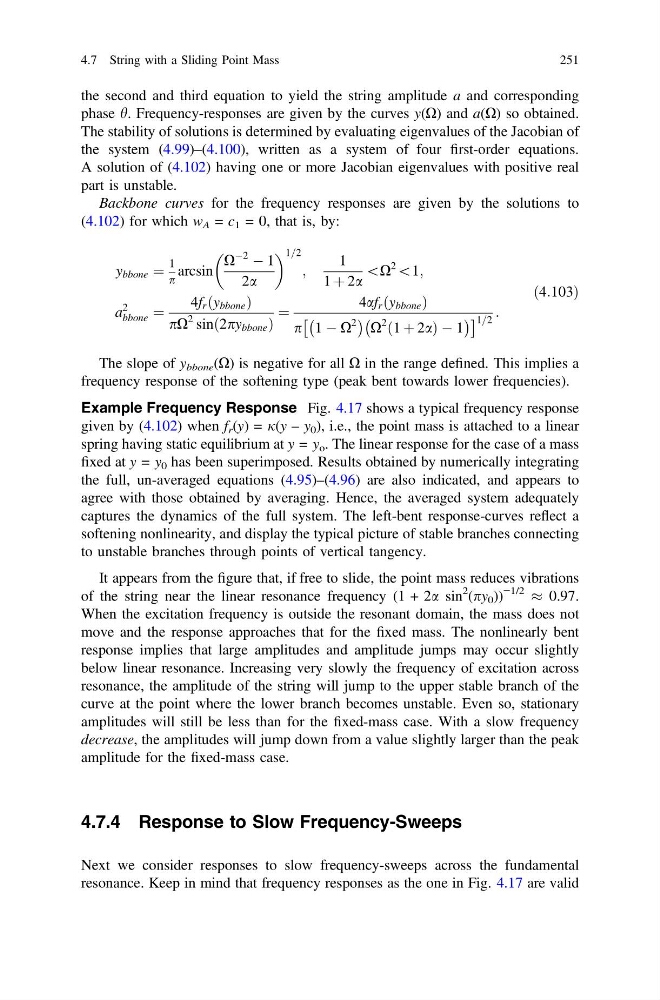
Backbone curves for the frequency responses are given by the solutions to
(4.102) for which w A = c 1 = 0, that is, by:
y bbone ¼
1
p
arcsin
X
À2
À 1
2a
1=2
;
1
1 þ 2a
\X
2
\1;
a
2
bbone ¼
4f r ðy bbone Þ
pX
2 sinð2py bbone Þ
¼
4af r ðy bbone Þ
p 1 À X
2
À
Á X
2 1 þ 2a
ð
ÞÀ1
À
Á
Â
à 1=2 :
ð4:103Þ
The slope of y bbone (X) is negative for all X in the range defined. This implies a
frequency response of the softening type (peak bent towards lower frequencies).
Example Frequency Response Fig. 4.17 shows a typical frequency response
given by (4.102) when f r (y) = j(y – y 0 ), i.e., the point mass is attached to a linear
spring having static equilibrium at y = y o . The linear response for the case of a mass
fixed at y = y 0 has been superimposed. Results obtained by numerically integrating
the full, un-averaged equations (4.95)–(4.96) are also indicated, and appears to
agree with those obtained by averaging. Hence, the averaged system adequately
captures the dynamics of the full system. The left-bent response-curves reflect a
softening nonlinearity, and display the typical picture of stable branches connecting
to unstable branches through points of vertical tangency.
It appears from the figure that, if free to slide, the point mass reduces vibrations
of the string near the linear resonance frequency (1 + 2a sin
2 (py 0 ))
−1/2
% 0.97.
When the excitation frequency is outside the resonant domain, the mass does not
move and the response approaches that for the fixed mass. The nonlinearly bent
response implies that large amplitudes and amplitude jumps may occur slightly
below linear resonance. Increasing very slowly the frequency of excitation across
resonance, the amplitude of the string will jump to the upper stable branch of the
curve at the point where the lower branch becomes unstable. Even so, stationary
amplitudes will still be less than for the fixed-mass case. With a slow frequency
decrease, the amplitudes will jump down from a value slightly larger than the peak
amplitude for the fixed-mass case.
4.7.4 Response to Slow Frequency-Sweeps
Next we consider responses to slow frequency-sweeps across the fundamental
resonance. Keep in mind that frequency responses as the one in Fig. 4.17 are valid
4.7 String with a Sliding Point Mass
251
phase h. Frequency-responses are given by the curves y(X) and a(X) so obtained.
The stability of solutions is determined by evaluating eigenvalues of the Jacobian of
the system (4.99)–(4.100), written as a system of four first-order equations.
A solution of (4.102) having one or more Jacobian eigenvalues with positive real
part is unstable.
Backbone curves for the frequency responses are given by the solutions to
(4.102) for which w A = c 1 = 0, that is, by:
y bbone ¼
1
p
arcsin
X
À2
À 1
2a
1=2
;
1
1 þ 2a
\X
2
\1;
a
2
bbone ¼
4f r ðy bbone Þ
pX
2 sinð2py bbone Þ
¼
4af r ðy bbone Þ
p 1 À X
2
À
Á X
2 1 þ 2a
ð
ÞÀ1
À
Á
Â
à 1=2 :
ð4:103Þ
The slope of y bbone (X) is negative for all X in the range defined. This implies a
frequency response of the softening type (peak bent towards lower frequencies).
Example Frequency Response Fig. 4.17 shows a typical frequency response
given by (4.102) when f r (y) = j(y – y 0 ), i.e., the point mass is attached to a linear
spring having static equilibrium at y = y o . The linear response for the case of a mass
fixed at y = y 0 has been superimposed. Results obtained by numerically integrating
the full, un-averaged equations (4.95)–(4.96) are also indicated, and appears to
agree with those obtained by averaging. Hence, the averaged system adequately
captures the dynamics of the full system. The left-bent response-curves reflect a
softening nonlinearity, and display the typical picture of stable branches connecting
to unstable branches through points of vertical tangency.
It appears from the figure that, if free to slide, the point mass reduces vibrations
of the string near the linear resonance frequency (1 + 2a sin
2 (py 0 ))
−1/2
% 0.97.
When the excitation frequency is outside the resonant domain, the mass does not
move and the response approaches that for the fixed mass. The nonlinearly bent
response implies that large amplitudes and amplitude jumps may occur slightly
below linear resonance. Increasing very slowly the frequency of excitation across
resonance, the amplitude of the string will jump to the upper stable branch of the
curve at the point where the lower branch becomes unstable. Even so, stationary
amplitudes will still be less than for the fixed-mass case. With a slow frequency
decrease, the amplitudes will jump down from a value slightly larger than the peak
amplitude for the fixed-mass case.
4.7.4 Response to Slow Frequency-Sweeps
Next we consider responses to slow frequency-sweeps across the fundamental
resonance. Keep in mind that frequency responses as the one in Fig. 4.17 are valid
4.7 String with a Sliding Point Mass
251