

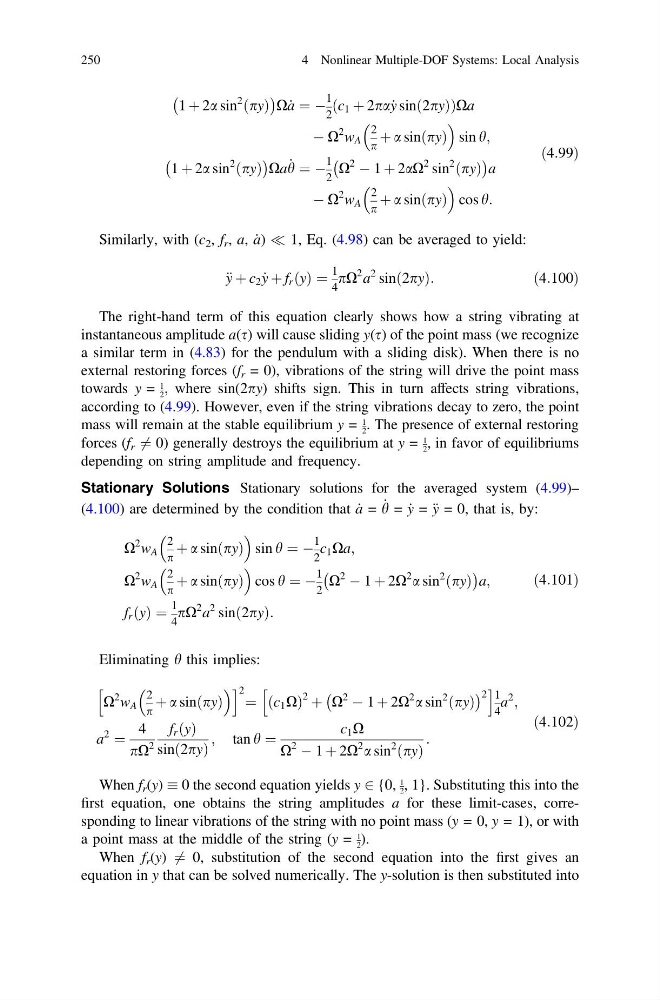
1 þ 2a sin
2
ðpyÞ
À
Á X _
a ¼ À
1
2
c 1 þ 2pa_ y sinð2pyÞ
ð
Þ Xa
À X
2 w A
2
p
þ a sinðpyÞ
sin h;
1 þ 2a sin
2
ðpyÞ
À
Á Xa _
h ¼ À
1
2
X
2
À 1 þ 2aX
2 sin
2
ðpyÞ
À
Á
a
À X
2 w A
2
p
þ a sinðpyÞ
cos h:
ð4:99Þ
Similarly, with (c 2 , f r , a, _
a) ( 1, Eq. (4.98) can be averaged to yield:
€ y þ c 2 _
y þ f r ðyÞ ¼
1
4
pX
2 a
2 sinð2pyÞ:
ð4:100Þ
The right-hand term of this equation clearly shows how a string vibrating at
instantaneous amplitude a(s) will cause sliding y(s) of the point mass (we recognize
a similar term in (4.83) for the pendulum with a sliding disk). When there is no
external restoring forces (f r = 0), vibrations of the string will drive the point mass
towards y =
1
2 ; where sin(2py) shifts sign. This in turn affects string vibrations,
according to (4.99). However, even if the string vibrations decay to zero, the point
mass will remain at the stable equilibrium y =
1
2 . The presence of external restoring
forces (f r 6 ¼ 0) generally destroys the equilibrium at y =
1
2 , in favor of equilibriums
depending on string amplitude and frequency.
Stationary Solutions Stationary solutions for the averaged system (4.99)–
(4.100) are determined by the condition that _
a = _
h = _
y = € y = 0, that is, by:
X
2 w A
2
p
þ a sinðpyÞ
sin h ¼ À
1
2
c 1 Xa;
X
2 w A
2
p
þ a sinðpyÞ
cos h ¼ À
1
2
X
2
À 1 þ 2X
2 a sin
2
ðpyÞ
À
Á
a;
f r ðyÞ ¼
1
4
pX
2 a
2 sinð2pyÞ:
ð4:101Þ
Eliminating h this implies:
X
2 w A
2
p
þ a sinðpyÞ
h
i 2 ¼ c 1 X
ð
Þ
2 þ X
2
À 1 þ 2X
2 a sin
2
ðpyÞ
À
Á 2
h
i
1
4
a
2
;
a
2
¼
4
pX
2
f r ðyÞ
sinð2pyÞ
; tan h ¼
c 1 X
X
2
À 1 þ 2X
2 a sin
2
ðpyÞ
:
ð4:102Þ
When f r (y) 0 the second equation yields y 2 {0,
1
2 , 1}. Substituting this into the
first equation, one obtains the string amplitudes a for these limit-cases, corresponding to linear vibrations of the string with no point mass (y = 0, y = 1), or with
a point mass at the middle of the string (y =
1
2 ).
When f r (y) 6 ¼ 0, substitution of the second equation into the first gives an
equation in y that can be solved numerically. The y-solution is then substituted into
250
4 Nonlinear Multiple-DOF Systems: Local Analysis
2
ðpyÞ
À
Á X _
a ¼ À
1
2
c 1 þ 2pa_ y sinð2pyÞ
ð
Þ Xa
À X
2 w A
2
p
þ a sinðpyÞ
sin h;
1 þ 2a sin
2
ðpyÞ
À
Á Xa _
h ¼ À
1
2
X
2
À 1 þ 2aX
2 sin
2
ðpyÞ
À
Á
a
À X
2 w A
2
p
þ a sinðpyÞ
cos h:
ð4:99Þ
Similarly, with (c 2 , f r , a, _
a) ( 1, Eq. (4.98) can be averaged to yield:
€ y þ c 2 _
y þ f r ðyÞ ¼
1
4
pX
2 a
2 sinð2pyÞ:
ð4:100Þ
The right-hand term of this equation clearly shows how a string vibrating at
instantaneous amplitude a(s) will cause sliding y(s) of the point mass (we recognize
a similar term in (4.83) for the pendulum with a sliding disk). When there is no
external restoring forces (f r = 0), vibrations of the string will drive the point mass
towards y =
1
2 ; where sin(2py) shifts sign. This in turn affects string vibrations,
according to (4.99). However, even if the string vibrations decay to zero, the point
mass will remain at the stable equilibrium y =
1
2 . The presence of external restoring
forces (f r 6 ¼ 0) generally destroys the equilibrium at y =
1
2 , in favor of equilibriums
depending on string amplitude and frequency.
Stationary Solutions Stationary solutions for the averaged system (4.99)–
(4.100) are determined by the condition that _
a = _
h = _
y = € y = 0, that is, by:
X
2 w A
2
p
þ a sinðpyÞ
sin h ¼ À
1
2
c 1 Xa;
X
2 w A
2
p
þ a sinðpyÞ
cos h ¼ À
1
2
X
2
À 1 þ 2X
2 a sin
2
ðpyÞ
À
Á
a;
f r ðyÞ ¼
1
4
pX
2 a
2 sinð2pyÞ:
ð4:101Þ
Eliminating h this implies:
X
2 w A
2
p
þ a sinðpyÞ
h
i 2 ¼ c 1 X
ð
Þ
2 þ X
2
À 1 þ 2X
2 a sin
2
ðpyÞ
À
Á 2
h
i
1
4
a
2
;
a
2
¼
4
pX
2
f r ðyÞ
sinð2pyÞ
; tan h ¼
c 1 X
X
2
À 1 þ 2X
2 a sin
2
ðpyÞ
:
ð4:102Þ
When f r (y) 0 the second equation yields y 2 {0,
1
2 , 1}. Substituting this into the
first equation, one obtains the string amplitudes a for these limit-cases, corresponding to linear vibrations of the string with no point mass (y = 0, y = 1), or with
a point mass at the middle of the string (y =
1
2 ).
When f r (y) 6 ¼ 0, substitution of the second equation into the first gives an
equation in y that can be solved numerically. The y-solution is then substituted into
250
4 Nonlinear Multiple-DOF Systems: Local Analysis