

significant nonlinear effects to show up. We assume the point mass to be small, a (
1, and employ averaging for obtaining first-order approximations to the response.
With a base excitation near-resonant to the fundamental mode, Eq. (4.94) apply
with q(s) = 0 and w 0 (s) = w A sin(Xs). Here w A is the constant amplitude of excitation, and X % 1 is the constant frequency of excitation which is near to the natural
frequency of the string with no point mass. The effect of nonlinear stretching is
easily included, though to keep the analysis simple it is neglected in this section
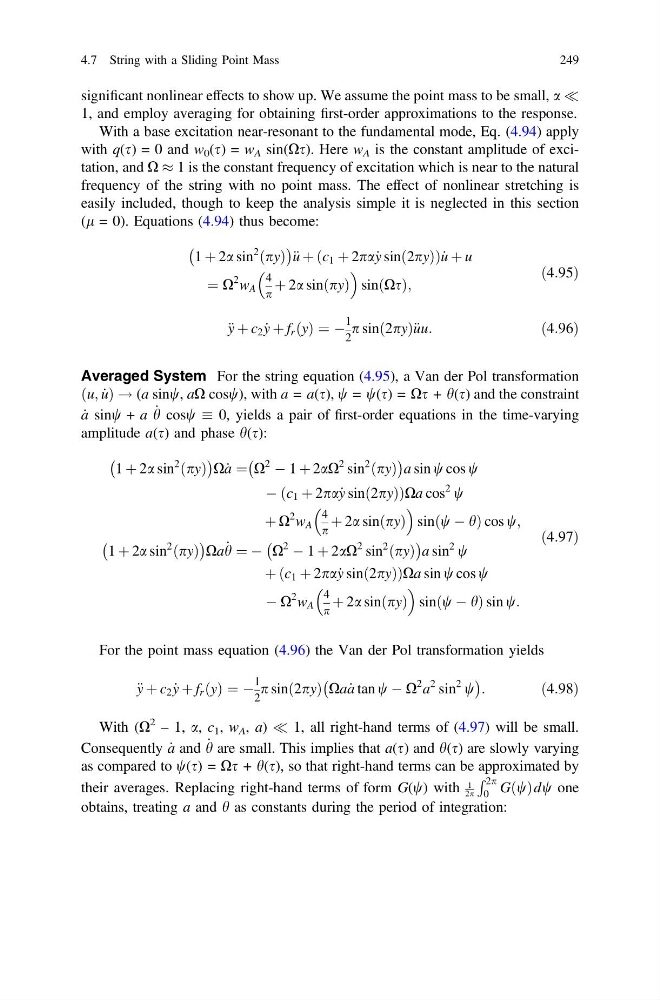
(l = 0). Equations (4.94) thus become:
1 þ 2a sin
2
ðpyÞ
À
Á € u þ c 1 þ 2pa_ y sinð2pyÞ
ð
Þ _
u þ u
¼ X
2 w A
4
p
þ 2a sinðpyÞ
sinðXsÞ;
ð4:95Þ
€ y þ c 2 _
y þ f r ðyÞ ¼ À
1
2
p sinð2pyÞ€ uu:
ð4:96Þ
Averaged System For the string equation (4.95), a Van der Pol transformation
ðu; _
uÞ ! (a sinw, aX cosw), with a = a(s), w = w(s) = Xs + h(s) and the constraint
_
a sinw + a _
h cosw 0, yields a pair of first-order equations in the time-varying
amplitude a(s) and phase h(s):
1 þ 2a sin
2
ðpyÞ
À
Á
X _
a ¼ X
2
À 1 þ 2aX
2 sin
2
ðpyÞ
À
Á
a sin w cos w
À c 1 þ 2pa_ y sinð2pyÞ
ð
Þ Xa cos
2 w
þ X
2 w A
4
p
þ 2a sinðpyÞ
sinðw À hÞ cos w;
1 þ 2a sin
2
ðpyÞ
À
Á Xa _
h ¼ À X
2
À 1 þ 2aX
2 sin
2
ðpyÞ
À
Á
a sin
2 w
þ c 1 þ 2pa_ y sinð2pyÞ
ð
Þ Xa sin w cos w
À X
2 w A
4
p
þ 2a sinðpyÞ
sinðw À hÞ sin w:
ð4:97Þ
For the point mass equation (4.96) the Van der Pol transformation yields
€ y þ c 2 _
y þ f r ðyÞ ¼ À
1
2
p sinð2pyÞ Xa _
a tan w À X
2 a
2 sin
2 w
À
Á :
ð4:98Þ
With (X
2
– 1, a, c 1 , w A , a) ( 1, all right-hand terms of (4.97) will be small.
Consequently _
a and _
h are small. This implies that a(s) and h(s) are slowly varying
as compared to w(s) = Xs + h(s), so that right-hand terms can be approximated by
their averages. Replacing right-hand terms of form G(w) with
1
2p
R 2p
0 GðwÞdw one
obtains, treating a and h as constants during the period of integration:
4.7 String with a Sliding Point Mass
249
1, and employ averaging for obtaining first-order approximations to the response.
With a base excitation near-resonant to the fundamental mode, Eq. (4.94) apply
with q(s) = 0 and w 0 (s) = w A sin(Xs). Here w A is the constant amplitude of excitation, and X % 1 is the constant frequency of excitation which is near to the natural
frequency of the string with no point mass. The effect of nonlinear stretching is
easily included, though to keep the analysis simple it is neglected in this section
(l = 0). Equations (4.94) thus become:
1 þ 2a sin
2
ðpyÞ
À
Á € u þ c 1 þ 2pa_ y sinð2pyÞ
ð
Þ _
u þ u
¼ X
2 w A
4
p
þ 2a sinðpyÞ
sinðXsÞ;
ð4:95Þ
€ y þ c 2 _
y þ f r ðyÞ ¼ À
1
2
p sinð2pyÞ€ uu:
ð4:96Þ
Averaged System For the string equation (4.95), a Van der Pol transformation
ðu; _
uÞ ! (a sinw, aX cosw), with a = a(s), w = w(s) = Xs + h(s) and the constraint
_
a sinw + a _
h cosw 0, yields a pair of first-order equations in the time-varying
amplitude a(s) and phase h(s):
1 þ 2a sin
2
ðpyÞ
À
Á
X _
a ¼ X
2
À 1 þ 2aX
2 sin
2
ðpyÞ
À
Á
a sin w cos w
À c 1 þ 2pa_ y sinð2pyÞ
ð
Þ Xa cos
2 w
þ X
2 w A
4
p
þ 2a sinðpyÞ
sinðw À hÞ cos w;
1 þ 2a sin
2
ðpyÞ
À
Á Xa _
h ¼ À X
2
À 1 þ 2aX
2 sin
2
ðpyÞ
À
Á
a sin
2 w
þ c 1 þ 2pa_ y sinð2pyÞ
ð
Þ Xa sin w cos w
À X
2 w A
4
p
þ 2a sinðpyÞ
sinðw À hÞ sin w:
ð4:97Þ
For the point mass equation (4.96) the Van der Pol transformation yields
€ y þ c 2 _
y þ f r ðyÞ ¼ À
1
2
p sinð2pyÞ Xa _
a tan w À X
2 a
2 sin
2 w
À
Á :
ð4:98Þ
With (X
2
– 1, a, c 1 , w A , a) ( 1, all right-hand terms of (4.97) will be small.
Consequently _
a and _
h are small. This implies that a(s) and h(s) are slowly varying
as compared to w(s) = Xs + h(s), so that right-hand terms can be approximated by
their averages. Replacing right-hand terms of form G(w) with
1
2p
R 2p
0 GðwÞdw one
obtains, treating a and h as constants during the period of integration:
4.7 String with a Sliding Point Mass
249