

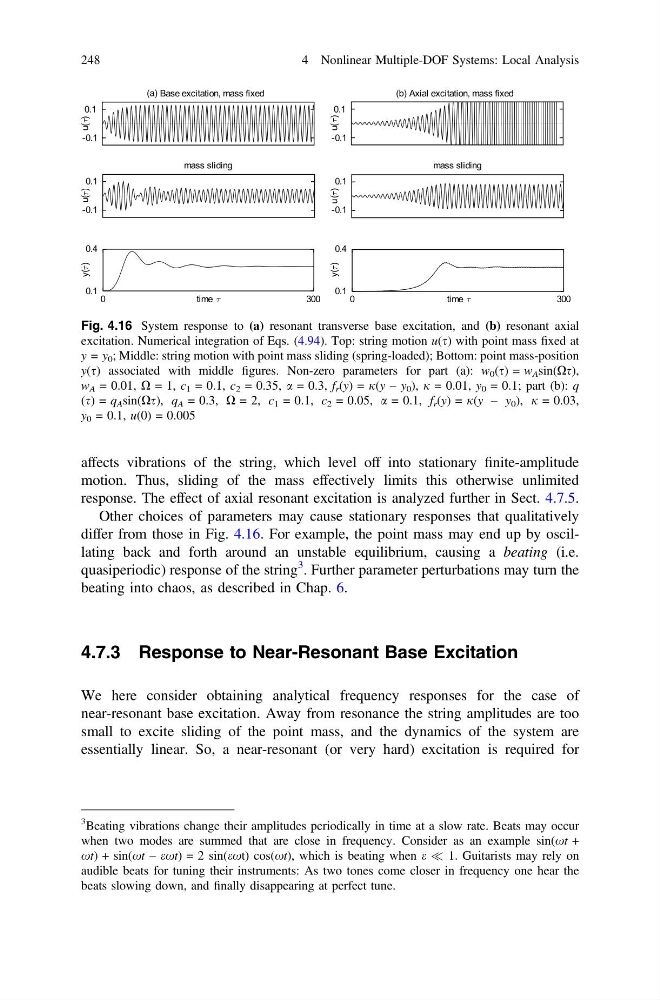
affects vibrations of the string, which level off into stationary finite-amplitude
motion. Thus, sliding of the mass effectively limits this otherwise unlimited
response. The effect of axial resonant excitation is analyzed further in Sect. 4.7.5.
Other choices of parameters may cause stationary responses that qualitatively
differ from those in Fig. 4.16. For example, the point mass may end up by oscillating back and forth around an unstable equilibrium, causing a beating (i.e.
quasiperiodic) response of the string
3 . Further parameter perturbations may turn the
beating into chaos, as described in Chap. 6.
4.7.3 Response to Near-Resonant Base Excitation
We here consider obtaining analytical frequency responses for the case of
near-resonant base excitation. Away from resonance the string amplitudes are too
small to excite sliding of the point mass, and the dynamics of the system are
essentially linear. So, a near-resonant (or very hard) excitation is required for
Fig. 4.16 System response to (a) resonant transverse base excitation, and (b) resonant axial
excitation. Numerical integration of Eqs. (4.94). Top: string motion u(s) with point mass fixed at
y = y 0 ; Middle: string motion with point mass sliding (spring-loaded); Bottom: point mass-position
y(s) associated with middle figures. Non-zero parameters for part (a): w 0 (s) = w A sin(Xs),
w A = 0.01, X = 1, c 1 = 0.1, c 2 = 0.35, a = 0.3, f r (y) = j(y – y 0 ), j = 0.01, y 0 = 0.1; part (b): q
(s) = q A sin(Xs), q A = 0.3, X = 2, c 1 = 0.1, c 2 = 0.05, a = 0.1, f r (y) = j(y – y 0 ), j = 0.03,
y 0 = 0.1, u(0) = 0.005
3
Beating vibrations change their amplitudes periodically in time at a slow rate. Beats may occur
when two modes are summed that are close in frequency. Consider as an example sin(xt +
xt) + sin(xt – ext) = 2 sin(ext) cos(xt), which is beating when e ( 1. Guitarists may rely on
audible beats for tuning their instruments: As two tones come closer in frequency one hear the
beats slowing down, and finally disappearing at perfect tune.
248
4 Nonlinear Multiple-DOF Systems: Local Analysis
motion. Thus, sliding of the mass effectively limits this otherwise unlimited
response. The effect of axial resonant excitation is analyzed further in Sect. 4.7.5.
Other choices of parameters may cause stationary responses that qualitatively
differ from those in Fig. 4.16. For example, the point mass may end up by oscillating back and forth around an unstable equilibrium, causing a beating (i.e.
quasiperiodic) response of the string
3 . Further parameter perturbations may turn the
beating into chaos, as described in Chap. 6.
4.7.3 Response to Near-Resonant Base Excitation
We here consider obtaining analytical frequency responses for the case of
near-resonant base excitation. Away from resonance the string amplitudes are too
small to excite sliding of the point mass, and the dynamics of the system are
essentially linear. So, a near-resonant (or very hard) excitation is required for
Fig. 4.16 System response to (a) resonant transverse base excitation, and (b) resonant axial
excitation. Numerical integration of Eqs. (4.94). Top: string motion u(s) with point mass fixed at
y = y 0 ; Middle: string motion with point mass sliding (spring-loaded); Bottom: point mass-position
y(s) associated with middle figures. Non-zero parameters for part (a): w 0 (s) = w A sin(Xs),
w A = 0.01, X = 1, c 1 = 0.1, c 2 = 0.35, a = 0.3, f r (y) = j(y – y 0 ), j = 0.01, y 0 = 0.1; part (b): q
(s) = q A sin(Xs), q A = 0.3, X = 2, c 1 = 0.1, c 2 = 0.05, a = 0.1, f r (y) = j(y – y 0 ), j = 0.03,
y 0 = 0.1, u(0) = 0.005
3
Beating vibrations change their amplitudes periodically in time at a slow rate. Beats may occur
when two modes are summed that are close in frequency. Consider as an example sin(xt +
xt) + sin(xt – ext) = 2 sin(ext) cos(xt), which is beating when e ( 1. Guitarists may rely on
audible beats for tuning their instruments: As two tones come closer in frequency one hear the
beats slowing down, and finally disappearing at perfect tune.
248
4 Nonlinear Multiple-DOF Systems: Local Analysis