

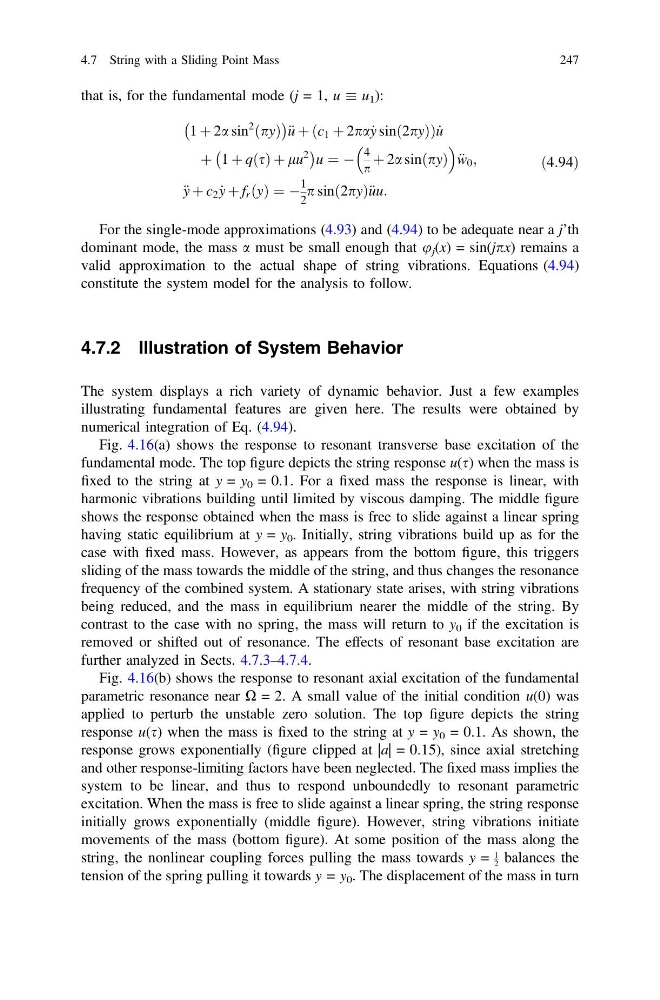
that is, for the fundamental mode (j = 1, u u 1 ):
1 þ 2a sin
2
ðpyÞ
À
Á € u þ c 1 þ 2pa_ y sinð2pyÞ
ð
Þ _
u
þ 1 þ qðsÞ þ lu
2
À
Á
u ¼ À
4
p
þ 2a sinðpyÞ
€
w 0 ;
€ y þ c 2 _
y þ f r ðyÞ ¼ À
1
2
p sinð2pyÞ€ uu:
ð4:94Þ
For the single-mode approximations (4.93) and (4.94) to be adequate near a j’th
dominant mode, the mass a must be small enough that u j (x) = sin(jpx) remains a
valid approximation to the actual shape of string vibrations. Equations (4.94)
constitute the system model for the analysis to follow.
4.7.2 Illustration of System Behavior
The system displays a rich variety of dynamic behavior. Just a few examples
illustrating fundamental features are given here. The results were obtained by
numerical integration of Eq. (4.94).
Fig. 4.16(a) shows the response to resonant transverse base excitation of the
fundamental mode. The top figure depicts the string response u(s) when the mass is
fixed to the string at y = y 0 = 0.1. For a fixed mass the response is linear, with
harmonic vibrations building until limited by viscous damping. The middle figure
shows the response obtained when the mass is free to slide against a linear spring
having static equilibrium at y = y 0 . Initially, string vibrations build up as for the
case with fixed mass. However, as appears from the bottom figure, this triggers
sliding of the mass towards the middle of the string, and thus changes the resonance
frequency of the combined system. A stationary state arises, with string vibrations
being reduced, and the mass in equilibrium nearer the middle of the string. By
contrast to the case with no spring, the mass will return to y 0 if the excitation is
removed or shifted out of resonance. The effects of resonant base excitation are
further analyzed in Sects. 4.7.3–4.7.4.
Fig. 4.16(b) shows the response to resonant axial excitation of the fundamental
parametric resonance near X = 2. A small value of the initial condition u(0) was
applied to perturb the unstable zero solution. The top figure depicts the string
response u(s) when the mass is fixed to the string at y = y 0 = 0.1. As shown, the
response grows exponentially (figure clipped at |a| = 0.15), since axial stretching
and other response-limiting factors have been neglected. The fixed mass implies the
system to be linear, and thus to respond unboundedly to resonant parametric
excitation. When the mass is free to slide against a linear spring, the string response
initially grows exponentially (middle figure). However, string vibrations initiate
movements of the mass (bottom figure). At some position of the mass along the
string, the nonlinear coupling forces pulling the mass towards y =
1
2 balances the
tension of the spring pulling it towards y = y 0 . The displacement of the mass in turn
4.7 String with a Sliding Point Mass
247
1 þ 2a sin
2
ðpyÞ
À
Á € u þ c 1 þ 2pa_ y sinð2pyÞ
ð
Þ _
u
þ 1 þ qðsÞ þ lu
2
À
Á
u ¼ À
4
p
þ 2a sinðpyÞ
€
w 0 ;
€ y þ c 2 _
y þ f r ðyÞ ¼ À
1
2
p sinð2pyÞ€ uu:
ð4:94Þ
For the single-mode approximations (4.93) and (4.94) to be adequate near a j’th
dominant mode, the mass a must be small enough that u j (x) = sin(jpx) remains a
valid approximation to the actual shape of string vibrations. Equations (4.94)
constitute the system model for the analysis to follow.
4.7.2 Illustration of System Behavior
The system displays a rich variety of dynamic behavior. Just a few examples
illustrating fundamental features are given here. The results were obtained by
numerical integration of Eq. (4.94).
Fig. 4.16(a) shows the response to resonant transverse base excitation of the
fundamental mode. The top figure depicts the string response u(s) when the mass is
fixed to the string at y = y 0 = 0.1. For a fixed mass the response is linear, with
harmonic vibrations building until limited by viscous damping. The middle figure
shows the response obtained when the mass is free to slide against a linear spring
having static equilibrium at y = y 0 . Initially, string vibrations build up as for the
case with fixed mass. However, as appears from the bottom figure, this triggers
sliding of the mass towards the middle of the string, and thus changes the resonance
frequency of the combined system. A stationary state arises, with string vibrations
being reduced, and the mass in equilibrium nearer the middle of the string. By
contrast to the case with no spring, the mass will return to y 0 if the excitation is
removed or shifted out of resonance. The effects of resonant base excitation are
further analyzed in Sects. 4.7.3–4.7.4.
Fig. 4.16(b) shows the response to resonant axial excitation of the fundamental
parametric resonance near X = 2. A small value of the initial condition u(0) was
applied to perturb the unstable zero solution. The top figure depicts the string
response u(s) when the mass is fixed to the string at y = y 0 = 0.1. As shown, the
response grows exponentially (figure clipped at |a| = 0.15), since axial stretching
and other response-limiting factors have been neglected. The fixed mass implies the
system to be linear, and thus to respond unboundedly to resonant parametric
excitation. When the mass is free to slide against a linear spring, the string response
initially grows exponentially (middle figure). However, string vibrations initiate
movements of the mass (bottom figure). At some position of the mass along the
string, the nonlinear coupling forces pulling the mass towards y =
1
2 balances the
tension of the spring pulling it towards y = y 0 . The displacement of the mass in turn
4.7 String with a Sliding Point Mass
247