

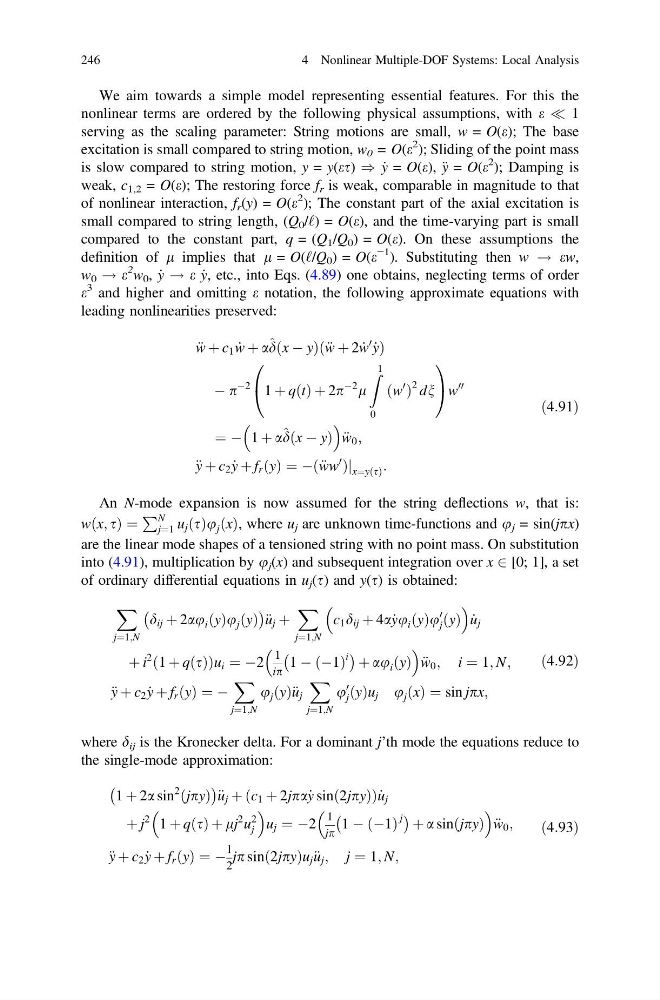
We aim towards a simple model representing essential features. For this the
nonlinear terms are ordered by the following physical assumptions, with e ( 1
serving as the scaling parameter: String motions are small, w = O(e); The base
excitation is small compared to string motion, w 0 = O(e
2 ); Sliding of the point mass
is slow compared to string motion, y = y(es) ) _
y = O(e), € y = O(e
2 ); Damping is
weak, c 1,2 = O(e); The restoring force f r is weak, comparable in magnitude to that
of nonlinear interaction, f r (y) = O(e
2 ); The constant part of the axial excitation is
small compared to string length, (Q 0 /‘) = O(e), and the time-varying part is small
compared to the constant part, q = (Q 1 /Q 0 ) = O(e). On these assumptions the
definition of l implies that l = O(‘/Q 0 ) = O(e
−1 ). Substituting then w ! ew,
w 0 ! e
2 w 0 , _
y ! e _
y, etc., into Eqs. (4.89) one obtains, neglecting terms of order
e
3 and higher and omitting e notation, the following approximate equations with
leading nonlinearities preserved:
€
w þ c 1 _
w þ a ^ dðx À yÞ €
w þ 2 _
w
0
_
y
ð
Þ
À p
À2 1 þ qðtÞ þ 2p
À2 l
Z 1
0
ðw
0
Þ
2 dn
0
@
1
A w
00
¼ À 1 þ a ^ dðx À yÞ
€
w 0 ;
€ y þ c 2 _
y þ f r ðyÞ ¼ À €
ww
0
ð
Þj x¼yðsÞ :
ð4:91Þ
An N-mode expansion is now assumed for the string deflections w, that is:
wðx; sÞ ¼
P N
j¼1 u j ðsÞu j ðxÞ, where u j are unknown time-functions and u j = sin(jpx)
are the linear mode shapes of a tensioned string with no point mass. On substitution
into (4.91), multiplication by u j (x) and subsequent integration over x 2 [0; 1], a set
of ordinary differential equations in u j (s) and y(s) is obtained:
X
j¼1;N
d ij þ 2au i ðyÞu j ðyÞ
À
Á
€ u j þ
X
j¼1;N
c 1 d ij þ 4a_ yu i ðyÞu
0
j ðyÞ
_
u j
þ i
2 1 þ qðsÞ
ð
Þ u i ¼ À2
1
ip
1 À ðÀ1Þ
i
À
Á þ au i ðyÞ
€
w 0 ; i ¼ 1; N;
€ y þ c 2 _
y þ f r ðyÞ ¼ À
X
j¼1;N
u j ðyÞ€ u j
X
j¼1;N
u
0
j ðyÞu j u j ðxÞ ¼ sin jpx;
ð4:92Þ
where d ij is the Kronecker delta. For a dominant j’th mode the equations reduce to
the single-mode approximation:
1 þ 2a sin
2
ðjpyÞ
À
Á € u j þ c 1 þ 2jpa_ y sinð2jpyÞ
ð
Þ _
u j
þ j
2 1 þ qðsÞ þ lj
2 u
2
j
u j ¼ À2
1
jp
1 À ðÀ1Þ
j
À
Á þ a sinðjpyÞ
€
w 0 ;
€ y þ c 2 _
y þ f r ðyÞ ¼ À
1
2
jp sinð2jpyÞu j € u j ; j ¼ 1; N;
ð4:93Þ
246
4 Nonlinear Multiple-DOF Systems: Local Analysis
nonlinear terms are ordered by the following physical assumptions, with e ( 1
serving as the scaling parameter: String motions are small, w = O(e); The base
excitation is small compared to string motion, w 0 = O(e
2 ); Sliding of the point mass
is slow compared to string motion, y = y(es) ) _
y = O(e), € y = O(e
2 ); Damping is
weak, c 1,2 = O(e); The restoring force f r is weak, comparable in magnitude to that
of nonlinear interaction, f r (y) = O(e
2 ); The constant part of the axial excitation is
small compared to string length, (Q 0 /‘) = O(e), and the time-varying part is small
compared to the constant part, q = (Q 1 /Q 0 ) = O(e). On these assumptions the
definition of l implies that l = O(‘/Q 0 ) = O(e
−1 ). Substituting then w ! ew,
w 0 ! e
2 w 0 , _
y ! e _
y, etc., into Eqs. (4.89) one obtains, neglecting terms of order
e
3 and higher and omitting e notation, the following approximate equations with
leading nonlinearities preserved:
€
w þ c 1 _
w þ a ^ dðx À yÞ €
w þ 2 _
w
0
_
y
ð
Þ
À p
À2 1 þ qðtÞ þ 2p
À2 l
Z 1
0
ðw
0
Þ
2 dn
0
@
1
A w
00
¼ À 1 þ a ^ dðx À yÞ
€
w 0 ;
€ y þ c 2 _
y þ f r ðyÞ ¼ À €
ww
0
ð
Þj x¼yðsÞ :
ð4:91Þ
An N-mode expansion is now assumed for the string deflections w, that is:
wðx; sÞ ¼
P N
j¼1 u j ðsÞu j ðxÞ, where u j are unknown time-functions and u j = sin(jpx)
are the linear mode shapes of a tensioned string with no point mass. On substitution
into (4.91), multiplication by u j (x) and subsequent integration over x 2 [0; 1], a set
of ordinary differential equations in u j (s) and y(s) is obtained:
X
j¼1;N
d ij þ 2au i ðyÞu j ðyÞ
À
Á
€ u j þ
X
j¼1;N
c 1 d ij þ 4a_ yu i ðyÞu
0
j ðyÞ
_
u j
þ i
2 1 þ qðsÞ
ð
Þ u i ¼ À2
1
ip
1 À ðÀ1Þ
i
À
Á þ au i ðyÞ
€
w 0 ; i ¼ 1; N;
€ y þ c 2 _
y þ f r ðyÞ ¼ À
X
j¼1;N
u j ðyÞ€ u j
X
j¼1;N
u
0
j ðyÞu j u j ðxÞ ¼ sin jpx;
ð4:92Þ
where d ij is the Kronecker delta. For a dominant j’th mode the equations reduce to
the single-mode approximation:
1 þ 2a sin
2
ðjpyÞ
À
Á € u j þ c 1 þ 2jpa_ y sinð2jpyÞ
ð
Þ _
u j
þ j
2 1 þ qðsÞ þ lj
2 u
2
j
u j ¼ À2
1
jp
1 À ðÀ1Þ
j
À
Á þ a sinðjpyÞ
€
w 0 ;
€ y þ c 2 _
y þ f r ðyÞ ¼ À
1
2
jp sinð2jpyÞu j € u j ; j ¼ 1; N;
ð4:93Þ
246
4 Nonlinear Multiple-DOF Systems: Local Analysis