

ð€ w þ €
w 0 Þ þ c 1 ð _
w þ _
w 0 Þ
þ a ^ dðx À yÞ €
w þ €
w 0 þ 2 _
w
0
_
y þ w
00
_
y
2
þ w
0
€ y
À
Á
À p
À2 1 þ qðtÞ þ 2p
À2 l
Z 1
0
ðw
0
Þ
2 dn
0
@
1
A w
00
¼ 0;
€ y þ c 2 _
y þ f r ðyÞ ¼ À €
w þ €
w 0 þ 2 _
w
0
_
y þ w
00
_
y
2
þ w
0
€ y
À
Á
w
0
À
Á
x¼yðsÞ
;
ð4:89Þ
with boundary conditions w(0, s) = w(1, s) = 0. Linear viscous damping has been
added, and nondimensional variables and parameters are defined by:
x ¼
X
‘
; s ¼ ~
xt; ~
x
2
¼
EAQ 0
qA‘
p
‘
2 ;
wðx; sÞ ¼
WðX; tÞ À W 0 ðtÞ
‘
; yðsÞ ¼
YðtÞ
‘
;
a ¼
m
qA‘
; c 1;2 ¼
C 1;2
~
x
; w 0 ðsÞ ¼
W 0 ðtÞ
‘
;
qðtÞ ¼
Q 1 ðtÞ
Q 0
; f r ðyÞ ¼
F r ðYÞ
m ~
x 2 ‘
; l ¼
p
2
‘
4Q 0
:
ð4:90Þ
Note that time is normalized by the fundamental natural frequency of a string
with no point mass and constant tension, that a denotes the fraction of point mass to
string mass, and that string deformations are measured with respect to the moving
base (so that boundary conditions become homogeneous).
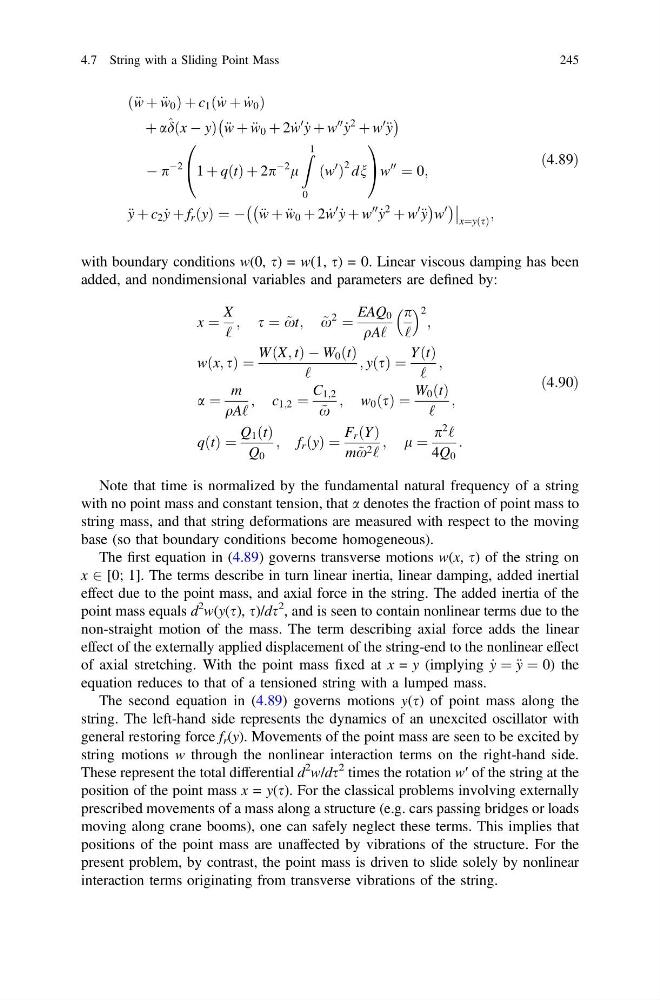
The first equation in (4.89) governs transverse motions w(x, s) of the string on
x 2 [0; 1]. The terms describe in turn linear inertia, linear damping, added inertial
effect due to the point mass, and axial force in the string. The added inertia of the
point mass equals d
2 w(y(s), s)/ds
2 , and is seen to contain nonlinear terms due to the
non-straight motion of the mass. The term describing axial force adds the linear
effect of the externally applied displacement of the string-end to the nonlinear effect
of axial stretching. With the point mass fixed at x = y (implying _
y ¼ € y ¼ 0) the
equation reduces to that of a tensioned string with a lumped mass.
The second equation in (4.89) governs motions y(s) of point mass along the
string. The left-hand side represents the dynamics of an unexcited oscillator with
general restoring force f r (y). Movements of the point mass are seen to be excited by
string motions w through the nonlinear interaction terms on the right-hand side.
These represent the total differential d
2
w/ds
2 times the rotation w′ of the string at the
position of the point mass x = y(s). For the classical problems involving externally
prescribed movements of a mass along a structure (e.g. cars passing bridges or loads
moving along crane booms), one can safely neglect these terms. This implies that
positions of the point mass are unaffected by vibrations of the structure. For the
present problem, by contrast, the point mass is driven to slide solely by nonlinear
interaction terms originating from transverse vibrations of the string.
4.7 String with a Sliding Point Mass
245
w 0 Þ þ c 1 ð _
w þ _
w 0 Þ
þ a ^ dðx À yÞ €
w þ €
w 0 þ 2 _
w
0
_
y þ w
00
_
y
2
þ w
0
€ y
À
Á
À p
À2 1 þ qðtÞ þ 2p
À2 l
Z 1
0
ðw
0
Þ
2 dn
0
@
1
A w
00
¼ 0;
€ y þ c 2 _
y þ f r ðyÞ ¼ À €
w þ €
w 0 þ 2 _
w
0
_
y þ w
00
_
y
2
þ w
0
€ y
À
Á
w
0
À
Á
x¼yðsÞ
;
ð4:89Þ
with boundary conditions w(0, s) = w(1, s) = 0. Linear viscous damping has been
added, and nondimensional variables and parameters are defined by:
x ¼
X
‘
; s ¼ ~
xt; ~
x
2
¼
EAQ 0
qA‘
p
‘
2 ;
wðx; sÞ ¼
WðX; tÞ À W 0 ðtÞ
‘
; yðsÞ ¼
YðtÞ
‘
;
a ¼
m
qA‘
; c 1;2 ¼
C 1;2
~
x
; w 0 ðsÞ ¼
W 0 ðtÞ
‘
;
qðtÞ ¼
Q 1 ðtÞ
Q 0
; f r ðyÞ ¼
F r ðYÞ
m ~
x 2 ‘
; l ¼
p
2
‘
4Q 0
:
ð4:90Þ
Note that time is normalized by the fundamental natural frequency of a string
with no point mass and constant tension, that a denotes the fraction of point mass to
string mass, and that string deformations are measured with respect to the moving
base (so that boundary conditions become homogeneous).
The first equation in (4.89) governs transverse motions w(x, s) of the string on
x 2 [0; 1]. The terms describe in turn linear inertia, linear damping, added inertial
effect due to the point mass, and axial force in the string. The added inertia of the
point mass equals d
2 w(y(s), s)/ds
2 , and is seen to contain nonlinear terms due to the
non-straight motion of the mass. The term describing axial force adds the linear
effect of the externally applied displacement of the string-end to the nonlinear effect
of axial stretching. With the point mass fixed at x = y (implying _
y ¼ € y ¼ 0) the
equation reduces to that of a tensioned string with a lumped mass.
The second equation in (4.89) governs motions y(s) of point mass along the
string. The left-hand side represents the dynamics of an unexcited oscillator with
general restoring force f r (y). Movements of the point mass are seen to be excited by
string motions w through the nonlinear interaction terms on the right-hand side.
These represent the total differential d
2
w/ds
2 times the rotation w′ of the string at the
position of the point mass x = y(s). For the classical problems involving externally
prescribed movements of a mass along a structure (e.g. cars passing bridges or loads
moving along crane booms), one can safely neglect these terms. This implies that
positions of the point mass are unaffected by vibrations of the structure. For the
present problem, by contrast, the point mass is driven to slide solely by nonlinear
interaction terms originating from transverse vibrations of the string.
4.7 String with a Sliding Point Mass
245