

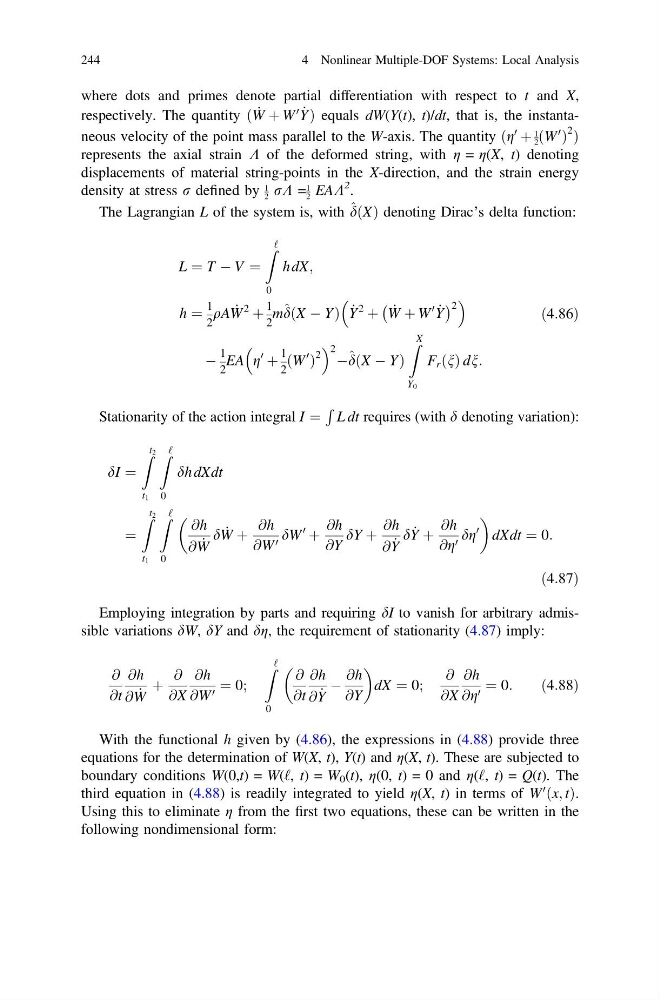
where dots and primes denote partial differentiation with respect to t and X,
respectively. The quantity ð _
W þ W
0 _
YÞ equals dW(Y(t), t)/dt, that is, the instantaneous velocity of the point mass parallel to the W-axis. The quantity ðg
0
þ
1
2 ðW
0
Þ
2 Þ
represents the axial strain K of the deformed string, with η = η(X, t) denoting
displacements of material string-points in the X-direction, and the strain energy
density at stress r defined by
1
2 rK =
1
2 EAK
2 .
The Lagrangian L of the system is, with ^ dðXÞ denoting Dirac’s delta function:
L ¼ T À V ¼
Z ‘
0
hdX;
h ¼
1
2
qA _
W
2
þ
1
2
m ^ dðX À YÞ _
Y
2
þ _
W þ W
0 _
Y
À
Á 2
À
1
2
EA g
0
þ
1
2
ðW
0
Þ
2
2 À ^ dðX À YÞ
Z X
Y 0
F r ðnÞ dn:
ð4:86Þ
Stationarity of the action integral I ¼
R
L dt requires (with d denoting variation):
dI ¼
Z t 2
t 1
Z ‘
0
dhdXdt
¼
Z t 2
t 1
Z ‘
0
@h
@ _
W
d _
W þ
@h
@W 0 dW
0
þ
@h
@Y
dY þ
@h
@ _
Y
d _
Y þ
@h
@g 0 dg
0
dXdt ¼ 0:
ð4:87Þ
Employing integration by parts and requiring dI to vanish for arbitrary admissible variations dW, dY and dη, the requirement of stationarity (4.87) imply:
@
@t
@h
@ _
W
þ
@
@X
@h
@W 0 ¼ 0;
Z ‘
0
@
@t
@h
@ _
Y
À
@h
@Y
dX ¼ 0;
@
@X
@h
@g 0 ¼ 0:
ð4:88Þ
With the functional h given by (4.86), the expressions in (4.88) provide three
equations for the determination of W(X, t), Y(t) and η(X, t). These are subjected to
boundary conditions W(0,t) = W(‘, t) = W 0 (t), η(0, t) = 0 and η(‘, t) = Q(t). The
third equation in (4.88) is readily integrated to yield η(X, t) in terms of W
0 x; t
ð Þ.
Using this to eliminate η from the first two equations, these can be written in the
following nondimensional form:
244
4 Nonlinear Multiple-DOF Systems: Local Analysis
respectively. The quantity ð _
W þ W
0 _
YÞ equals dW(Y(t), t)/dt, that is, the instantaneous velocity of the point mass parallel to the W-axis. The quantity ðg
0
þ
1
2 ðW
0
Þ
2 Þ
represents the axial strain K of the deformed string, with η = η(X, t) denoting
displacements of material string-points in the X-direction, and the strain energy
density at stress r defined by
1
2 rK =
1
2 EAK
2 .
The Lagrangian L of the system is, with ^ dðXÞ denoting Dirac’s delta function:
L ¼ T À V ¼
Z ‘
0
hdX;
h ¼
1
2
qA _
W
2
þ
1
2
m ^ dðX À YÞ _
Y
2
þ _
W þ W
0 _
Y
À
Á 2
À
1
2
EA g
0
þ
1
2
ðW
0
Þ
2
2 À ^ dðX À YÞ
Z X
Y 0
F r ðnÞ dn:
ð4:86Þ
Stationarity of the action integral I ¼
R
L dt requires (with d denoting variation):
dI ¼
Z t 2
t 1
Z ‘
0
dhdXdt
¼
Z t 2
t 1
Z ‘
0
@h
@ _
W
d _
W þ
@h
@W 0 dW
0
þ
@h
@Y
dY þ
@h
@ _
Y
d _
Y þ
@h
@g 0 dg
0
dXdt ¼ 0:
ð4:87Þ
Employing integration by parts and requiring dI to vanish for arbitrary admissible variations dW, dY and dη, the requirement of stationarity (4.87) imply:
@
@t
@h
@ _
W
þ
@
@X
@h
@W 0 ¼ 0;
Z ‘
0
@
@t
@h
@ _
Y
À
@h
@Y
dX ¼ 0;
@
@X
@h
@g 0 ¼ 0:
ð4:88Þ
With the functional h given by (4.86), the expressions in (4.88) provide three
equations for the determination of W(X, t), Y(t) and η(X, t). These are subjected to
boundary conditions W(0,t) = W(‘, t) = W 0 (t), η(0, t) = 0 and η(‘, t) = Q(t). The
third equation in (4.88) is readily integrated to yield η(X, t) in terms of W
0 x; t
ð Þ.
Using this to eliminate η from the first two equations, these can be written in the
following nondimensional form:
244
4 Nonlinear Multiple-DOF Systems: Local Analysis