

Siddiqui et al. 2003), for energy harvesting (Bukhari et al. 2020, Shin et al. 2020),
or for general self-tuning into resonance (Krack et al. 2017, Müller and Krack
2020a, b).
The present section contains an extract of the study by Thomsen (1996a),
emphasizing the method of analysis and the nonlinear phenomena involved.
Equations of motion for a string with a sliding point mass are set up using Hamilton’s
Principle, discretized using mode shape expansion, and analyzed using averaging.
Responses to near-resonant external and parametric excitations are obtained and
discussed, as are responses to slow frequency-sweeps across resonance.
4.7.1 Model System and Equations of Motion
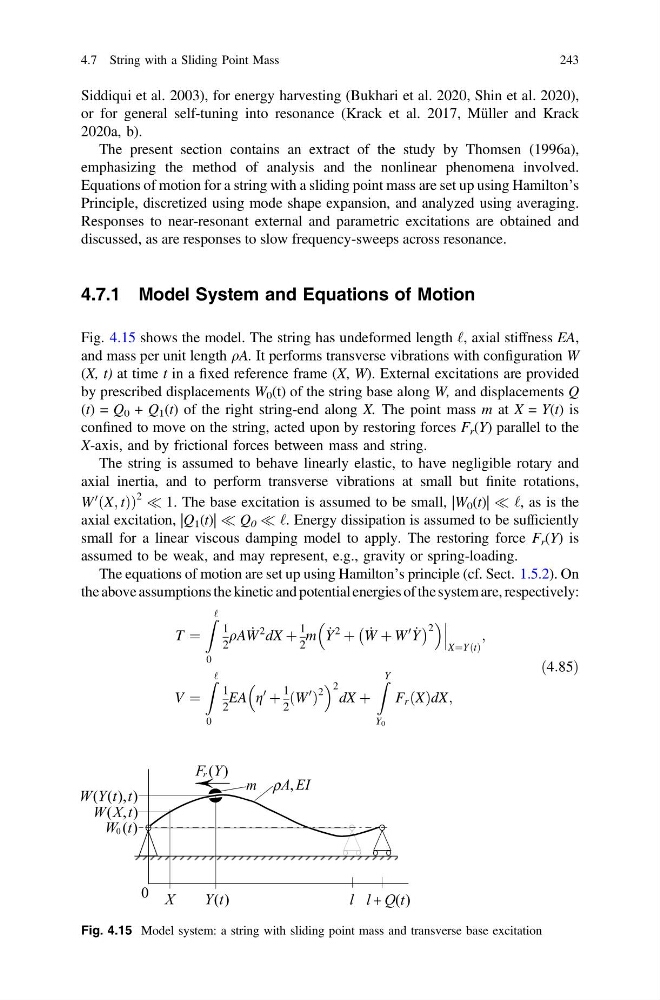
Fig. 4.15 shows the model. The string has undeformed length ‘, axial stiffness EA,
and mass per unit length qA. It performs transverse vibrations with configuration W
(X, t) at time t in a fixed reference frame (X, W). External excitations are provided
by prescribed displacements W 0 (t) of the string base along W, and displacements Q
(t) = Q 0 + Q 1 (t) of the right string-end along X. The point mass m at X = Y(t) is
confined to move on the string, acted upon by restoring forces F r (Y) parallel to the
X-axis, and by frictional forces between mass and string.
The string is assumed to behave linearly elastic, to have negligible rotary and
axial inertia, and to perform transverse vibrations at small but finite rotations,
W
0
ðX; tÞÞ
2 ( 1. The base excitation is assumed to be small, |W 0 (t)| ( ‘, as is the
axial excitation, |Q 1 (t)| ( Q 0 ( ‘. Energy dissipation is assumed to be sufficiently
small for a linear viscous damping model to apply. The restoring force F r (Y) is
assumed to be weak, and may represent, e.g., gravity or spring-loading.
The equations of motion are set up using Hamilton’s principle (cf. Sect. 1.5.2). On
the above assumptions the kinetic and potential energies of the system are, respectively:
T ¼
Z ‘
0
1
2
qA _
W
2 dX þ
1
2
m _
Y
2
þ _
W þ W
0 _
Y
À
Á 2
X¼YðtÞ
;
V ¼
Z ‘
0
1
2
EA g
0
þ
1
2
ðW
0
Þ
2
2
dX þ
Z Y
Y 0
F r ðXÞdX;
ð4:85Þ
Fig. 4.15 Model system: a string with sliding point mass and transverse base excitation
4.7 String with a Sliding Point Mass
243
or for general self-tuning into resonance (Krack et al. 2017, Müller and Krack
2020a, b).
The present section contains an extract of the study by Thomsen (1996a),
emphasizing the method of analysis and the nonlinear phenomena involved.
Equations of motion for a string with a sliding point mass are set up using Hamilton’s
Principle, discretized using mode shape expansion, and analyzed using averaging.
Responses to near-resonant external and parametric excitations are obtained and
discussed, as are responses to slow frequency-sweeps across resonance.
4.7.1 Model System and Equations of Motion
Fig. 4.15 shows the model. The string has undeformed length ‘, axial stiffness EA,
and mass per unit length qA. It performs transverse vibrations with configuration W
(X, t) at time t in a fixed reference frame (X, W). External excitations are provided
by prescribed displacements W 0 (t) of the string base along W, and displacements Q
(t) = Q 0 + Q 1 (t) of the right string-end along X. The point mass m at X = Y(t) is
confined to move on the string, acted upon by restoring forces F r (Y) parallel to the
X-axis, and by frictional forces between mass and string.
The string is assumed to behave linearly elastic, to have negligible rotary and
axial inertia, and to perform transverse vibrations at small but finite rotations,
W
0
ðX; tÞÞ
2 ( 1. The base excitation is assumed to be small, |W 0 (t)| ( ‘, as is the
axial excitation, |Q 1 (t)| ( Q 0 ( ‘. Energy dissipation is assumed to be sufficiently
small for a linear viscous damping model to apply. The restoring force F r (Y) is
assumed to be weak, and may represent, e.g., gravity or spring-loading.
The equations of motion are set up using Hamilton’s principle (cf. Sect. 1.5.2). On
the above assumptions the kinetic and potential energies of the system are, respectively:
T ¼
Z ‘
0
1
2
qA _
W
2 dX þ
1
2
m _
Y
2
þ _
W þ W
0 _
Y
À
Á 2
X¼YðtÞ
;
V ¼
Z ‘
0
1
2
EA g
0
þ
1
2
ðW
0
Þ
2
2
dX þ
Z Y
Y 0
F r ðXÞdX;
ð4:85Þ
Fig. 4.15 Model system: a string with sliding point mass and transverse base excitation
4.7 String with a Sliding Point Mass
243