

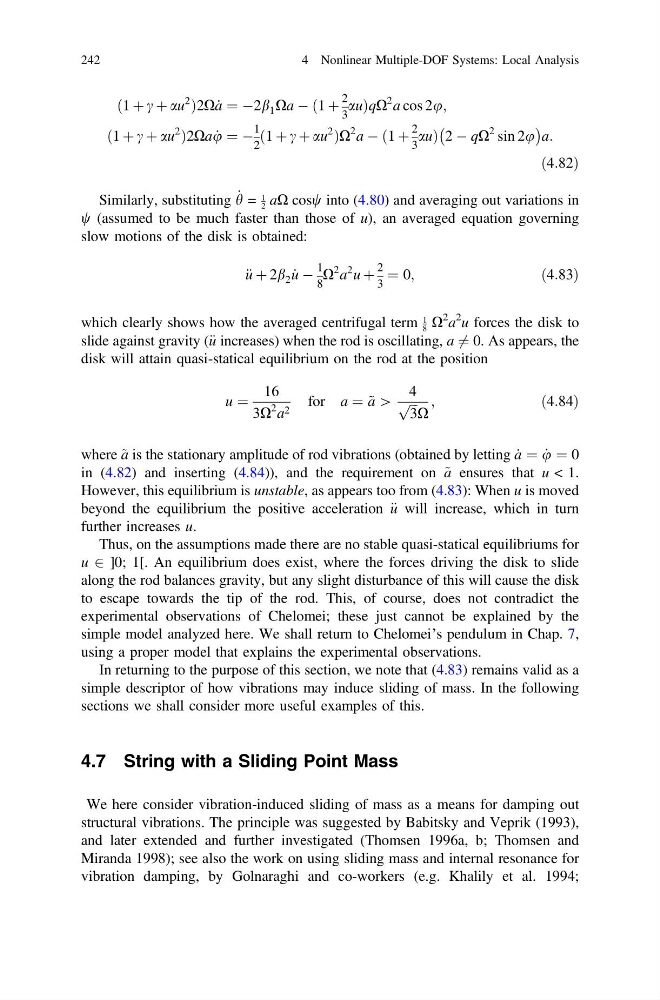
ð1 þ c þ au
2
Þ2X _
a ¼ À2b 1 Xa À ð1 þ
2
3
auÞqX
2 a cos 2u;
ð1 þ c þ au
2
Þ2Xa _
u ¼ À
1
2
ð1 þ c þ au
2
ÞX
2 a À ð1 þ
2
3
auÞ 2 À qX
2 sin 2u
À
Á
a:
ð4:82Þ
Similarly, substituting _
h =
1
2 aX cosw into (4.80) and averaging out variations in
w (assumed to be much faster than those of u), an averaged equation governing
slow motions of the disk is obtained:
€ u þ 2b 2 _
u À
1
8
X
2 a
2 u þ
2
3
¼ 0;
ð4:83Þ
which clearly shows how the averaged centrifugal term
1
8 X
2 a
2 u forces the disk to
slide against gravity (€ u increases) when the rod is oscillating, a 6 ¼ 0. As appears, the
disk will attain quasi-statical equilibrium on the rod at the position
u ¼
16
3X
2 a 2 for a ¼ ~ a [
4
ffiffi ffi
3
p X
;
ð4:84Þ
where ~ a is the stationary amplitude of rod vibrations (obtained by letting _
a ¼ _
u ¼ 0
in (4.82) and inserting (4.84)), and the requirement on ~ a ensures that u < 1.
However, this equilibrium is unstable, as appears too from (4.83): When u is moved
beyond the equilibrium the positive acceleration € u will increase, which in turn
further increases u.
Thus, on the assumptions made there are no stable quasi-statical equilibriums for
u 2 ]0; 1[. An equilibrium does exist, where the forces driving the disk to slide
along the rod balances gravity, but any slight disturbance of this will cause the disk
to escape towards the tip of the rod. This, of course, does not contradict the
experimental observations of Chelomei; these just cannot be explained by the
simple model analyzed here. We shall return to Chelomei’s pendulum in Chap. 7,
using a proper model that explains the experimental observations.
In returning to the purpose of this section, we note that (4.83) remains valid as a
simple descriptor of how vibrations may induce sliding of mass. In the following
sections we shall consider more useful examples of this.
4.7 String with a Sliding Point Mass
We here consider vibration-induced sliding of mass as a means for damping out
structural vibrations. The principle was suggested by Babitsky and Veprik (1993),
and later extended and further investigated (Thomsen 1996a, b; Thomsen and
Miranda 1998); see also the work on using sliding mass and internal resonance for
vibration damping, by Golnaraghi and co-workers (e.g. Khalily et al. 1994;
242
4 Nonlinear Multiple-DOF Systems: Local Analysis
2
Þ2X _
a ¼ À2b 1 Xa À ð1 þ
2
3
auÞqX
2 a cos 2u;
ð1 þ c þ au
2
Þ2Xa _
u ¼ À
1
2
ð1 þ c þ au
2
ÞX
2 a À ð1 þ
2
3
auÞ 2 À qX
2 sin 2u
À
Á
a:
ð4:82Þ
Similarly, substituting _
h =
1
2 aX cosw into (4.80) and averaging out variations in
w (assumed to be much faster than those of u), an averaged equation governing
slow motions of the disk is obtained:
€ u þ 2b 2 _
u À
1
8
X
2 a
2 u þ
2
3
¼ 0;
ð4:83Þ
which clearly shows how the averaged centrifugal term
1
8 X
2 a
2 u forces the disk to
slide against gravity (€ u increases) when the rod is oscillating, a 6 ¼ 0. As appears, the
disk will attain quasi-statical equilibrium on the rod at the position
u ¼
16
3X
2 a 2 for a ¼ ~ a [
4
ffiffi ffi
3
p X
;
ð4:84Þ
where ~ a is the stationary amplitude of rod vibrations (obtained by letting _
a ¼ _
u ¼ 0
in (4.82) and inserting (4.84)), and the requirement on ~ a ensures that u < 1.
However, this equilibrium is unstable, as appears too from (4.83): When u is moved
beyond the equilibrium the positive acceleration € u will increase, which in turn
further increases u.
Thus, on the assumptions made there are no stable quasi-statical equilibriums for
u 2 ]0; 1[. An equilibrium does exist, where the forces driving the disk to slide
along the rod balances gravity, but any slight disturbance of this will cause the disk
to escape towards the tip of the rod. This, of course, does not contradict the
experimental observations of Chelomei; these just cannot be explained by the
simple model analyzed here. We shall return to Chelomei’s pendulum in Chap. 7,
using a proper model that explains the experimental observations.
In returning to the purpose of this section, we note that (4.83) remains valid as a
simple descriptor of how vibrations may induce sliding of mass. In the following
sections we shall consider more useful examples of this.
4.7 String with a Sliding Point Mass
We here consider vibration-induced sliding of mass as a means for damping out
structural vibrations. The principle was suggested by Babitsky and Veprik (1993),
and later extended and further investigated (Thomsen 1996a, b; Thomsen and
Miranda 1998); see also the work on using sliding mass and internal resonance for
vibration damping, by Golnaraghi and co-workers (e.g. Khalily et al. 1994;
242
4 Nonlinear Multiple-DOF Systems: Local Analysis