

restricted so as to prevent this. One can show (Kuo et al. 1972, Nayfeh and
Balachandran 1995) that secular terms are eliminated when q 1 is orthogonal to the
left eigenvector v of A 0 , that is, we require v
T
q 1 = 0 where v is a solution of
v
T (A 0 − ix 0 I) = 0
T , or equivalently, of (A 0
T - ix 0 I)v = 0. Substituting q 1 from
(4.69) into the condition v
T
q 1 = 0 one obtains the following solvability condition:
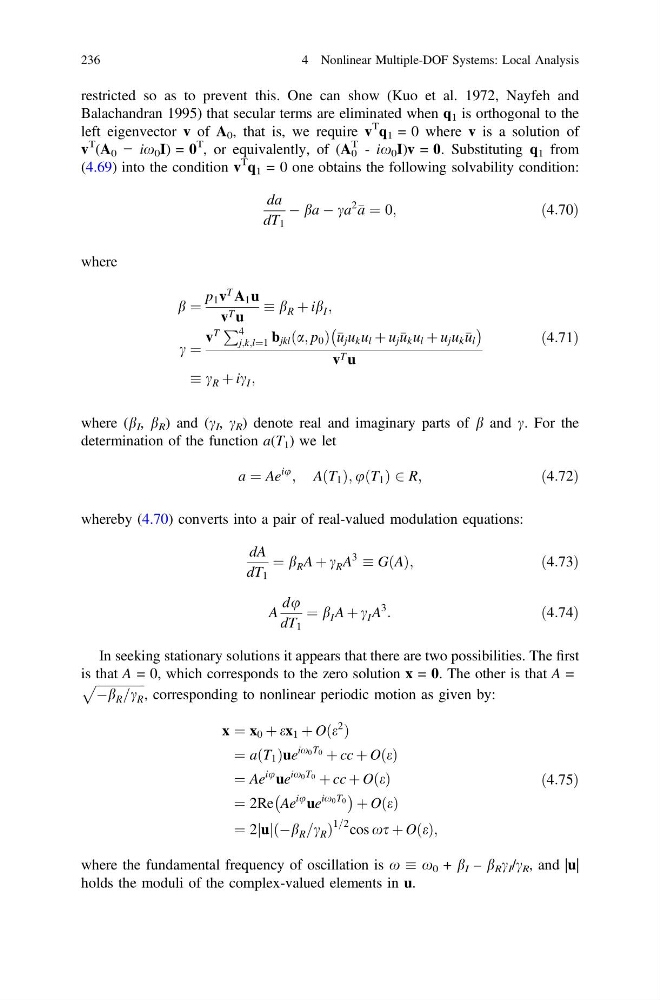
da
dT 1
À ba À ca
2
a ¼ 0;
ð4:70Þ
where
b ¼
p 1 v
T
A 1 u
v T u
b R þ ib I ;
c ¼
v
T
P 4
j;k;l¼1 b jkl ða; p 0 Þ u j u k u l þ u j u k u l þ u j u k u l
À
Á
v T u
c R þ ic I ;
ð4:71Þ
where (b I , b R ) and (c I , c R ) denote real and imaginary parts of b and c. For the
determination of the function a(T 1 ) we let
a ¼ Ae
iu
; AðT 1 Þ; uðT 1 Þ 2 R;
ð4:72Þ
whereby (4.70) converts into a pair of real-valued modulation equations:
dA
dT 1
¼ b R A þ c R A
3
GðAÞ;
ð4:73Þ
A
du
dT 1
¼ b I A þ c I A
3
:
ð4:74Þ
In seeking stationary solutions it appears that there are two possibilities. The first
is that A = 0, which corresponds to the zero solution x = 0. The other is that A =
ffiffiffiffiffiffiffiffiffiffiffiffiffiffiffi ffi
Àb R =c R
p
, corresponding to nonlinear periodic motion as given by:
x ¼ x 0 þ ex 1 þ Oðe
2
Þ
¼ aðT 1 Þue
ix 0 T 0 þ cc þ OðeÞ
¼ Ae
iu
ue
ix 0 T 0 þ cc þ OðeÞ
¼ 2Re Ae
iu
ue
ix 0 T 0
À
Á þ OðeÞ
¼ 2 u
j j Àb R =c R
ð
Þ
1=2 cos xs þ OðeÞ;
ð4:75Þ
where the fundamental frequency of oscillation is x x 0 + b I – b R c I /c R , and |u|
holds the moduli of the complex-valued elements in u.
236
4 Nonlinear Multiple-DOF Systems: Local Analysis
Balachandran 1995) that secular terms are eliminated when q 1 is orthogonal to the
left eigenvector v of A 0 , that is, we require v
T
q 1 = 0 where v is a solution of
v
T (A 0 − ix 0 I) = 0
T , or equivalently, of (A 0
T - ix 0 I)v = 0. Substituting q 1 from
(4.69) into the condition v
T
q 1 = 0 one obtains the following solvability condition:
da
dT 1
À ba À ca
2
a ¼ 0;
ð4:70Þ
where
b ¼
p 1 v
T
A 1 u
v T u
b R þ ib I ;
c ¼
v
T
P 4
j;k;l¼1 b jkl ða; p 0 Þ u j u k u l þ u j u k u l þ u j u k u l
À
Á
v T u
c R þ ic I ;
ð4:71Þ
where (b I , b R ) and (c I , c R ) denote real and imaginary parts of b and c. For the
determination of the function a(T 1 ) we let
a ¼ Ae
iu
; AðT 1 Þ; uðT 1 Þ 2 R;
ð4:72Þ
whereby (4.70) converts into a pair of real-valued modulation equations:
dA
dT 1
¼ b R A þ c R A
3
GðAÞ;
ð4:73Þ
A
du
dT 1
¼ b I A þ c I A
3
:
ð4:74Þ
In seeking stationary solutions it appears that there are two possibilities. The first
is that A = 0, which corresponds to the zero solution x = 0. The other is that A =
ffiffiffiffiffiffiffiffiffiffiffiffiffiffiffi ffi
Àb R =c R
p
, corresponding to nonlinear periodic motion as given by:
x ¼ x 0 þ ex 1 þ Oðe
2
Þ
¼ aðT 1 Þue
ix 0 T 0 þ cc þ OðeÞ
¼ Ae
iu
ue
ix 0 T 0 þ cc þ OðeÞ
¼ 2Re Ae
iu
ue
ix 0 T 0
À
Á þ OðeÞ
¼ 2 u
j j Àb R =c R
ð
Þ
1=2 cos xs þ OðeÞ;
ð4:75Þ
where the fundamental frequency of oscillation is x x 0 + b I – b R c I /c R , and |u|
holds the moduli of the complex-valued elements in u.
236
4 Nonlinear Multiple-DOF Systems: Local Analysis