

Evaluating G
0
ðAÞ dG=dA of (4.73) (i.e. the Jacobian of G) at the stationary
points one finds G
0
ð0Þ ¼ b R and G
0
ð
ffiffiffiffiffiffiffiffiffiffiffiffiffiffiffi ffi
Àb R =c R
p
Þ = –2b R , respectively.
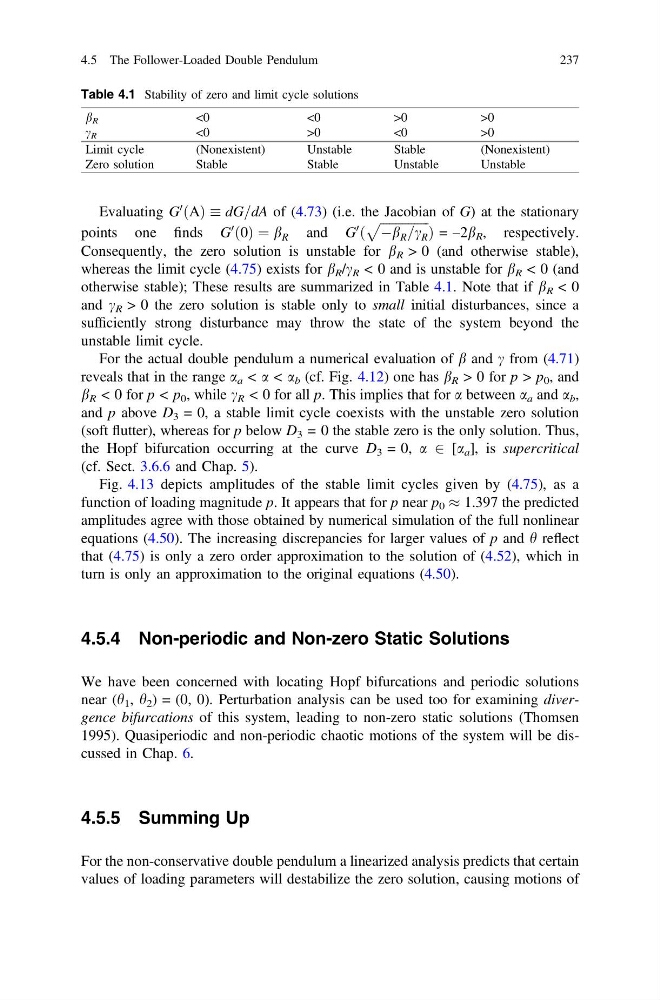
Consequently, the zero solution is unstable for b R > 0 (and otherwise stable),
whereas the limit cycle (4.75) exists for b R /c R < 0 and is unstable for b R < 0 (and
otherwise stable); These results are summarized in Table 4.1. Note that if b R < 0
and c R > 0 the zero solution is stable only to small initial disturbances, since a
sufficiently strong disturbance may throw the state of the system beyond the
unstable limit cycle.
For the actual double pendulum a numerical evaluation of b and c from (4.71)
reveals that in the range a a < a < a b (cf. Fig. 4.12) one has b R > 0 for p > p 0 , and
b R < 0 for p < p 0 , while c R < 0 for all p. This implies that for a between a a and a b ,
and p above D 3 = 0, a stable limit cycle coexists with the unstable zero solution
(soft flutter), whereas for p below D 3 = 0 the stable zero is the only solution. Thus,
the Hopf bifurcation occurring at the curve D 3 = 0, a 2 [a a ], is supercritical
(cf. Sect. 3.6.6 and Chap. 5).
Fig. 4.13 depicts amplitudes of the stable limit cycles given by (4.75), as a
function of loading magnitude p. It appears that for p near p 0 % 1.397 the predicted
amplitudes agree with those obtained by numerical simulation of the full nonlinear
equations (4.50). The increasing discrepancies for larger values of p and h reflect
that (4.75) is only a zero order approximation to the solution of (4.52), which in
turn is only an approximation to the original equations (4.50).
4.5.4 Non-periodic and Non-zero Static Solutions
We have been concerned with locating Hopf bifurcations and periodic solutions
near (h 1 , h 2 ) = (0, 0). Perturbation analysis can be used too for examining divergence bifurcations of this system, leading to non-zero static solutions (Thomsen
1995). Quasiperiodic and non-periodic chaotic motions of the system will be discussed in Chap. 6.
4.5.5 Summing Up
For the non-conservative double pendulum a linearized analysis predicts that certain
values of loading parameters will destabilize the zero solution, causing motions of
Table 4.1 Stability of zero and limit cycle solutions
b R
c R
<0
<0
<0
>0
>0
<0
>0
>0
Limit cycle
(Nonexistent)
Unstable
Stable
(Nonexistent)
Zero solution
Stable
Stable
Unstable
Unstable
4.5 The Follower-Loaded Double Pendulum
237
0
ðAÞ dG=dA of (4.73) (i.e. the Jacobian of G) at the stationary
points one finds G
0
ð0Þ ¼ b R and G
0
ð
ffiffiffiffiffiffiffiffiffiffiffiffiffiffiffi ffi
Àb R =c R
p
Þ = –2b R , respectively.
Consequently, the zero solution is unstable for b R > 0 (and otherwise stable),
whereas the limit cycle (4.75) exists for b R /c R < 0 and is unstable for b R < 0 (and
otherwise stable); These results are summarized in Table 4.1. Note that if b R < 0
and c R > 0 the zero solution is stable only to small initial disturbances, since a
sufficiently strong disturbance may throw the state of the system beyond the
unstable limit cycle.
For the actual double pendulum a numerical evaluation of b and c from (4.71)
reveals that in the range a a < a < a b (cf. Fig. 4.12) one has b R > 0 for p > p 0 , and
b R < 0 for p < p 0 , while c R < 0 for all p. This implies that for a between a a and a b ,
and p above D 3 = 0, a stable limit cycle coexists with the unstable zero solution
(soft flutter), whereas for p below D 3 = 0 the stable zero is the only solution. Thus,
the Hopf bifurcation occurring at the curve D 3 = 0, a 2 [a a ], is supercritical
(cf. Sect. 3.6.6 and Chap. 5).
Fig. 4.13 depicts amplitudes of the stable limit cycles given by (4.75), as a
function of loading magnitude p. It appears that for p near p 0 % 1.397 the predicted
amplitudes agree with those obtained by numerical simulation of the full nonlinear
equations (4.50). The increasing discrepancies for larger values of p and h reflect
that (4.75) is only a zero order approximation to the solution of (4.52), which in
turn is only an approximation to the original equations (4.50).
4.5.4 Non-periodic and Non-zero Static Solutions
We have been concerned with locating Hopf bifurcations and periodic solutions
near (h 1 , h 2 ) = (0, 0). Perturbation analysis can be used too for examining divergence bifurcations of this system, leading to non-zero static solutions (Thomsen
1995). Quasiperiodic and non-periodic chaotic motions of the system will be discussed in Chap. 6.
4.5.5 Summing Up
For the non-conservative double pendulum a linearized analysis predicts that certain
values of loading parameters will destabilize the zero solution, causing motions of
Table 4.1 Stability of zero and limit cycle solutions
b R
c R
<0
<0
<0
>0
>0
<0
>0
>0
Limit cycle
(Nonexistent)
Unstable
Stable
(Nonexistent)
Zero solution
Stable
Stable
Unstable
Unstable
4.5 The Follower-Loaded Double Pendulum
237