

@x 0
@T 0
À A 0 x 0 ¼ 0;
ð4:64Þ
and to order e
1 :
@x 1
@T 0
À A 0 x 1 ¼ À
@x 0
@T 1
þ p 1 A 1 x 0 þ
X 4
j;k;l¼1
b jkl ða; p 0 Þx 0j x 0k x 0l ;
ð4:65Þ
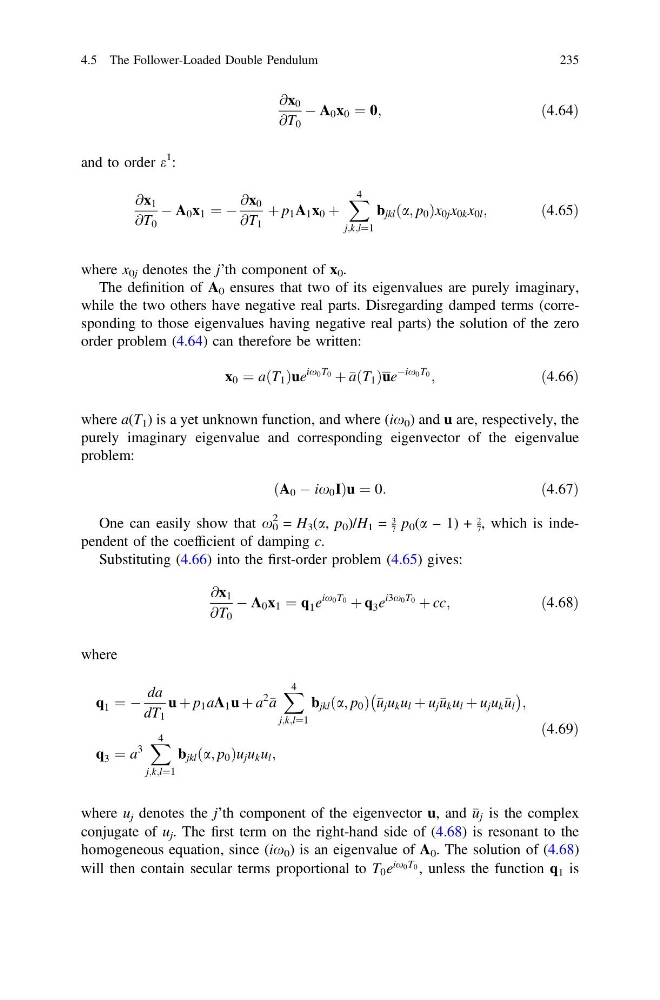
where x 0j denotes the j’th component of x 0 .
The definition of A 0 ensures that two of its eigenvalues are purely imaginary,
while the two others have negative real parts. Disregarding damped terms (corresponding to those eigenvalues having negative real parts) the solution of the zero
order problem (4.64) can therefore be written:
x 0 ¼ aðT 1 Þue
ix 0 T 0 þ aðT 1 Þue
Àix 0 T 0 ;
ð4:66Þ
where a(T 1 ) is a yet unknown function, and where (ix 0 ) and u are, respectively, the
purely imaginary eigenvalue and corresponding eigenvector of the eigenvalue
problem:
A 0 À ix 0 I
ð
Þ u ¼ 0:
ð4:67Þ
One can easily show that x 0
2 = H 3 (a, p 0 )/H 1 =
3
7 p 0 (a – 1) +
2
7 , which is independent of the coefficient of damping c.
Substituting (4.66) into the first-order problem (4.65) gives:
@x 1
@T 0
À A 0 x 1 ¼ q 1 e
ix 0 T 0 þ q 3 e
i3x 0 T 0 þ cc;
ð4:68Þ
where
q 1 ¼ À
da
dT 1
u þ p 1 aA 1 u þ a
2
a
X 4
j;k;l¼1
b jkl ða; p 0 Þ u j u k u l þ u j u k u l þ u j u k u l
À
Á ;
q 3 ¼ a
3
X 4
j;k;l¼1
b jkl ða; p 0 Þu j u k u l ;
ð4:69Þ
where u j denotes the j’th component of the eigenvector u, and u j is the complex
conjugate of u j . The first term on the right-hand side of (4.68) is resonant to the
homogeneous equation, since (ix 0 ) is an eigenvalue of A 0 . The solution of (4.68)
will then contain secular terms proportional to T 0 e
ix 0 T 0 , unless the function q 1 is
4.5 The Follower-Loaded Double Pendulum
235
@T 0
À A 0 x 0 ¼ 0;
ð4:64Þ
and to order e
1 :
@x 1
@T 0
À A 0 x 1 ¼ À
@x 0
@T 1
þ p 1 A 1 x 0 þ
X 4
j;k;l¼1
b jkl ða; p 0 Þx 0j x 0k x 0l ;
ð4:65Þ
where x 0j denotes the j’th component of x 0 .
The definition of A 0 ensures that two of its eigenvalues are purely imaginary,
while the two others have negative real parts. Disregarding damped terms (corresponding to those eigenvalues having negative real parts) the solution of the zero
order problem (4.64) can therefore be written:
x 0 ¼ aðT 1 Þue
ix 0 T 0 þ aðT 1 Þue
Àix 0 T 0 ;
ð4:66Þ
where a(T 1 ) is a yet unknown function, and where (ix 0 ) and u are, respectively, the
purely imaginary eigenvalue and corresponding eigenvector of the eigenvalue
problem:
A 0 À ix 0 I
ð
Þ u ¼ 0:
ð4:67Þ
One can easily show that x 0
2 = H 3 (a, p 0 )/H 1 =
3
7 p 0 (a – 1) +
2
7 , which is independent of the coefficient of damping c.
Substituting (4.66) into the first-order problem (4.65) gives:
@x 1
@T 0
À A 0 x 1 ¼ q 1 e
ix 0 T 0 þ q 3 e
i3x 0 T 0 þ cc;
ð4:68Þ
where
q 1 ¼ À
da
dT 1
u þ p 1 aA 1 u þ a
2
a
X 4
j;k;l¼1
b jkl ða; p 0 Þ u j u k u l þ u j u k u l þ u j u k u l
À
Á ;
q 3 ¼ a
3
X 4
j;k;l¼1
b jkl ða; p 0 Þu j u k u l ;
ð4:69Þ
where u j denotes the j’th component of the eigenvector u, and u j is the complex
conjugate of u j . The first term on the right-hand side of (4.68) is resonant to the
homogeneous equation, since (ix 0 ) is an eigenvalue of A 0 . The solution of (4.68)
will then contain secular terms proportional to T 0 e
ix 0 T 0 , unless the function q 1 is
4.5 The Follower-Loaded Double Pendulum
235