

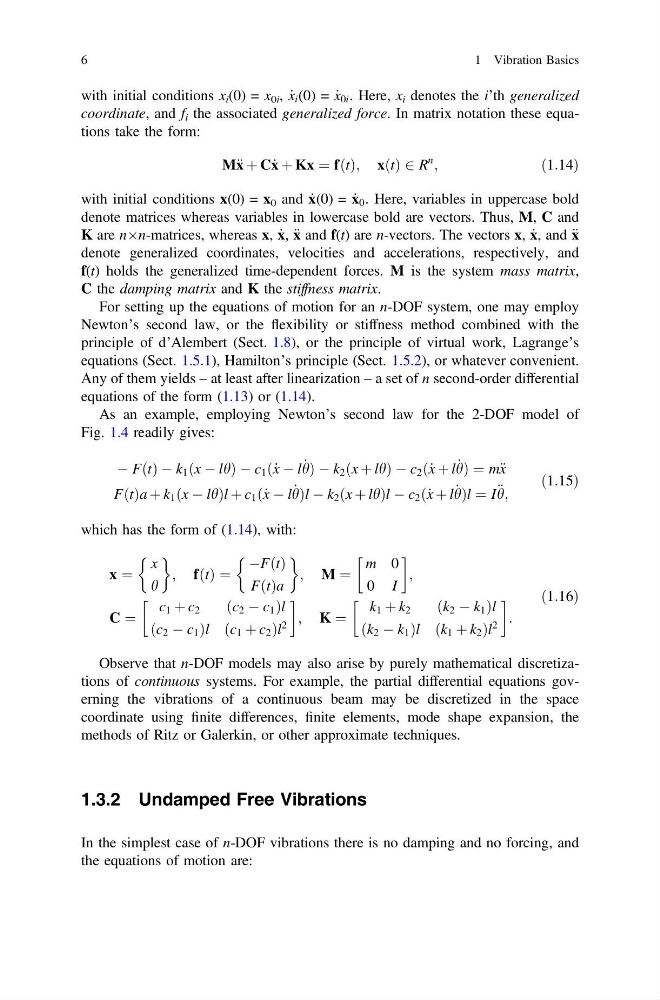
with initial conditions x i (0) = x 0i , _
x i (0) = _
x 0i . Here, x i denotes the i’th generalized
coordinate, and f i the associated generalized force. In matrix notation these equations take the form:
M€ x þ C _
x þ Kx ¼ fðtÞ; xðtÞ 2 R
n
;
ð1:14Þ
with initial conditions x(0) = x 0 and _
x(0) = _
x 0 . Here, variables in uppercase bold
denote matrices whereas variables in lowercase bold are vectors. Thus, M, C and
K are nÂn-matrices, whereas x, _
x, € x and f(t) are n-vectors. The vectors x, _
x, and € x
denote generalized coordinates, velocities and accelerations, respectively, and
f(t) holds the generalized time-dependent forces. M is the system mass matrix,
C the damping matrix and K the stiffness matrix.
For setting up the equations of motion for an n-DOF system, one may employ
Newton’s second law, or the flexibility or stiffness method combined with the
principle of d’Alembert (Sect. 1.8), or the principle of virtual work, Lagrange’s
equations (Sect. 1.5.1), Hamilton’s principle (Sect. 1.5.2), or whatever convenient.
Any of them yields – at least after linearization – a set of n second-order differential
equations of the form (1.13) or (1.14).
As an example, employing Newton’s second law for the 2-DOF model of
Fig. 1.4 readily gives:
À FðtÞ À k 1 ðx À lhÞ À c 1 ð_ x À l _
hÞ À k 2 ðx þ lhÞ À c 2 ð_ x þ l _
hÞ ¼ m€ x
FðtÞa þ k 1 ðx À lhÞl þ c 1 ð_ x À l _
hÞl À k 2 ðx þ lhÞl À c 2 ð_ x þ l _
hÞl ¼ I € h;
ð1:15Þ
which has the form of (1.14), with:
x ¼
x
h
& '
; fðtÞ ¼
ÀFðtÞ
FðtÞa
&
'
; M ¼
m 0
0 I
!
;
C ¼
c 1 þ c 2
ðc 2 À c 1 Þl
ðc 2 À c 1 Þl ðc 1 þ c 2 Þl
2
!
; K ¼
k 1 þ k 2
ðk 2 À k 1 Þl
ðk 2 À k 1 Þl ðk 1 þ k 2 Þl
2
!
:
ð1:16Þ
Observe that n-DOF models may also arise by purely mathematical discretizations of continuous systems. For example, the partial differential equations governing the vibrations of a continuous beam may be discretized in the space
coordinate using finite differences, finite elements, mode shape expansion, the
methods of Ritz or Galerkin, or other approximate techniques.
1.3.2 Undamped Free Vibrations
In the simplest case of n-DOF vibrations there is no damping and no forcing, and
the equations of motion are:
6
1 Vibration Basics
x i (0) = _
x 0i . Here, x i denotes the i’th generalized
coordinate, and f i the associated generalized force. In matrix notation these equations take the form:
M€ x þ C _
x þ Kx ¼ fðtÞ; xðtÞ 2 R
n
;
ð1:14Þ
with initial conditions x(0) = x 0 and _
x(0) = _
x 0 . Here, variables in uppercase bold
denote matrices whereas variables in lowercase bold are vectors. Thus, M, C and
K are nÂn-matrices, whereas x, _
x, € x and f(t) are n-vectors. The vectors x, _
x, and € x
denote generalized coordinates, velocities and accelerations, respectively, and
f(t) holds the generalized time-dependent forces. M is the system mass matrix,
C the damping matrix and K the stiffness matrix.
For setting up the equations of motion for an n-DOF system, one may employ
Newton’s second law, or the flexibility or stiffness method combined with the
principle of d’Alembert (Sect. 1.8), or the principle of virtual work, Lagrange’s
equations (Sect. 1.5.1), Hamilton’s principle (Sect. 1.5.2), or whatever convenient.
Any of them yields – at least after linearization – a set of n second-order differential
equations of the form (1.13) or (1.14).
As an example, employing Newton’s second law for the 2-DOF model of
Fig. 1.4 readily gives:
À FðtÞ À k 1 ðx À lhÞ À c 1 ð_ x À l _
hÞ À k 2 ðx þ lhÞ À c 2 ð_ x þ l _
hÞ ¼ m€ x
FðtÞa þ k 1 ðx À lhÞl þ c 1 ð_ x À l _
hÞl À k 2 ðx þ lhÞl À c 2 ð_ x þ l _
hÞl ¼ I € h;
ð1:15Þ
which has the form of (1.14), with:
x ¼
x
h
& '
; fðtÞ ¼
ÀFðtÞ
FðtÞa
&
'
; M ¼
m 0
0 I
!
;
C ¼
c 1 þ c 2
ðc 2 À c 1 Þl
ðc 2 À c 1 Þl ðc 1 þ c 2 Þl
2
!
; K ¼
k 1 þ k 2
ðk 2 À k 1 Þl
ðk 2 À k 1 Þl ðk 1 þ k 2 Þl
2
!
:
ð1:16Þ
Observe that n-DOF models may also arise by purely mathematical discretizations of continuous systems. For example, the partial differential equations governing the vibrations of a continuous beam may be discretized in the space
coordinate using finite differences, finite elements, mode shape expansion, the
methods of Ritz or Galerkin, or other approximate techniques.
1.3.2 Undamped Free Vibrations
In the simplest case of n-DOF vibrations there is no damping and no forcing, and
the equations of motion are:
6
1 Vibration Basics