

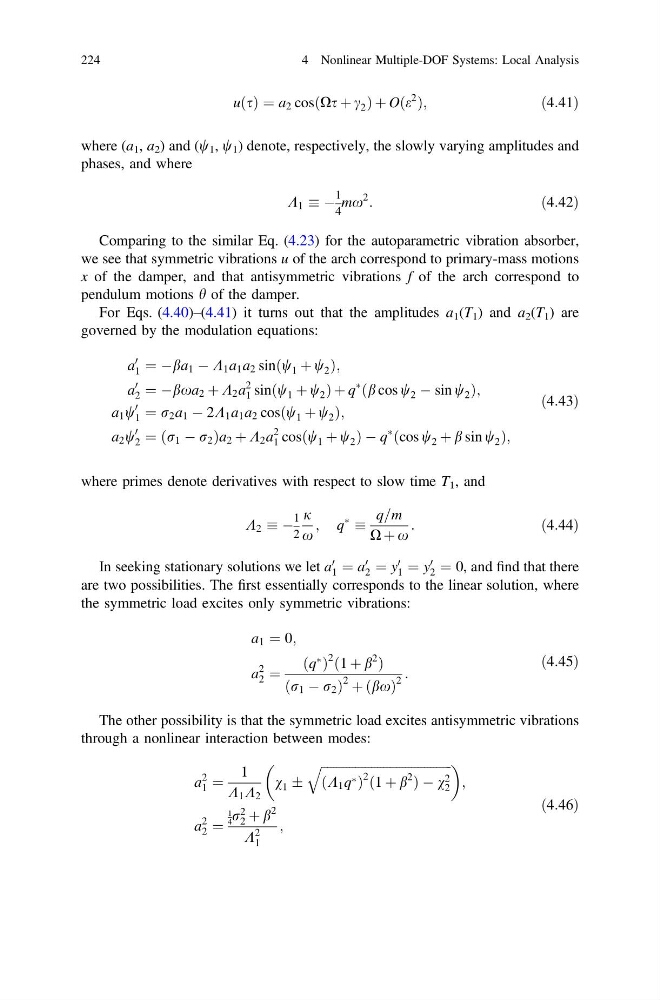
uðsÞ ¼ a 2 cosðXs þ c 2 Þ þ Oðe
2
Þ;
ð4:41Þ
where (a 1 , a 2 ) and (w 1 , w 1 ) denote, respectively, the slowly varying amplitudes and
phases, and where
K 1 À
1
4
mx
2
:
ð4:42Þ
Comparing to the similar Eq. (4.23) for the autoparametric vibration absorber,
we see that symmetric vibrations u of the arch correspond to primary-mass motions
x of the damper, and that antisymmetric vibrations f of the arch correspond to
pendulum motions h of the damper.
For Eqs. (4.40)–(4.41) it turns out that the amplitudes a 1 (T 1 ) and a 2 (T 1 ) are
governed by the modulation equations:
a
0
1 ¼ Àba 1 À K 1 a 1 a 2 sinðw 1 þ w 2 Þ;
a
0
2 ¼ Àbxa 2 þ K 2 a
2
1 sinðw 1 þ w 2 Þ þ q
Ã
ðb cos w 2 À sin w 2 Þ;
a 1 w
0
1 ¼ r 2 a 1 À 2K 1 a 1 a 2 cosðw 1 þ w 2 Þ;
a 2 w
0
2 ¼ ðr 1 À r 2 Þa 2 þ K 2 a
2
1 cosðw 1 þ w 2 Þ À q
Ã
ðcos w 2 þ b sin w 2 Þ;
ð4:43Þ
where primes denote derivatives with respect to slow time T 1 , and
K 2 À
1
2
j
x
; q
Ã
q=m
X þ x
:
ð4:44Þ
In seeking stationary solutions we let a
0
1 ¼ a
0
2 ¼ y
0
1 ¼ y
0
2 ¼ 0, and find that there
are two possibilities. The first essentially corresponds to the linear solution, where
the symmetric load excites only symmetric vibrations:
a 1 ¼ 0;
a
2
2 ¼
ðq
Ã
Þ
2 ð1 þ b
2
Þ
ðr 1 À r 2 Þ
2 þ ðbxÞ
2
:
ð4:45Þ
The other possibility is that the symmetric load excites antisymmetric vibrations
through a nonlinear interaction between modes:
a
2
1 ¼
1
K 1 K 2
v 1 Æ
ffiffiffiffiffiffiffiffiffiffiffiffiffiffiffiffiffiffiffiffiffiffiffiffiffiffiffiffiffiffiffiffiffiffiffiffiffiffiffiffiffi ffi
K 1 q Ã
ð
Þ
2 ð1 þ b
2
Þ À v 2
2
q
;
a
2
2 ¼
1
4 r
2
2 þ b
2
K
2
1
;
ð4:46Þ
224
4 Nonlinear Multiple-DOF Systems: Local Analysis
2
Þ;
ð4:41Þ
where (a 1 , a 2 ) and (w 1 , w 1 ) denote, respectively, the slowly varying amplitudes and
phases, and where
K 1 À
1
4
mx
2
:
ð4:42Þ
Comparing to the similar Eq. (4.23) for the autoparametric vibration absorber,
we see that symmetric vibrations u of the arch correspond to primary-mass motions
x of the damper, and that antisymmetric vibrations f of the arch correspond to
pendulum motions h of the damper.
For Eqs. (4.40)–(4.41) it turns out that the amplitudes a 1 (T 1 ) and a 2 (T 1 ) are
governed by the modulation equations:
a
0
1 ¼ Àba 1 À K 1 a 1 a 2 sinðw 1 þ w 2 Þ;
a
0
2 ¼ Àbxa 2 þ K 2 a
2
1 sinðw 1 þ w 2 Þ þ q
Ã
ðb cos w 2 À sin w 2 Þ;
a 1 w
0
1 ¼ r 2 a 1 À 2K 1 a 1 a 2 cosðw 1 þ w 2 Þ;
a 2 w
0
2 ¼ ðr 1 À r 2 Þa 2 þ K 2 a
2
1 cosðw 1 þ w 2 Þ À q
Ã
ðcos w 2 þ b sin w 2 Þ;
ð4:43Þ
where primes denote derivatives with respect to slow time T 1 , and
K 2 À
1
2
j
x
; q
Ã
q=m
X þ x
:
ð4:44Þ
In seeking stationary solutions we let a
0
1 ¼ a
0
2 ¼ y
0
1 ¼ y
0
2 ¼ 0, and find that there
are two possibilities. The first essentially corresponds to the linear solution, where
the symmetric load excites only symmetric vibrations:
a 1 ¼ 0;
a
2
2 ¼
ðq
Ã
Þ
2 ð1 þ b
2
Þ
ðr 1 À r 2 Þ
2 þ ðbxÞ
2
:
ð4:45Þ
The other possibility is that the symmetric load excites antisymmetric vibrations
through a nonlinear interaction between modes:
a
2
1 ¼
1
K 1 K 2
v 1 Æ
ffiffiffiffiffiffiffiffiffiffiffiffiffiffiffiffiffiffiffiffiffiffiffiffiffiffiffiffiffiffiffiffiffiffiffiffiffiffiffiffiffi ffi
K 1 q Ã
ð
Þ
2 ð1 þ b
2
Þ À v 2
2
q
;
a
2
2 ¼
1
4 r
2
2 þ b
2
K
2
1
;
ð4:46Þ
224
4 Nonlinear Multiple-DOF Systems: Local Analysis