

become about the same, though, it turns out, with the latter case producing a slightly
closer fit to numerical results.
Considering the case X % 2, q = O(1), the terms of (4.31)–(4.32) are ordered
accordingly, so that the loading terms and linear terms appear at the lowest level of
approximation, whereas terms describing damping and nonlinearities appear at the
next, higher level:
€ f þ e2b _
f þ ð1 À emx
2 uÞf ¼ 0;
ð4:35Þ
€ u þ e2bx _
u þ x
2 u þ ejðf € f þ _
f
2
Þ ¼
q
m
cosðXsÞ;
ð4:36Þ
where e denotes the usual bookkeeper of small terms. Using the method of multiple
scales we assume for the solution a uniformly valid expansion:
f ¼ f 0 ðT 0 ; T 1 Þ þ ef 1 ðT 0 ; T 1 Þ þ Oðe
2
Þ;
ð4:37Þ
u ¼ u 0 ðT 0 ; T 1 Þ þ eu 1 ðT 0 ; T 1 Þ þ Oðe
2
Þ:
ð4:38Þ
The analysis proceeds just as for the autoparametric vibration absorber
(cf. Sect. 4.2). A pair of detuning parameters, r 1 and r 2 , are introduced to indicate
the nearness to internal and parametric resonance, respectively:
x ¼ 2 þ er 1 ;
X ¼ 2 þ er 2 :
ð4:39Þ
Performing then the usual operations one ends up with the following two-term
approximation for the nonlinear arch response:
f ðsÞ ¼ a 1 cosð
1
2
Xs À
1
2
w 1 Þ
þ
2K 1 a 1 a 2
3
2 X
ð Þ
2 À1
cosð
3
2
Xs À
1
2
w 1 þ w 2 Þ þ Oðe
2
Þ;
ð4:40Þ
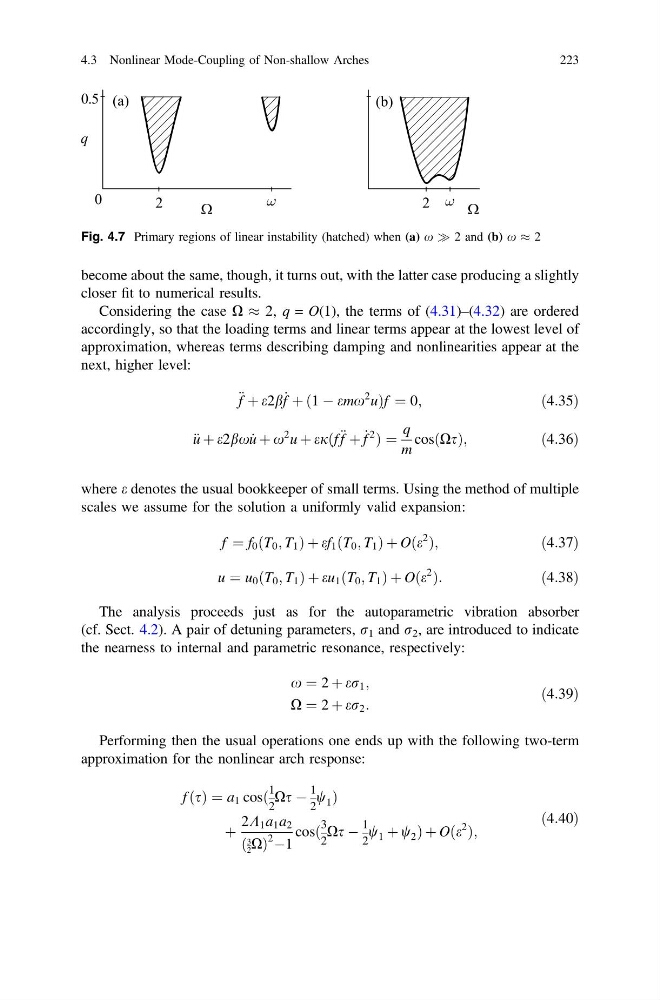
Fig. 4.7 Primary regions of linear instability (hatched) when (a) x ) 2 and (b) x % 2
4.3 Nonlinear Mode-Coupling of Non-shallow Arches
223
closer fit to numerical results.
Considering the case X % 2, q = O(1), the terms of (4.31)–(4.32) are ordered
accordingly, so that the loading terms and linear terms appear at the lowest level of
approximation, whereas terms describing damping and nonlinearities appear at the
next, higher level:
€ f þ e2b _
f þ ð1 À emx
2 uÞf ¼ 0;
ð4:35Þ
€ u þ e2bx _
u þ x
2 u þ ejðf € f þ _
f
2
Þ ¼
q
m
cosðXsÞ;
ð4:36Þ
where e denotes the usual bookkeeper of small terms. Using the method of multiple
scales we assume for the solution a uniformly valid expansion:
f ¼ f 0 ðT 0 ; T 1 Þ þ ef 1 ðT 0 ; T 1 Þ þ Oðe
2
Þ;
ð4:37Þ
u ¼ u 0 ðT 0 ; T 1 Þ þ eu 1 ðT 0 ; T 1 Þ þ Oðe
2
Þ:
ð4:38Þ
The analysis proceeds just as for the autoparametric vibration absorber
(cf. Sect. 4.2). A pair of detuning parameters, r 1 and r 2 , are introduced to indicate
the nearness to internal and parametric resonance, respectively:
x ¼ 2 þ er 1 ;
X ¼ 2 þ er 2 :
ð4:39Þ
Performing then the usual operations one ends up with the following two-term
approximation for the nonlinear arch response:
f ðsÞ ¼ a 1 cosð
1
2
Xs À
1
2
w 1 Þ
þ
2K 1 a 1 a 2
3
2 X
ð Þ
2 À1
cosð
3
2
Xs À
1
2
w 1 þ w 2 Þ þ Oðe
2
Þ;
ð4:40Þ
Fig. 4.7 Primary regions of linear instability (hatched) when (a) x ) 2 and (b) x % 2
4.3 Nonlinear Mode-Coupling of Non-shallow Arches
223