

4.3.2 Linear Response and Stability
Linearizing (4.32) by letting j = 0, one notices that the symmetric arch vibrations
components u(t) is governed by a conventional forced oscillator equation.
A particular solution for this equation is (cf. Sect. 1.2.3):
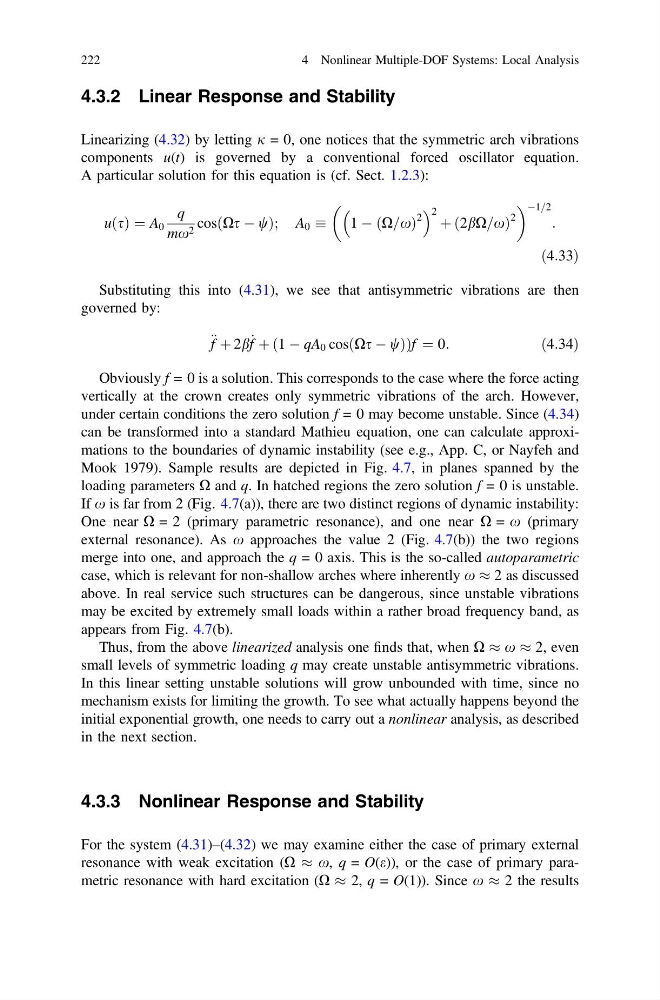
uðsÞ ¼ A 0
q
mx 2 cosðXs À wÞ; A 0
1 À ðX=xÞ
2
2 þ 2bX=x
ð
Þ
2
À1=2
:
ð4:33Þ
Substituting this into (4.31), we see that antisymmetric vibrations are then
governed by:
€ f þ 2b _
f þ 1 À qA 0 cosðXs À wÞ
ð
Þ f ¼ 0:
ð4:34Þ
Obviously f = 0 is a solution. This corresponds to the case where the force acting
vertically at the crown creates only symmetric vibrations of the arch. However,
under certain conditions the zero solution f = 0 may become unstable. Since (4.34)
can be transformed into a standard Mathieu equation, one can calculate approximations to the boundaries of dynamic instability (see e.g., App. C, or Nayfeh and
Mook 1979). Sample results are depicted in Fig. 4.7, in planes spanned by the
loading parameters X and q. In hatched regions the zero solution f = 0 is unstable.
If x is far from 2 (Fig. 4.7(a)), there are two distinct regions of dynamic instability:
One near X = 2 (primary parametric resonance), and one near X = x (primary
external resonance). As x approaches the value 2 (Fig. 4.7(b)) the two regions
merge into one, and approach the q = 0 axis. This is the so-called autoparametric
case, which is relevant for non-shallow arches where inherently x % 2 as discussed
above. In real service such structures can be dangerous, since unstable vibrations
may be excited by extremely small loads within a rather broad frequency band, as
appears from Fig. 4.7(b).
Thus, from the above linearized analysis one finds that, when X % x % 2, even
small levels of symmetric loading q may create unstable antisymmetric vibrations.
In this linear setting unstable solutions will grow unbounded with time, since no
mechanism exists for limiting the growth. To see what actually happens beyond the
initial exponential growth, one needs to carry out a nonlinear analysis, as described
in the next section.
4.3.3 Nonlinear Response and Stability
For the system (4.31)–(4.32) we may examine either the case of primary external
resonance with weak excitation (X % x, q = O(e)), or the case of primary parametric resonance with hard excitation (X % 2, q = O(1)). Since x % 2 the results
222
4 Nonlinear Multiple-DOF Systems: Local Analysis
Linearizing (4.32) by letting j = 0, one notices that the symmetric arch vibrations
components u(t) is governed by a conventional forced oscillator equation.
A particular solution for this equation is (cf. Sect. 1.2.3):
uðsÞ ¼ A 0
q
mx 2 cosðXs À wÞ; A 0
1 À ðX=xÞ
2
2 þ 2bX=x
ð
Þ
2
À1=2
:
ð4:33Þ
Substituting this into (4.31), we see that antisymmetric vibrations are then
governed by:
€ f þ 2b _
f þ 1 À qA 0 cosðXs À wÞ
ð
Þ f ¼ 0:
ð4:34Þ
Obviously f = 0 is a solution. This corresponds to the case where the force acting
vertically at the crown creates only symmetric vibrations of the arch. However,
under certain conditions the zero solution f = 0 may become unstable. Since (4.34)
can be transformed into a standard Mathieu equation, one can calculate approximations to the boundaries of dynamic instability (see e.g., App. C, or Nayfeh and
Mook 1979). Sample results are depicted in Fig. 4.7, in planes spanned by the
loading parameters X and q. In hatched regions the zero solution f = 0 is unstable.
If x is far from 2 (Fig. 4.7(a)), there are two distinct regions of dynamic instability:
One near X = 2 (primary parametric resonance), and one near X = x (primary
external resonance). As x approaches the value 2 (Fig. 4.7(b)) the two regions
merge into one, and approach the q = 0 axis. This is the so-called autoparametric
case, which is relevant for non-shallow arches where inherently x % 2 as discussed
above. In real service such structures can be dangerous, since unstable vibrations
may be excited by extremely small loads within a rather broad frequency band, as
appears from Fig. 4.7(b).
Thus, from the above linearized analysis one finds that, when X % x % 2, even
small levels of symmetric loading q may create unstable antisymmetric vibrations.
In this linear setting unstable solutions will grow unbounded with time, since no
mechanism exists for limiting the growth. To see what actually happens beyond the
initial exponential growth, one needs to carry out a nonlinear analysis, as described
in the next section.
4.3.3 Nonlinear Response and Stability
For the system (4.31)–(4.32) we may examine either the case of primary external
resonance with weak excitation (X % x, q = O(e)), or the case of primary parametric resonance with hard excitation (X % 2, q = O(1)). Since x % 2 the results
222
4 Nonlinear Multiple-DOF Systems: Local Analysis