

uðu; tÞ ¼ ~ f ðtÞ sin
pu
a
; vðu; tÞ ¼ À
a
p
~ f ðtÞ 1 þ cos
pu
a
;
ð4:30Þ
where ~ f ðtÞ is the unknown modal amplitude. Nonlinearities arise when incorporating the second-order effects of vertical displacements of the crown, as well as the
influence of symmetric components of displacement. The resulting two-mode
approximation for the vibrating arch becomes (Thomsen 1992):
€ f þ 2b _
f þ ð1 À mx
2 uÞf ¼ 0;
ð4:31Þ
€ u þ 2bx _
u þ x
2 u þ jðf € f þ _
f
2
Þ ¼
q
m
cosðXsÞ;
ð4:32Þ
where the nondimensional quantities are defined in terms of the linear natural
frequencies ~
x a and x s of antisymmetric and symmetric vibrations, as follows:
f
Horizontal crown-displacement
u
Vertical crown-displacement (due to symmetric vibrations)
x = x s / ~
x a
Frequency ratio (of symmetric to antisymmetric vibrations)
m, j
Nonlinear coefficients, m = m(a), j = j(a)
q = P t /(P
* – P 0 )
Magnitude of external load (P
* is the static buckling load)
X = h/ ~
x a
Frequency of external load
b
Viscous damping ratio
s
Nondimensional time, s = ~
x a t
The arch equations (4.31)–(4.32) resemble those of the autoparametric vibration
absorber, Eq. (4.4). Thus, interesting dynamics may arise when X % x % 2, corresponding to combined external and internal resonance. For non-shallow arches of
a rather wide range of opening spans 2a, curiously, the natural frequency of
symmetric vibrations is just about twice the frequency of antisymmetric vibration.
For example, an opening span 2a = 160° yields x = x s / ~
x a % 2.44. Non-shallow
arches are thus inherently near to internal resonance.
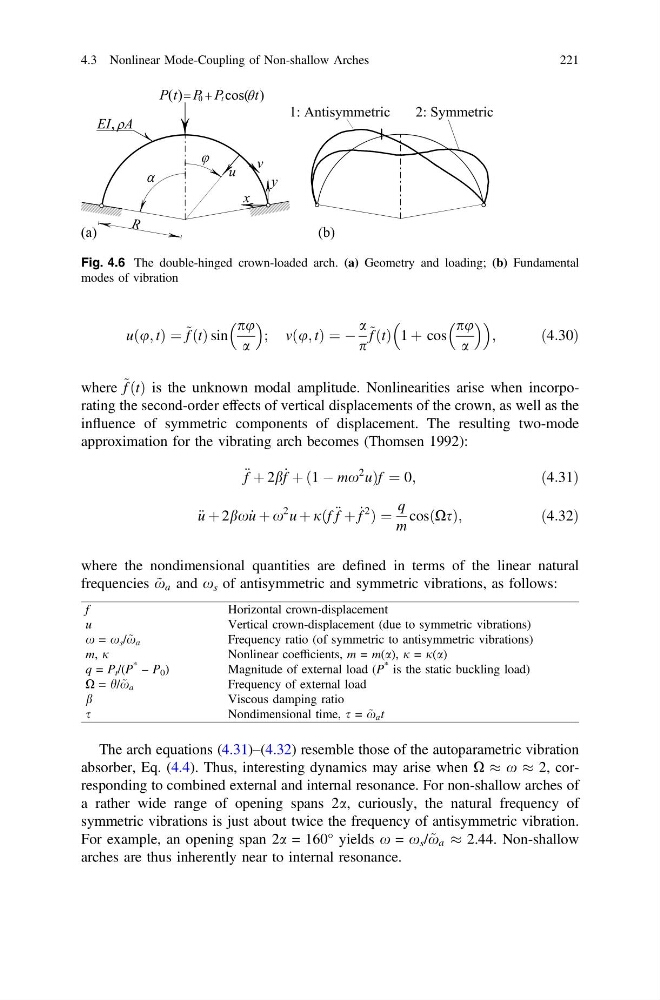
Fig. 4.6 The double-hinged crown-loaded arch. (a) Geometry and loading; (b) Fundamental
modes of vibration
4.3 Nonlinear Mode-Coupling of Non-shallow Arches
221
pu
a
; vðu; tÞ ¼ À
a
p
~ f ðtÞ 1 þ cos
pu
a
;
ð4:30Þ
where ~ f ðtÞ is the unknown modal amplitude. Nonlinearities arise when incorporating the second-order effects of vertical displacements of the crown, as well as the
influence of symmetric components of displacement. The resulting two-mode
approximation for the vibrating arch becomes (Thomsen 1992):
€ f þ 2b _
f þ ð1 À mx
2 uÞf ¼ 0;
ð4:31Þ
€ u þ 2bx _
u þ x
2 u þ jðf € f þ _
f
2
Þ ¼
q
m
cosðXsÞ;
ð4:32Þ
where the nondimensional quantities are defined in terms of the linear natural
frequencies ~
x a and x s of antisymmetric and symmetric vibrations, as follows:
f
Horizontal crown-displacement
u
Vertical crown-displacement (due to symmetric vibrations)
x = x s / ~
x a
Frequency ratio (of symmetric to antisymmetric vibrations)
m, j
Nonlinear coefficients, m = m(a), j = j(a)
q = P t /(P
* – P 0 )
Magnitude of external load (P
* is the static buckling load)
X = h/ ~
x a
Frequency of external load
b
Viscous damping ratio
s
Nondimensional time, s = ~
x a t
The arch equations (4.31)–(4.32) resemble those of the autoparametric vibration
absorber, Eq. (4.4). Thus, interesting dynamics may arise when X % x % 2, corresponding to combined external and internal resonance. For non-shallow arches of
a rather wide range of opening spans 2a, curiously, the natural frequency of
symmetric vibrations is just about twice the frequency of antisymmetric vibration.
For example, an opening span 2a = 160° yields x = x s / ~
x a % 2.44. Non-shallow
arches are thus inherently near to internal resonance.
Fig. 4.6 The double-hinged crown-loaded arch. (a) Geometry and loading; (b) Fundamental
modes of vibration
4.3 Nonlinear Mode-Coupling of Non-shallow Arches
221