

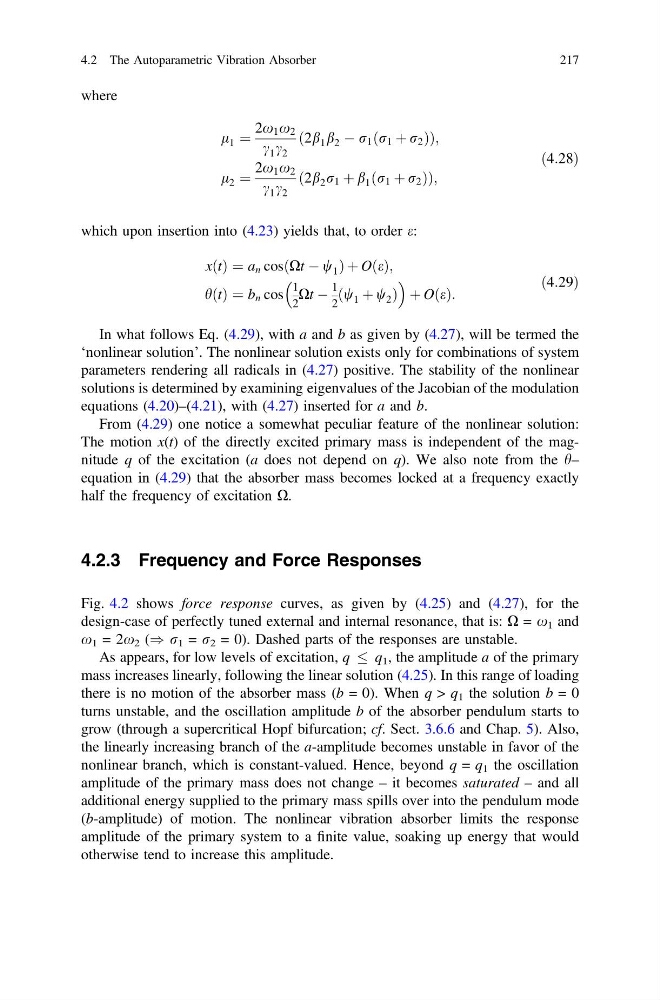
where
l 1 ¼
2x 1 x 2
c 1 c 2
2b 1 b 2 À r 1 ðr 1 þ r 2 Þ
ð
Þ ;
l 2 ¼
2x 1 x 2
c 1 c 2
2b 2 r 1 þ b 1 ðr 1 þ r 2 Þ
ð
Þ ;
ð4:28Þ
which upon insertion into (4.23) yields that, to order e:
xðtÞ ¼ a n cos Xt À w 1
ð
ÞþOðeÞ;
hðtÞ ¼ b n cos
1
2
Xt À
1
2
ðw 1 þ w 2 Þ
þ OðeÞ:
ð4:29Þ
In what follows Eq. (4.29), with a and b as given by (4.27), will be termed the
‘nonlinear solution’. The nonlinear solution exists only for combinations of system
parameters rendering all radicals in (4.27) positive. The stability of the nonlinear
solutions is determined by examining eigenvalues of the Jacobian of the modulation
equations (4.20)–(4.21), with (4.27) inserted for a and b.
From (4.29) one notice a somewhat peculiar feature of the nonlinear solution:
The motion x(t) of the directly excited primary mass is independent of the magnitude q of the excitation (a does not depend on q). We also note from the h–
equation in (4.29) that the absorber mass becomes locked at a frequency exactly
half the frequency of excitation X.
4.2.3 Frequency and Force Responses
Fig. 4.2 shows force response curves, as given by (4.25) and (4.27), for the
design-case of perfectly tuned external and internal resonance, that is: X = x 1 and
x 1 = 2x 2 () r 1 = r 2 = 0). Dashed parts of the responses are unstable.
As appears, for low levels of excitation, q
q 1 , the amplitude a of the primary
mass increases linearly, following the linear solution (4.25). In this range of loading
there is no motion of the absorber mass (b = 0). When q > q 1 the solution b = 0
turns unstable, and the oscillation amplitude b of the absorber pendulum starts to
grow (through a supercritical Hopf bifurcation; cf. Sect. 3.6.6 and Chap. 5). Also,
the linearly increasing branch of the a-amplitude becomes unstable in favor of the
nonlinear branch, which is constant-valued. Hence, beyond q = q 1 the oscillation
amplitude of the primary mass does not change – it becomes saturated – and all
additional energy supplied to the primary mass spills over into the pendulum mode
(b-amplitude) of motion. The nonlinear vibration absorber limits the response
amplitude of the primary system to a finite value, soaking up energy that would
otherwise tend to increase this amplitude.
4.2 The Autoparametric Vibration Absorber
217
l 1 ¼
2x 1 x 2
c 1 c 2
2b 1 b 2 À r 1 ðr 1 þ r 2 Þ
ð
Þ ;
l 2 ¼
2x 1 x 2
c 1 c 2
2b 2 r 1 þ b 1 ðr 1 þ r 2 Þ
ð
Þ ;
ð4:28Þ
which upon insertion into (4.23) yields that, to order e:
xðtÞ ¼ a n cos Xt À w 1
ð
ÞþOðeÞ;
hðtÞ ¼ b n cos
1
2
Xt À
1
2
ðw 1 þ w 2 Þ
þ OðeÞ:
ð4:29Þ
In what follows Eq. (4.29), with a and b as given by (4.27), will be termed the
‘nonlinear solution’. The nonlinear solution exists only for combinations of system
parameters rendering all radicals in (4.27) positive. The stability of the nonlinear
solutions is determined by examining eigenvalues of the Jacobian of the modulation
equations (4.20)–(4.21), with (4.27) inserted for a and b.
From (4.29) one notice a somewhat peculiar feature of the nonlinear solution:
The motion x(t) of the directly excited primary mass is independent of the magnitude q of the excitation (a does not depend on q). We also note from the h–
equation in (4.29) that the absorber mass becomes locked at a frequency exactly
half the frequency of excitation X.
4.2.3 Frequency and Force Responses
Fig. 4.2 shows force response curves, as given by (4.25) and (4.27), for the
design-case of perfectly tuned external and internal resonance, that is: X = x 1 and
x 1 = 2x 2 () r 1 = r 2 = 0). Dashed parts of the responses are unstable.
As appears, for low levels of excitation, q
q 1 , the amplitude a of the primary
mass increases linearly, following the linear solution (4.25). In this range of loading
there is no motion of the absorber mass (b = 0). When q > q 1 the solution b = 0
turns unstable, and the oscillation amplitude b of the absorber pendulum starts to
grow (through a supercritical Hopf bifurcation; cf. Sect. 3.6.6 and Chap. 5). Also,
the linearly increasing branch of the a-amplitude becomes unstable in favor of the
nonlinear branch, which is constant-valued. Hence, beyond q = q 1 the oscillation
amplitude of the primary mass does not change – it becomes saturated – and all
additional energy supplied to the primary mass spills over into the pendulum mode
(b-amplitude) of motion. The nonlinear vibration absorber limits the response
amplitude of the primary system to a finite value, soaking up energy that would
otherwise tend to increase this amplitude.
4.2 The Autoparametric Vibration Absorber
217