

À i2x 1 A
0
þ b 1 A
ð
ÞÀc 1 B
2 e
Àir 2 T 1 þ
1
2
qe
ir 1 T 1 ¼ 0;
À i2x 2 B
0
þ b 2 B
ð
ÞÀc 2 A
Be
ir 2 T 1 ¼ 0:
ð4:17Þ
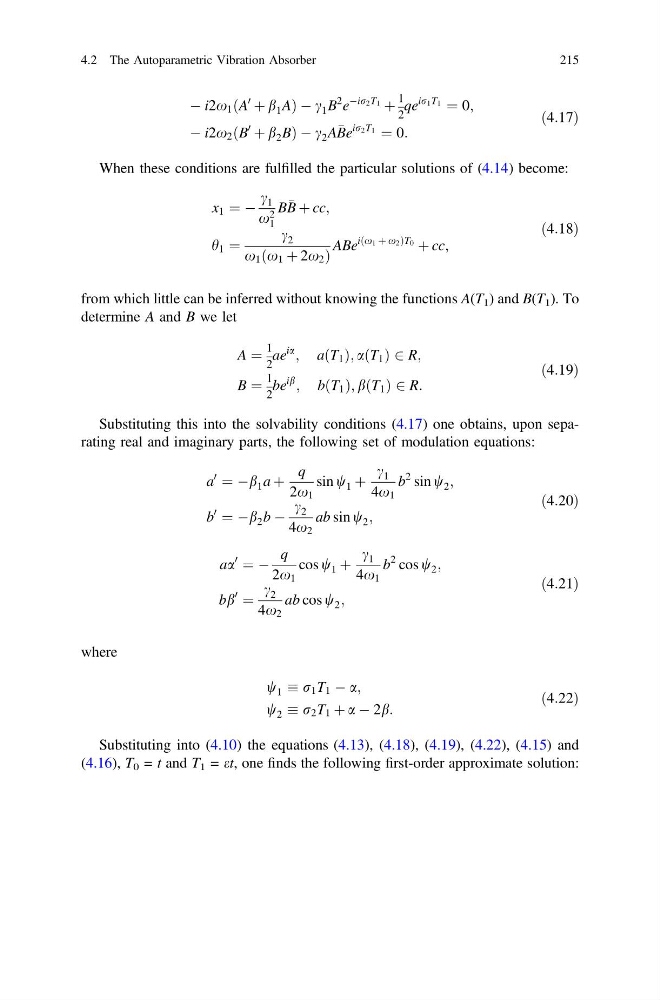
When these conditions are fulfilled the particular solutions of (4.14) become:
x 1 ¼ À
c 1
x 2
1
B
B þ cc;
h 1 ¼
c 2
x 1 ðx 1 þ 2x 2 Þ
ABe
iðx 1 þ x 2 ÞT 0 þ cc;
ð4:18Þ
from which little can be inferred without knowing the functions A(T 1 ) and B(T 1 ). To
determine A and B we let
A ¼
1
2
ae
ia
; aðT 1 Þ; aðT 1 Þ 2 R;
B ¼
1
2
be
ib
; bðT 1 Þ; bðT 1 Þ 2 R:
ð4:19Þ
Substituting this into the solvability conditions (4.17) one obtains, upon separating real and imaginary parts, the following set of modulation equations:
a
0
¼ Àb 1 a þ
q
2x 1
sin w 1 þ
c 1
4x 1
b
2 sin w 2 ;
b
0
¼ Àb 2 b À
c 2
4x 2
ab sin w 2 ;
ð4:20Þ
aa
0
¼ À
q
2x 1
cos w 1 þ
c 1
4x 1
b
2 cos w 2 ;
bb
0
¼
c 2
4x 2
ab cos w 2 ;
ð4:21Þ
where
w 1 r 1 T 1 À a;
w 2 r 2 T 1 þ a À 2b:
ð4:22Þ
Substituting into (4.10) the equations (4.13), (4.18), (4.19), (4.22), (4.15) and
(4.16), T 0 = t and T 1 = et, one finds the following first-order approximate solution:
4.2 The Autoparametric Vibration Absorber
215
0
þ b 1 A
ð
ÞÀc 1 B
2 e
Àir 2 T 1 þ
1
2
qe
ir 1 T 1 ¼ 0;
À i2x 2 B
0
þ b 2 B
ð
ÞÀc 2 A
Be
ir 2 T 1 ¼ 0:
ð4:17Þ
When these conditions are fulfilled the particular solutions of (4.14) become:
x 1 ¼ À
c 1
x 2
1
B
B þ cc;
h 1 ¼
c 2
x 1 ðx 1 þ 2x 2 Þ
ABe
iðx 1 þ x 2 ÞT 0 þ cc;
ð4:18Þ
from which little can be inferred without knowing the functions A(T 1 ) and B(T 1 ). To
determine A and B we let
A ¼
1
2
ae
ia
; aðT 1 Þ; aðT 1 Þ 2 R;
B ¼
1
2
be
ib
; bðT 1 Þ; bðT 1 Þ 2 R:
ð4:19Þ
Substituting this into the solvability conditions (4.17) one obtains, upon separating real and imaginary parts, the following set of modulation equations:
a
0
¼ Àb 1 a þ
q
2x 1
sin w 1 þ
c 1
4x 1
b
2 sin w 2 ;
b
0
¼ Àb 2 b À
c 2
4x 2
ab sin w 2 ;
ð4:20Þ
aa
0
¼ À
q
2x 1
cos w 1 þ
c 1
4x 1
b
2 cos w 2 ;
bb
0
¼
c 2
4x 2
ab cos w 2 ;
ð4:21Þ
where
w 1 r 1 T 1 À a;
w 2 r 2 T 1 þ a À 2b:
ð4:22Þ
Substituting into (4.10) the equations (4.13), (4.18), (4.19), (4.22), (4.15) and
(4.16), T 0 = t and T 1 = et, one finds the following first-order approximate solution:
4.2 The Autoparametric Vibration Absorber
215