

where D i
j
∂
j
/∂T i
j . The general solutions of the zero order equations (4.11) are:
x 0 ¼ AðT 1 Þe
ix 1 T 0 þ
AðT 1 Þe
Àix 1 T 0 ;
h 0 ¼ BðT 1 Þe
ix 2 T 0 þ
BðT 1 Þe
Àix 2 T 0 ;
ð4:13Þ
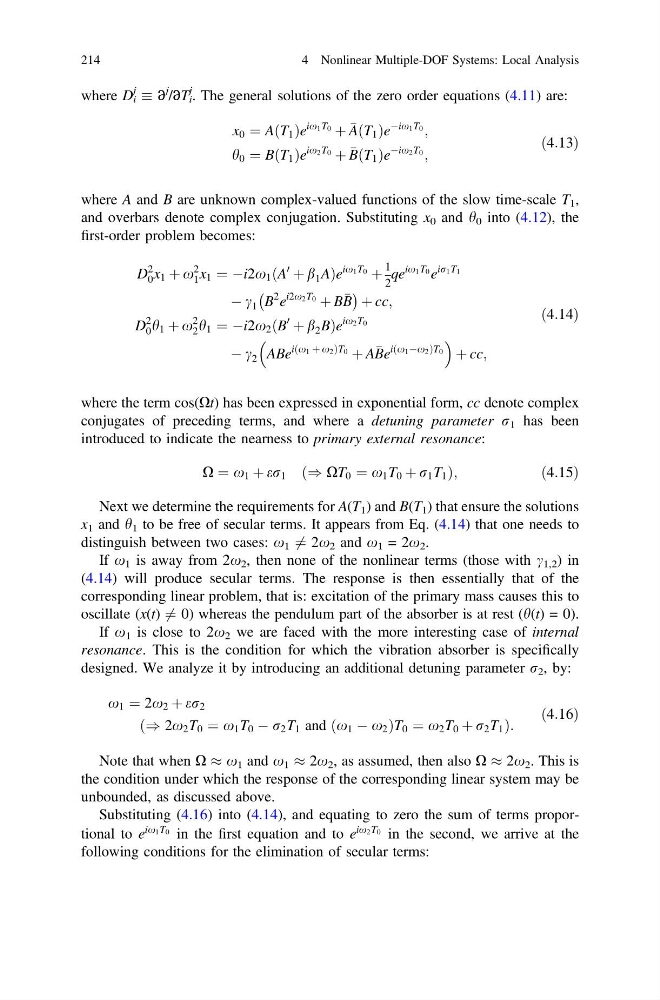
where A and B are unknown complex-valued functions of the slow time-scale T 1 ,
and overbars denote complex conjugation. Substituting x 0 and h 0 into (4.12), the
first-order problem becomes:
D
2
0 x 1 þ x
2
1 x 1 ¼ Ài2x 1 A
0
þ b 1 A
ð
Þ e
ix 1 T 0 þ
1
2
qe
ix 1 T 0 e
ir 1 T 1
À c 1 B
2 e
i2x 2 T 0 þ B
B
À
Á þ cc;
D
2
0 h 1 þ x
2
2 h 1 ¼ Ài2x 2 B
0
þ b 2 B
ð
Þ e
ix 2 T 0
À c 2 ABe
iðx 1 þ x 2 ÞT 0 þ A
Be
iðx 1 Àx 2 ÞT 0
þ cc;
ð4:14Þ
where the term cos(Xt) has been expressed in exponential form, cc denote complex
conjugates of preceding terms, and where a detuning parameter r 1 has been
introduced to indicate the nearness to primary external resonance:
X ¼ x 1 þ er 1 ð) XT 0 ¼ x 1 T 0 þ r 1 T 1 Þ;
ð4:15Þ
Next we determine the requirements for A(T 1 ) and B(T 1 ) that ensure the solutions
x 1 and h 1 to be free of secular terms. It appears from Eq. (4.14) that one needs to
distinguish between two cases: x 1 6 ¼ 2x 2 and x 1 = 2x 2 .
If x 1 is away from 2x 2 , then none of the nonlinear terms (those with c 1,2 ) in
(4.14) will produce secular terms. The response is then essentially that of the
corresponding linear problem, that is: excitation of the primary mass causes this to
oscillate (x(t) 6 ¼ 0) whereas the pendulum part of the absorber is at rest (h(t) = 0).
If x 1 is close to 2x 2 we are faced with the more interesting case of internal
resonance. This is the condition for which the vibration absorber is specifically
designed. We analyze it by introducing an additional detuning parameter r 2 , by:
x 1 ¼ 2x 2 þ er 2
) 2x 2 T 0 ¼ x 1 T 0 À r 2 T 1 and ðx 1 À x 2 ÞT 0 ¼ x 2 T 0 þ r 2 T 1
ð
Þ :
ð4:16Þ
Note that when X % x 1 and x 1 % 2x 2 , as assumed, then also X % 2x 2 . This is
the condition under which the response of the corresponding linear system may be
unbounded, as discussed above.
Substituting (4.16) into (4.14), and equating to zero the sum of terms proportional to e
ix 1 T 0 in the first equation and to e
ix 2 T 0 in the second, we arrive at the
following conditions for the elimination of secular terms:
214
4 Nonlinear Multiple-DOF Systems: Local Analysis
j
∂
j
/∂T i
j . The general solutions of the zero order equations (4.11) are:
x 0 ¼ AðT 1 Þe
ix 1 T 0 þ
AðT 1 Þe
Àix 1 T 0 ;
h 0 ¼ BðT 1 Þe
ix 2 T 0 þ
BðT 1 Þe
Àix 2 T 0 ;
ð4:13Þ
where A and B are unknown complex-valued functions of the slow time-scale T 1 ,
and overbars denote complex conjugation. Substituting x 0 and h 0 into (4.12), the
first-order problem becomes:
D
2
0 x 1 þ x
2
1 x 1 ¼ Ài2x 1 A
0
þ b 1 A
ð
Þ e
ix 1 T 0 þ
1
2
qe
ix 1 T 0 e
ir 1 T 1
À c 1 B
2 e
i2x 2 T 0 þ B
B
À
Á þ cc;
D
2
0 h 1 þ x
2
2 h 1 ¼ Ài2x 2 B
0
þ b 2 B
ð
Þ e
ix 2 T 0
À c 2 ABe
iðx 1 þ x 2 ÞT 0 þ A
Be
iðx 1 Àx 2 ÞT 0
þ cc;
ð4:14Þ
where the term cos(Xt) has been expressed in exponential form, cc denote complex
conjugates of preceding terms, and where a detuning parameter r 1 has been
introduced to indicate the nearness to primary external resonance:
X ¼ x 1 þ er 1 ð) XT 0 ¼ x 1 T 0 þ r 1 T 1 Þ;
ð4:15Þ
Next we determine the requirements for A(T 1 ) and B(T 1 ) that ensure the solutions
x 1 and h 1 to be free of secular terms. It appears from Eq. (4.14) that one needs to
distinguish between two cases: x 1 6 ¼ 2x 2 and x 1 = 2x 2 .
If x 1 is away from 2x 2 , then none of the nonlinear terms (those with c 1,2 ) in
(4.14) will produce secular terms. The response is then essentially that of the
corresponding linear problem, that is: excitation of the primary mass causes this to
oscillate (x(t) 6 ¼ 0) whereas the pendulum part of the absorber is at rest (h(t) = 0).
If x 1 is close to 2x 2 we are faced with the more interesting case of internal
resonance. This is the condition for which the vibration absorber is specifically
designed. We analyze it by introducing an additional detuning parameter r 2 , by:
x 1 ¼ 2x 2 þ er 2
) 2x 2 T 0 ¼ x 1 T 0 À r 2 T 1 and ðx 1 À x 2 ÞT 0 ¼ x 2 T 0 þ r 2 T 1
ð
Þ :
ð4:16Þ
Note that when X % x 1 and x 1 % 2x 2 , as assumed, then also X % 2x 2 . This is
the condition under which the response of the corresponding linear system may be
unbounded, as discussed above.
Substituting (4.16) into (4.14), and equating to zero the sum of terms proportional to e
ix 1 T 0 in the first equation and to e
ix 2 T 0 in the second, we arrive at the
following conditions for the elimination of secular terms:
214
4 Nonlinear Multiple-DOF Systems: Local Analysis