

in (4.7) will decrease in magnitude. Thus we may expect the nonlinearity to limit
the linearly unbounded h solution.
The idea underlying the autoparametric absorber, then, is that energy imparted to
the primary mass m 1 may be transferred into motions of the pendulum part through
a nonlinear coupling between the primary mass and the absorber. To see how this
works we now perform a perturbation analysis for the condition X % x 1 , which is
the most important case corresponding to primary resonance of the main system m 1 .
The system (4.6)–(4.7) is a special case of a slightly more general quadratic system
analyzed in Nayfeh and Mook (1979).
4.2.2 First-Order Approximate Response
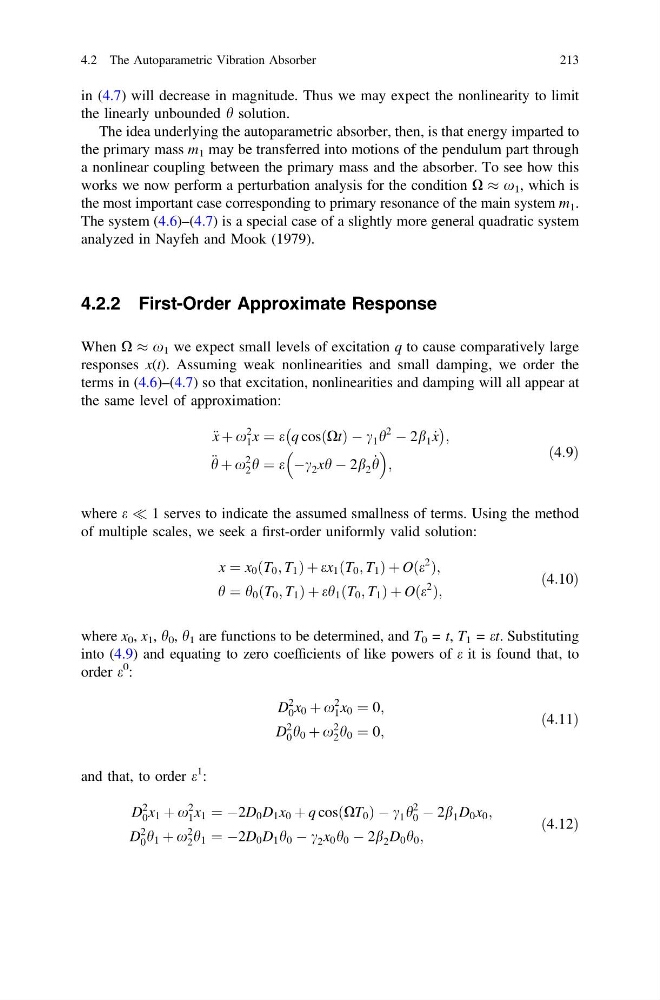
When X % x 1 we expect small levels of excitation q to cause comparatively large
responses x(t). Assuming weak nonlinearities and small damping, we order the
terms in (4.6)–(4.7) so that excitation, nonlinearities and damping will all appear at
the same level of approximation:
€ x þ x
2
1 x ¼ e q cosðXtÞ À c 1 h
2
À 2b 1 _
x
À
Á ;
€ h þ x
2
2 h ¼ e Àc 2 xh À 2b 2
_
h
;
ð4:9Þ
where e ( 1 serves to indicate the assumed smallness of terms. Using the method
of multiple scales, we seek a first-order uniformly valid solution:
x ¼ x 0 ðT 0 ; T 1 Þ þ ex 1 ðT 0 ; T 1 Þ þ Oðe
2
Þ;
h ¼ h 0 ðT 0 ; T 1 Þ þ eh 1 ðT 0 ; T 1 Þ þ Oðe
2
Þ;
ð4:10Þ
where x 0 , x 1 , h 0 , h 1 are functions to be determined, and T 0 = t, T 1 = et. Substituting
into (4.9) and equating to zero coefficients of like powers of e it is found that, to
order e
0 :
D
2
0 x 0 þ x
2
1 x 0 ¼ 0;
D
2
0 h 0 þ x
2
2 h 0 ¼ 0;
ð4:11Þ
and that, to order e
1 :
D
2
0 x 1 þ x
2
1 x 1 ¼ À2D 0 D 1 x 0 þ q cosðXT 0 Þ À c 1 h
2
0 À 2b 1 D 0 x 0 ;
D
2
0 h 1 þ x
2
2 h 1 ¼ À2D 0 D 1 h 0 À c 2 x 0 h 0 À 2b 2 D 0 h 0 ;
ð4:12Þ
4.2 The Autoparametric Vibration Absorber
213
the linearly unbounded h solution.
The idea underlying the autoparametric absorber, then, is that energy imparted to
the primary mass m 1 may be transferred into motions of the pendulum part through
a nonlinear coupling between the primary mass and the absorber. To see how this
works we now perform a perturbation analysis for the condition X % x 1 , which is
the most important case corresponding to primary resonance of the main system m 1 .
The system (4.6)–(4.7) is a special case of a slightly more general quadratic system
analyzed in Nayfeh and Mook (1979).
4.2.2 First-Order Approximate Response
When X % x 1 we expect small levels of excitation q to cause comparatively large
responses x(t). Assuming weak nonlinearities and small damping, we order the
terms in (4.6)–(4.7) so that excitation, nonlinearities and damping will all appear at
the same level of approximation:
€ x þ x
2
1 x ¼ e q cosðXtÞ À c 1 h
2
À 2b 1 _
x
À
Á ;
€ h þ x
2
2 h ¼ e Àc 2 xh À 2b 2
_
h
;
ð4:9Þ
where e ( 1 serves to indicate the assumed smallness of terms. Using the method
of multiple scales, we seek a first-order uniformly valid solution:
x ¼ x 0 ðT 0 ; T 1 Þ þ ex 1 ðT 0 ; T 1 Þ þ Oðe
2
Þ;
h ¼ h 0 ðT 0 ; T 1 Þ þ eh 1 ðT 0 ; T 1 Þ þ Oðe
2
Þ;
ð4:10Þ
where x 0 , x 1 , h 0 , h 1 are functions to be determined, and T 0 = t, T 1 = et. Substituting
into (4.9) and equating to zero coefficients of like powers of e it is found that, to
order e
0 :
D
2
0 x 0 þ x
2
1 x 0 ¼ 0;
D
2
0 h 0 þ x
2
2 h 0 ¼ 0;
ð4:11Þ
and that, to order e
1 :
D
2
0 x 1 þ x
2
1 x 1 ¼ À2D 0 D 1 x 0 þ q cosðXT 0 Þ À c 1 h
2
0 À 2b 1 D 0 x 0 ;
D
2
0 h 1 þ x
2
2 h 1 ¼ À2D 0 D 1 h 0 À c 2 x 0 h 0 À 2b 2 D 0 h 0 ;
ð4:12Þ
4.2 The Autoparametric Vibration Absorber
213