

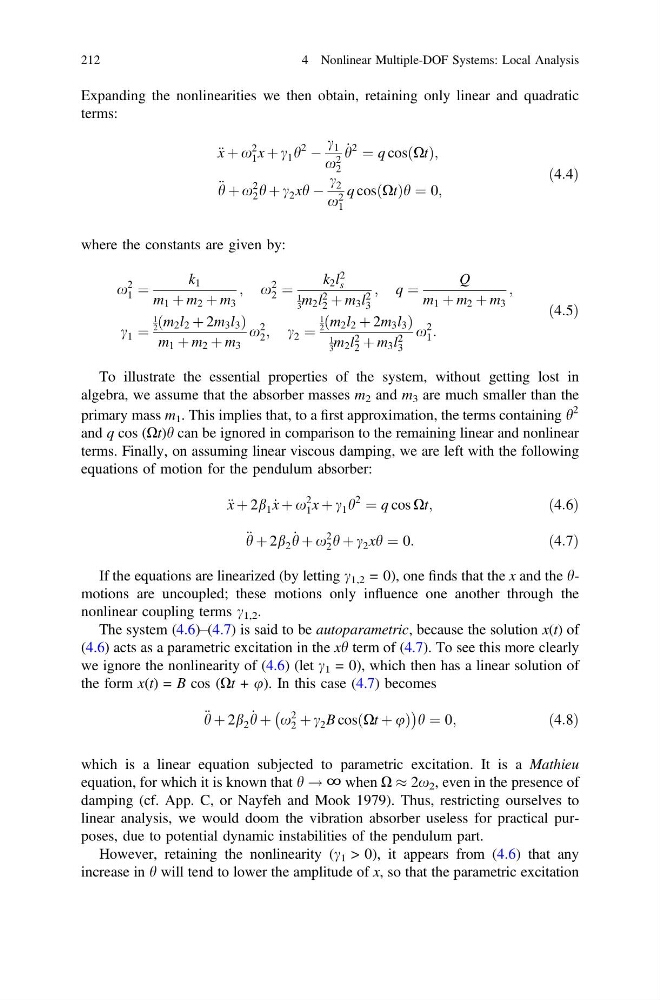
Expanding the nonlinearities we then obtain, retaining only linear and quadratic
terms:
€ x þ x
2
1 x þ c 1 h
2
À
c 1
x 2
2
_
h
2
¼ q cosðXtÞ;
€ h þ x
2
2 h þ c 2 xh À
c 2
x 2
1
q cosðXtÞh ¼ 0;
ð4:4Þ
where the constants are given by:
x
2
1 ¼
k 1
m 1 þ m 2 þ m 3
; x
2
2 ¼
k 2 l
2
s
1
3 m 2 l 2
2 þ m 3 l 2
3
; q ¼
Q
m 1 þ m 2 þ m 3
;
c 1 ¼
1
2 m 2 l 2 þ 2m 3 l 3
ð
Þ
m 1 þ m 2 þ m 3
x
2
2 ; c 2 ¼
1
2 m 2 l 2 þ 2m 3 l 3
ð
Þ
1
3 m 2 l 2
2 þ m 3 l 2
3
x
2
1 :
ð4:5Þ
To illustrate the essential properties of the system, without getting lost in
algebra, we assume that the absorber masses m 2 and m 3 are much smaller than the
primary mass m 1 . This implies that, to a first approximation, the terms containing h
2
and q cos (Xt)h can be ignored in comparison to the remaining linear and nonlinear
terms. Finally, on assuming linear viscous damping, we are left with the following
equations of motion for the pendulum absorber:
€ x þ 2b 1 _
x þ x
2
1 x þ c 1 h
2
¼ q cos Xt;
ð4:6Þ
€ h þ 2b 2
_
h þ x
2
2 h þ c 2 xh ¼ 0:
ð4:7Þ
If the equations are linearized (by letting c 1,2 = 0), one finds that the x and the hmotions are uncoupled; these motions only influence one another through the
nonlinear coupling terms c 1,2 .
The system (4.6)–(4.7) is said to be autoparametric, because the solution x(t) of
(4.6) acts as a parametric excitation in the xh term of (4.7). To see this more clearly
we ignore the nonlinearity of (4.6) (let c 1 = 0), which then has a linear solution of
the form x(t) = B cos (Xt + u). In this case (4.7) becomes
€ h þ 2b 2
_
h þ x
2
2 þ c 2 B cosðXt þ uÞ
À
Á
h ¼ 0;
ð4:8Þ
which is a linear equation subjected to parametric excitation. It is a Mathieu
equation, for which it is known that h ! ∞ when X % 2x 2 , even in the presence of
damping (cf. App. C, or Nayfeh and Mook 1979). Thus, restricting ourselves to
linear analysis, we would doom the vibration absorber useless for practical purposes, due to potential dynamic instabilities of the pendulum part.
However, retaining the nonlinearity (c 1 > 0), it appears from (4.6) that any
increase in h will tend to lower the amplitude of x, so that the parametric excitation
212
4 Nonlinear Multiple-DOF Systems: Local Analysis
terms:
€ x þ x
2
1 x þ c 1 h
2
À
c 1
x 2
2
_
h
2
¼ q cosðXtÞ;
€ h þ x
2
2 h þ c 2 xh À
c 2
x 2
1
q cosðXtÞh ¼ 0;
ð4:4Þ
where the constants are given by:
x
2
1 ¼
k 1
m 1 þ m 2 þ m 3
; x
2
2 ¼
k 2 l
2
s
1
3 m 2 l 2
2 þ m 3 l 2
3
; q ¼
Q
m 1 þ m 2 þ m 3
;
c 1 ¼
1
2 m 2 l 2 þ 2m 3 l 3
ð
Þ
m 1 þ m 2 þ m 3
x
2
2 ; c 2 ¼
1
2 m 2 l 2 þ 2m 3 l 3
ð
Þ
1
3 m 2 l 2
2 þ m 3 l 2
3
x
2
1 :
ð4:5Þ
To illustrate the essential properties of the system, without getting lost in
algebra, we assume that the absorber masses m 2 and m 3 are much smaller than the
primary mass m 1 . This implies that, to a first approximation, the terms containing h
2
and q cos (Xt)h can be ignored in comparison to the remaining linear and nonlinear
terms. Finally, on assuming linear viscous damping, we are left with the following
equations of motion for the pendulum absorber:
€ x þ 2b 1 _
x þ x
2
1 x þ c 1 h
2
¼ q cos Xt;
ð4:6Þ
€ h þ 2b 2
_
h þ x
2
2 h þ c 2 xh ¼ 0:
ð4:7Þ
If the equations are linearized (by letting c 1,2 = 0), one finds that the x and the hmotions are uncoupled; these motions only influence one another through the
nonlinear coupling terms c 1,2 .
The system (4.6)–(4.7) is said to be autoparametric, because the solution x(t) of
(4.6) acts as a parametric excitation in the xh term of (4.7). To see this more clearly
we ignore the nonlinearity of (4.6) (let c 1 = 0), which then has a linear solution of
the form x(t) = B cos (Xt + u). In this case (4.7) becomes
€ h þ 2b 2
_
h þ x
2
2 þ c 2 B cosðXt þ uÞ
À
Á
h ¼ 0;
ð4:8Þ
which is a linear equation subjected to parametric excitation. It is a Mathieu
equation, for which it is known that h ! ∞ when X % 2x 2 , even in the presence of
damping (cf. App. C, or Nayfeh and Mook 1979). Thus, restricting ourselves to
linear analysis, we would doom the vibration absorber useless for practical purposes, due to potential dynamic instabilities of the pendulum part.
However, retaining the nonlinearity (c 1 > 0), it appears from (4.6) that any
increase in h will tend to lower the amplitude of x, so that the parametric excitation
212
4 Nonlinear Multiple-DOF Systems: Local Analysis