

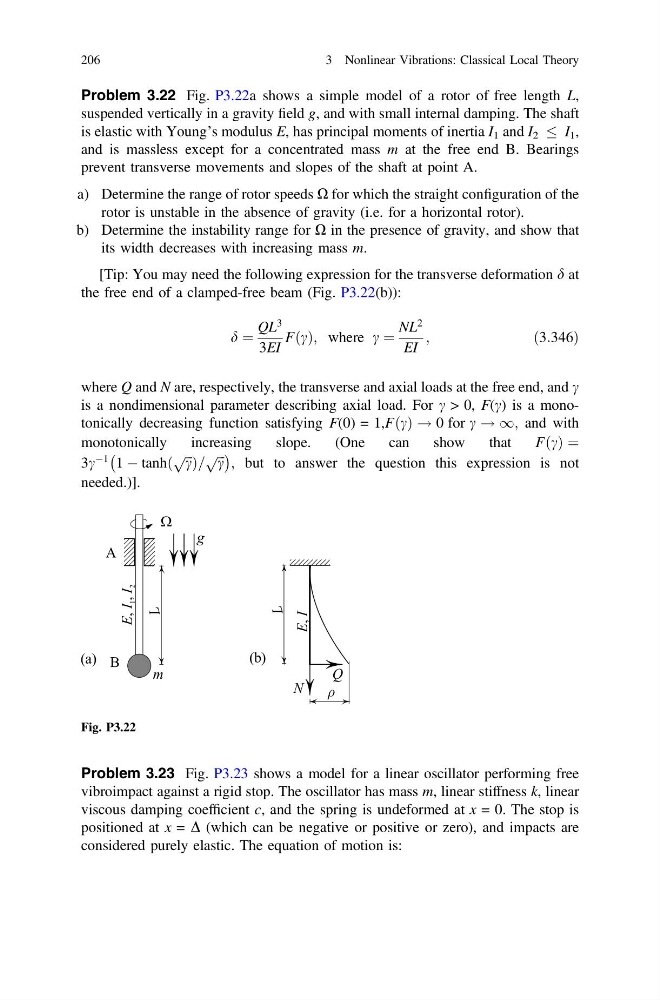
Problem 3.22 Fig. P3.22a shows a simple model of a rotor of free length L,
suspended vertically in a gravity field g, and with small internal damping. The shaft
is elastic with Young’s modulus E, has principal moments of inertia I 1 and I 2
I 1 ,
and is massless except for a concentrated mass m at the free end B. Bearings
prevent transverse movements and slopes of the shaft at point A.
a) Determine the range of rotor speeds X for which the straight configuration of the
rotor is unstable in the absence of gravity (i.e. for a horizontal rotor).
b) Determine the instability range for X in the presence of gravity, and show that
its width decreases with increasing mass m.
[Tip: You may need the following expression for the transverse deformation d at
the free end of a clamped-free beam (Fig. P3.22(b)):
d ¼
QL
3
3EI
FðcÞ; where c ¼
NL
2
EI
;
ð3:346Þ
where Q and N are, respectively, the transverse and axial loads at the free end, and c
is a nondimensional parameter describing axial load. For c > 0, F(c) is a monotonically decreasing function satisfying F(0) = 1,FðcÞ ! 0 for c ! 1; and with
monotonically
increasing
slope.
(One
can
show
that
FðcÞ ¼
3c
À1 1 À tanhð
ffiffi ffi
c
p Þ=
ffiffi ffi
c
p
À
Á
; but to answer the question this expression is not
needed.)].
Problem 3.23 Fig. P3.23 shows a model for a linear oscillator performing free
vibroimpact against a rigid stop. The oscillator has mass m, linear stiffness k, linear
viscous damping coefficient c, and the spring is undeformed at x = 0. The stop is
positioned at x = D (which can be negative or positive or zero), and impacts are
considered purely elastic. The equation of motion is:
Fig. P3.22
206
3 Nonlinear Vibrations: Classical Local Theory
suspended vertically in a gravity field g, and with small internal damping. The shaft
is elastic with Young’s modulus E, has principal moments of inertia I 1 and I 2
I 1 ,
and is massless except for a concentrated mass m at the free end B. Bearings
prevent transverse movements and slopes of the shaft at point A.
a) Determine the range of rotor speeds X for which the straight configuration of the
rotor is unstable in the absence of gravity (i.e. for a horizontal rotor).
b) Determine the instability range for X in the presence of gravity, and show that
its width decreases with increasing mass m.
[Tip: You may need the following expression for the transverse deformation d at
the free end of a clamped-free beam (Fig. P3.22(b)):
d ¼
QL
3
3EI
FðcÞ; where c ¼
NL
2
EI
;
ð3:346Þ
where Q and N are, respectively, the transverse and axial loads at the free end, and c
is a nondimensional parameter describing axial load. For c > 0, F(c) is a monotonically decreasing function satisfying F(0) = 1,FðcÞ ! 0 for c ! 1; and with
monotonically
increasing
slope.
(One
can
show
that
FðcÞ ¼
3c
À1 1 À tanhð
ffiffi ffi
c
p Þ=
ffiffi ffi
c
p
À
Á
; but to answer the question this expression is not
needed.)].
Problem 3.23 Fig. P3.23 shows a model for a linear oscillator performing free
vibroimpact against a rigid stop. The oscillator has mass m, linear stiffness k, linear
viscous damping coefficient c, and the spring is undeformed at x = 0. The stop is
positioned at x = D (which can be negative or positive or zero), and impacts are
considered purely elastic. The equation of motion is:
Fig. P3.22
206
3 Nonlinear Vibrations: Classical Local Theory