

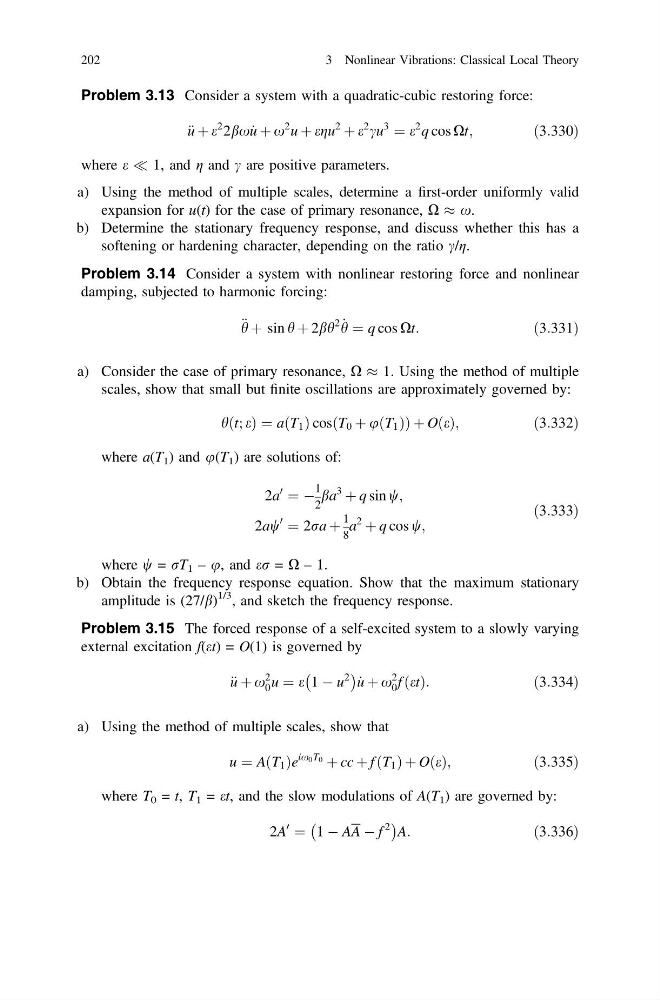
Problem 3.13 Consider a system with a quadratic-cubic restoring force:
€ u þ e
2 2bx _
u þ x
2 u þ egu
2
þ e
2 cu
3
¼ e
2 q cos Xt;
ð3:330Þ
where e ( 1, and η and c are positive parameters.
a) Using the method of multiple scales, determine a first-order uniformly valid
expansion for u(t) for the case of primary resonance, X % x.
b) Determine the stationary frequency response, and discuss whether this has a
softening or hardening character, depending on the ratio c/η.
Problem 3.14 Consider a system with nonlinear restoring force and nonlinear
damping, subjected to harmonic forcing:
€ h þ sin h þ 2bh
2 _
h ¼ q cos Xt:
ð3:331Þ
a) Consider the case of primary resonance, X % 1. Using the method of multiple
scales, show that small but finite oscillations are approximately governed by:
hðt; eÞ ¼ aðT 1 Þ cos T 0 þ uðT 1 Þ
ð
ÞþOðeÞ;
ð3:332Þ
where a(T 1 ) and u(T 1 ) are solutions of:
2a
0
¼ À
1
2
ba
3
þ q sin w;
2aw
0
¼ 2ra þ
1
8
a
2
þ q cos w;
ð3:333Þ
where w = rT 1 – u, and er = X – 1.
b) Obtain the frequency response equation. Show that the maximum stationary
amplitude is (27/b)
1/3 , and sketch the frequency response.
Problem 3.15 The forced response of a self-excited system to a slowly varying
external excitation f(et) = O(1) is governed by
€ u þ x
2
0 u ¼ e 1 À u
2
À
Á _
u þ x
2
0 f ðetÞ:
ð3:334Þ
a) Using the method of multiple scales, show that
u ¼ AðT 1 Þe
ix 0 T 0 þ cc þ f ðT 1 Þ þ OðeÞ;
ð3:335Þ
where T 0 = t, T 1 = et, and the slow modulations of A(T 1 ) are governed by:
2A
0
¼ 1 À AA À f
2
À
Á
A:
ð3:336Þ
202
3 Nonlinear Vibrations: Classical Local Theory
€ u þ e
2 2bx _
u þ x
2 u þ egu
2
þ e
2 cu
3
¼ e
2 q cos Xt;
ð3:330Þ
where e ( 1, and η and c are positive parameters.
a) Using the method of multiple scales, determine a first-order uniformly valid
expansion for u(t) for the case of primary resonance, X % x.
b) Determine the stationary frequency response, and discuss whether this has a
softening or hardening character, depending on the ratio c/η.
Problem 3.14 Consider a system with nonlinear restoring force and nonlinear
damping, subjected to harmonic forcing:
€ h þ sin h þ 2bh
2 _
h ¼ q cos Xt:
ð3:331Þ
a) Consider the case of primary resonance, X % 1. Using the method of multiple
scales, show that small but finite oscillations are approximately governed by:
hðt; eÞ ¼ aðT 1 Þ cos T 0 þ uðT 1 Þ
ð
ÞþOðeÞ;
ð3:332Þ
where a(T 1 ) and u(T 1 ) are solutions of:
2a
0
¼ À
1
2
ba
3
þ q sin w;
2aw
0
¼ 2ra þ
1
8
a
2
þ q cos w;
ð3:333Þ
where w = rT 1 – u, and er = X – 1.
b) Obtain the frequency response equation. Show that the maximum stationary
amplitude is (27/b)
1/3 , and sketch the frequency response.
Problem 3.15 The forced response of a self-excited system to a slowly varying
external excitation f(et) = O(1) is governed by
€ u þ x
2
0 u ¼ e 1 À u
2
À
Á _
u þ x
2
0 f ðetÞ:
ð3:334Þ
a) Using the method of multiple scales, show that
u ¼ AðT 1 Þe
ix 0 T 0 þ cc þ f ðT 1 Þ þ OðeÞ;
ð3:335Þ
where T 0 = t, T 1 = et, and the slow modulations of A(T 1 ) are governed by:
2A
0
¼ 1 À AA À f
2
À
Á
A:
ð3:336Þ
202
3 Nonlinear Vibrations: Classical Local Theory