

b) Express A(T 1 ) in polar form and determine the equations governing slow
modulations of amplitudes and phases.
c) Show that when f
2 < 1 a nontrivial stationary solution exists:
uðtÞ ¼
ffiffiffiffiffiffiffiffiffiffiffiffiffiffiffiffiffi ffi
1 À f ðtÞ
2
q
cosðx 0 t þ u 0 Þ þ f ðtÞ þ OðeÞ:
ð3:337Þ
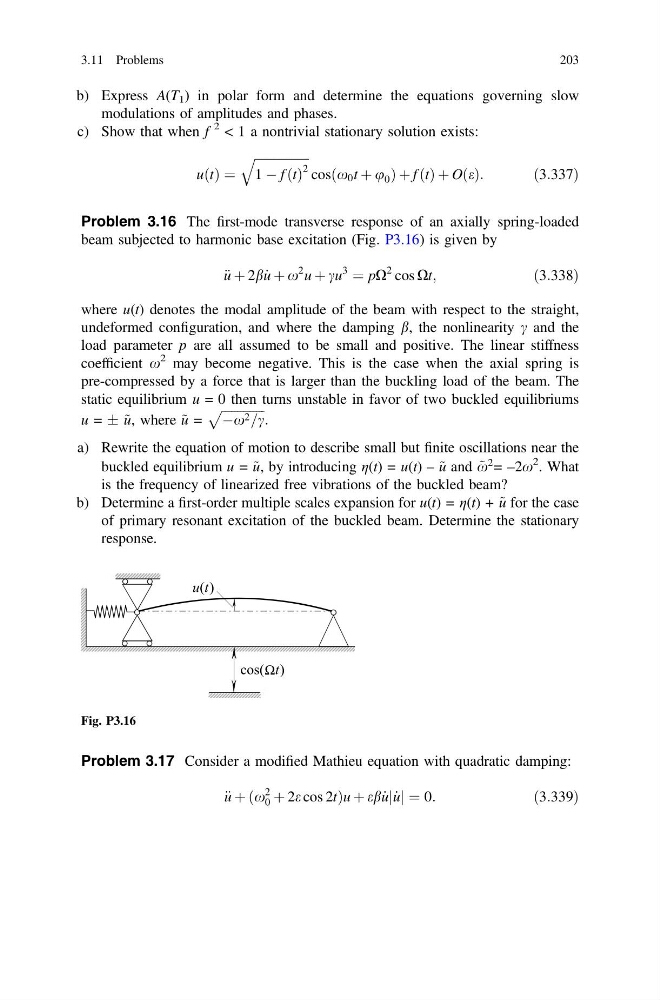
Problem 3.16 The first-mode transverse response of an axially spring-loaded
beam subjected to harmonic base excitation (Fig. P3.16) is given by
€ u þ 2b _
u þ x
2 u þ cu
3
¼ pX
2 cos Xt;
ð3:338Þ
where u(t) denotes the modal amplitude of the beam with respect to the straight,
undeformed configuration, and where the damping b, the nonlinearity c and the
load parameter p are all assumed to be small and positive. The linear stiffness
coefficient x
2 may become negative. This is the case when the axial spring is
pre-compressed by a force that is larger than the buckling load of the beam. The
static equilibrium u = 0 then turns unstable in favor of two buckled equilibriums
u = ± ~ u, where ~ u =
ffiffiffiffiffiffiffiffiffiffiffiffiffiffi
Àx 2 =c
p
:
a) Rewrite the equation of motion to describe small but finite oscillations near the
buckled equilibrium u = ~ u, by introducing η(t) = u(t) – ~ u and ~
x
2 = –2x
2 . What
is the frequency of linearized free vibrations of the buckled beam?
b) Determine a first-order multiple scales expansion for u(t) = η(t) + ~ u for the case
of primary resonant excitation of the buckled beam. Determine the stationary
response.
Problem 3.17 Consider a modified Mathieu equation with quadratic damping:
€ u þ ðx
2
0 þ 2e cos 2tÞu þ eb _
u _
u
j j ¼ 0:
ð3:339Þ
Fig. P3.16
3.11 Problems
203
modulations of amplitudes and phases.
c) Show that when f
2 < 1 a nontrivial stationary solution exists:
uðtÞ ¼
ffiffiffiffiffiffiffiffiffiffiffiffiffiffiffiffiffi ffi
1 À f ðtÞ
2
q
cosðx 0 t þ u 0 Þ þ f ðtÞ þ OðeÞ:
ð3:337Þ
Problem 3.16 The first-mode transverse response of an axially spring-loaded
beam subjected to harmonic base excitation (Fig. P3.16) is given by
€ u þ 2b _
u þ x
2 u þ cu
3
¼ pX
2 cos Xt;
ð3:338Þ
where u(t) denotes the modal amplitude of the beam with respect to the straight,
undeformed configuration, and where the damping b, the nonlinearity c and the
load parameter p are all assumed to be small and positive. The linear stiffness
coefficient x
2 may become negative. This is the case when the axial spring is
pre-compressed by a force that is larger than the buckling load of the beam. The
static equilibrium u = 0 then turns unstable in favor of two buckled equilibriums
u = ± ~ u, where ~ u =
ffiffiffiffiffiffiffiffiffiffiffiffiffiffi
Àx 2 =c
p
:
a) Rewrite the equation of motion to describe small but finite oscillations near the
buckled equilibrium u = ~ u, by introducing η(t) = u(t) – ~ u and ~
x
2 = –2x
2 . What
is the frequency of linearized free vibrations of the buckled beam?
b) Determine a first-order multiple scales expansion for u(t) = η(t) + ~ u for the case
of primary resonant excitation of the buckled beam. Determine the stationary
response.
Problem 3.17 Consider a modified Mathieu equation with quadratic damping:
€ u þ ðx
2
0 þ 2e cos 2tÞu þ eb _
u _
u
j j ¼ 0:
ð3:339Þ
Fig. P3.16
3.11 Problems
203