

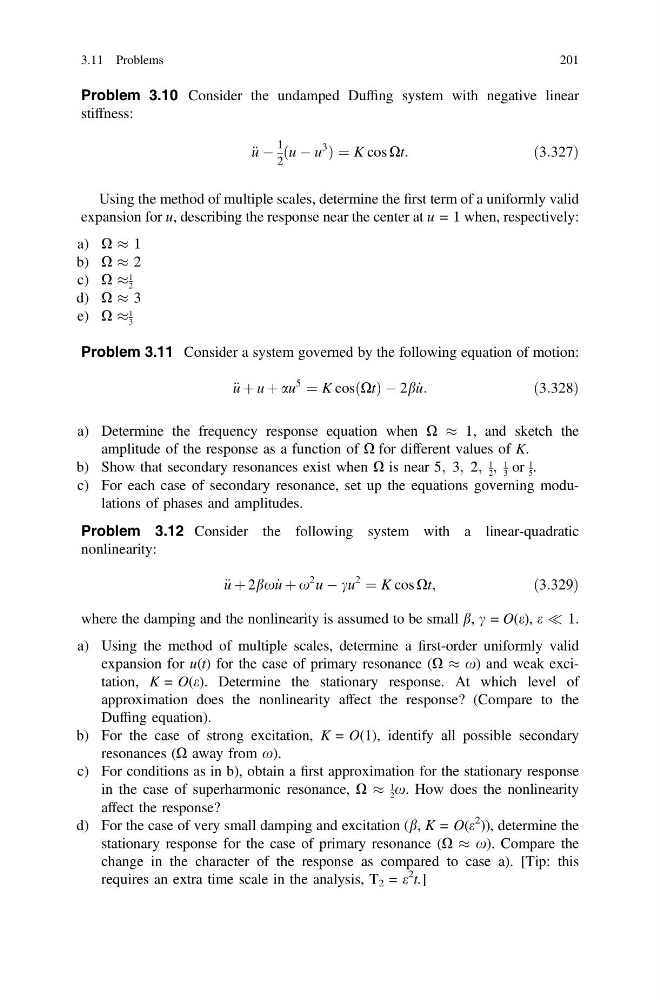
Problem 3.10 Consider the undamped Duffing system with negative linear
stiffness:
€ u À
1
2
ðu À u
3
Þ ¼ K cos Xt:
ð3:327Þ
Using the method of multiple scales, determine the first term of a uniformly valid
expansion for u, describing the response near the center at u = 1 when, respectively:
a) X % 1
b) X % 2
c) X %
1
2
d) X % 3
e) X %
1
3
Problem 3.11 Consider a system governed by the following equation of motion:
€ u þ u þ au
5
¼ K cosðXtÞ À 2b _
u:
ð3:328Þ
a) Determine the frequency response equation when X % 1, and sketch the
amplitude of the response as a function of X for different values of K.
b) Show that secondary resonances exist when X is near 5; 3; 2;
1
2 ;
1
3 or
1
5 .
c) For each case of secondary resonance, set up the equations governing modulations of phases and amplitudes.
Problem 3.12 Consider the following system with a linear-quadratic
nonlinearity:
€ u þ 2bx _
u þ x
2 u À cu
2
¼ K cos Xt;
ð3:329Þ
where the damping and the nonlinearity is assumed to be small b, c = O(e), e ( 1.
a) Using the method of multiple scales, determine a first-order uniformly valid
expansion for u(t) for the case of primary resonance (X % x) and weak excitation, K = O(e). Determine the stationary response. At which level of
approximation does the nonlinearity affect the response? (Compare to the
Duffing equation).
b) For the case of strong excitation, K = O(1), identify all possible secondary
resonances (X away from x).
c) For conditions as in b), obtain a first approximation for the stationary response
in the case of superharmonic resonance, X %
1
2 x. How does the nonlinearity
affect the response?
d) For the case of very small damping and excitation (b, K = O(e
2 )), determine the
stationary response for the case of primary resonance (X % x). Compare the
change in the character of the response as compared to case a). [Tip: this
requires an extra time scale in the analysis, T 2 = e
2 t.]
3.11 Problems
201
stiffness:
€ u À
1
2
ðu À u
3
Þ ¼ K cos Xt:
ð3:327Þ
Using the method of multiple scales, determine the first term of a uniformly valid
expansion for u, describing the response near the center at u = 1 when, respectively:
a) X % 1
b) X % 2
c) X %
1
2
d) X % 3
e) X %
1
3
Problem 3.11 Consider a system governed by the following equation of motion:
€ u þ u þ au
5
¼ K cosðXtÞ À 2b _
u:
ð3:328Þ
a) Determine the frequency response equation when X % 1, and sketch the
amplitude of the response as a function of X for different values of K.
b) Show that secondary resonances exist when X is near 5; 3; 2;
1
2 ;
1
3 or
1
5 .
c) For each case of secondary resonance, set up the equations governing modulations of phases and amplitudes.
Problem 3.12 Consider the following system with a linear-quadratic
nonlinearity:
€ u þ 2bx _
u þ x
2 u À cu
2
¼ K cos Xt;
ð3:329Þ
where the damping and the nonlinearity is assumed to be small b, c = O(e), e ( 1.
a) Using the method of multiple scales, determine a first-order uniformly valid
expansion for u(t) for the case of primary resonance (X % x) and weak excitation, K = O(e). Determine the stationary response. At which level of
approximation does the nonlinearity affect the response? (Compare to the
Duffing equation).
b) For the case of strong excitation, K = O(1), identify all possible secondary
resonances (X away from x).
c) For conditions as in b), obtain a first approximation for the stationary response
in the case of superharmonic resonance, X %
1
2 x. How does the nonlinearity
affect the response?
d) For the case of very small damping and excitation (b, K = O(e
2 )), determine the
stationary response for the case of primary resonance (X % x). Compare the
change in the character of the response as compared to case a). [Tip: this
requires an extra time scale in the analysis, T 2 = e
2 t.]
3.11 Problems
201